24 Aug, 2026
Costs soaring for coal, gas plants under DOE emergency orders

By Karin Rives
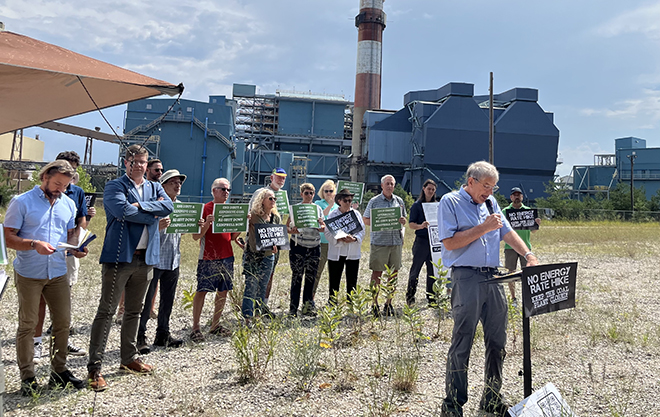
| Michigan physician Steven Ashmead speaks in front of CMS Energy's J.H. Campbell plant in August 2025. Source: Sierra Club Michigan. |
Since the Trump administration began issuing emergency orders in 2025 to prevent fossil-fueled power plants from shutting down, US electric utilities have incurred initial repair and operation costs approaching $1 billion.
The expenses are detailed in cost recovery filings with the Federal Energy Regulatory Commission, during testimony before state regulators, and in lawsuits challenging the US Department of Energy's orders. Plant operators whose power is dispatched into the wholesale market and earn revenue can offset some of the costs they incur, but not all are able to.
Ultimately, ratepayers are expected to cover the remaining outlays from keeping aging plants online, totaling hundreds of millions of dollars — and the bill keeps rising each day a DOE order remains in effect.
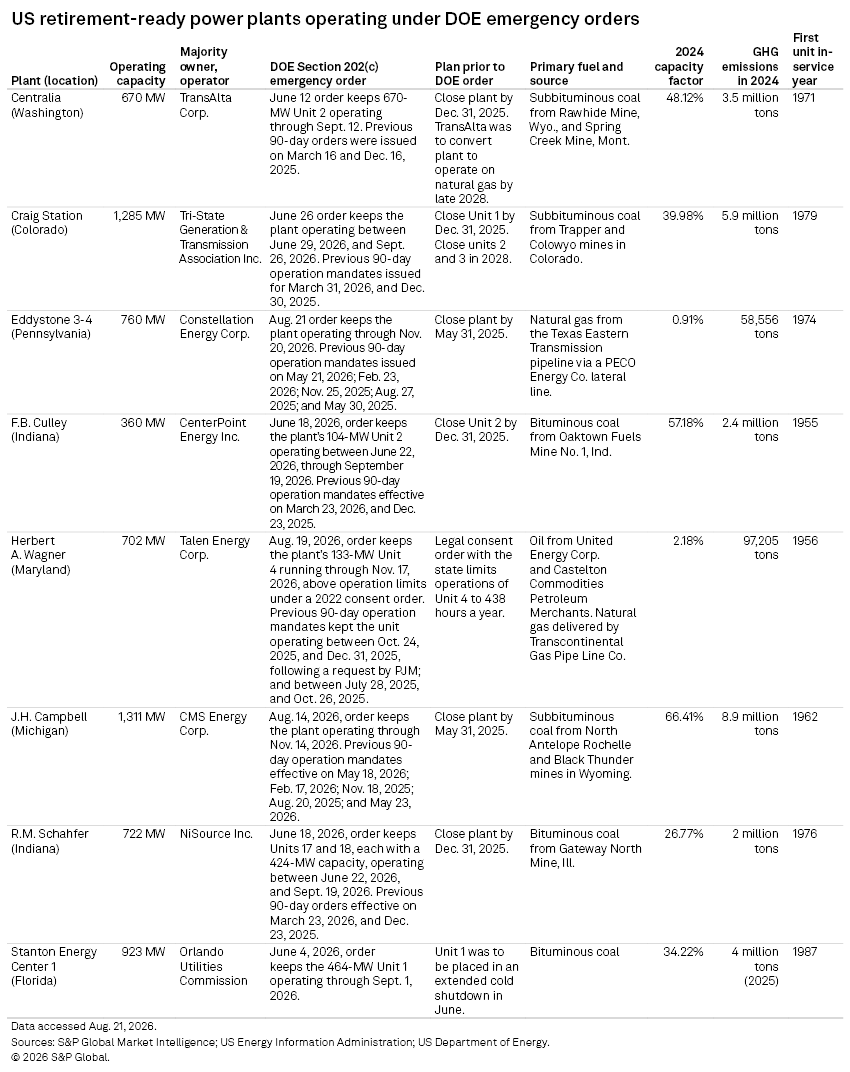
On Aug. 21, Energy Secretary Chris Wright issued an order to keep the two gas-fired peaker units at Constellation Energy Corp.'s 760-megawatt Eddystone plant in Pennsylvania running through Nov. 20. The plant was set to be retired in May 2025 but has remained in operation to comply with a series of 90-day orders.
Wright cited tight grid conditions in the PJM Interconnection wholesale power market, as seen during a historic winter storm in early 2026. Retiring the Eddystone plant would add to the region's "increasing demand and shortage of electricity" and risk power outages, his order issued under Section 202(c) of the 1935 Federal Power Act said.
Wright also cited March congressional testimony by Jim Robb, head of the North American Electric Reliability Corp., who said "there's no question" plants under Section 202(c) orders helped to keep the lights on during the 2026 winter storm.
The Trump administration has issued more than two dozen such emergency mandates since May 2025 to override state laws and regulatory decisions requiring uneconomic power plants to close. All but two of the plants under DOE orders are fueled by coal.
Ratepayers face growing impact
Between June and November 2025, Constellation incurred $10 million in total costs to keep the Eddystone plant operating under the DOE orders, company spokesman Mark Rodgers said in an email. The plant has been subject to three additional 90-day orders since then, but Constellation has no official data yet on the expenses it has incurred in that time frame.
The latest Eddystone mandate came a week after CMS Energy Corp. received a sixth DOE emergency order to keep its 1,311-MW J.H. Campbell plant running. Two days earlier, the agency ordered Talen Energy Corp. to continue running the 702-MW oil-fired Herbert A Wagner plant in Maryland for another 90 days as requested by PJM, sidestepping a 2022 consent order limiting the plant's operation.
CMS said in a June 30 financial filing that the DOE orders thus far had a "net impact" of $259 million in costs after applying revenues of $239 million from electricity sales in the Midcontinent Independent System Operator region, for a total gross cost for the first 13 months of $498 million. Ratepayers will be asked to cover the $259 million, with more to come.
"We are alarmed by the significant and growing costs utilities are incurring to keep dilapidated and unreliable coal plants open," Ben Inskeep with Citizens Action Coalition said in an email. "It is particularly outrageous that FERC has approved raising the bills of Midwest families to pay for the costs of these coal plants."
The Indiana advocacy group is among numerous groups and states that are suing the DOE, FERC and regional power market operators over the Section 202(c) orders.
Plants sitting idle
Utilities affected by the DOE orders have several proceedings underway before FERC to recover their plant costs from ratepayers in the wholesale markets where they operate. Plants that are not getting dispatched still incur costs that must be recouped.
TransAlta Corp. requested nearly $20 million for its initial 90-day DOE order that began in mid-December 2025. None of TransAlta's costs were offset by electricity sales because its Centralia coal plant in southwest Washington has yet to be dispatched, according to the company's April 2026 cost recovery filing with FERC.
A TransAlta spokesperson confirmed in early August that the plant was still not operating. By mid-September, the company will have six more months for which it will seek recovery.
The 722-MW R.M. Schahfer coal plant in Indiana is also sitting idle, but due to outages and repairs.
Northern Indiana Public Service Co. LLC (NIPSCO), the operator of the 50-year-old plant, incurred more than $71 million in expenses complying with the first DOE order issued Dec. 23, 2025, according to the company's Aug. 4 recovery request. After $33.5 million in electricity sales to the MISO market offset nearly half that cost, NIPSCO has asked FERC to approve a $38 million recovery from ratepayers.
But Schahfer's Unit 17 has been in an outage since March 1 and will not be back in operation until October. Its Unit 18 was placed in forced outage on July 9 when a turbine blade fell off. NIPSCO estimated in a recent state rate case that getting the plant back online would cost $1 billion. NIPSCO hired the engineering firm Sargent & Lundy to assess the work ahead, which includes turbine and generator repairs, boiler tube replacements, structural and mechanical work on cooling towers, and other costly upgrades.
"DOE is aware of the investments that have been, and will be, necessary to comply with the DOE orders," Evan Reese, an attorney with the Day Pitney law firm representing NIPSCO, wrote in a letter accompanying the Aug. 4 filing.
Meanwhile, the plant is running up expenses NIPSCO cannot offset with electricity revenues, which means the company will turn to ratepayers to cover the ultimate cost of repairing and maintaining the plant.
Another Indiana coal plant under a different DOE order, CenterPoint Energy Inc.'s 360-MW F.B. Culley facility, is averaging about $1.2 million in monthly costs, Shane Bradford, vice president of the company's Indiana subsidiary, told state regulators in March.
Due to a planned outage, which Bradford said "will also have an additional cost," that plant has not been operating since May.
'Unnecessary costs' from plants that run
The Trump administration's strategy of using Section 202(c) orders is coinciding with rapidly rising retail electricity prices.
"After six so-called emergency orders, it is clear that DOE intends to stretch Section 202(c) of the Federal Power Act to force an aging, obsolete plant to operate indefinitely," Michigan Attorney General Dana Nessel said in an Aug. 17 statement after the agency issued the latest J.H. Campbell order. "Hundreds of millions of dollars in unnecessary costs are stacking up, and Michigan families will be forced to foot the bill to keep online a plant that should have been retired more than a year ago."
Nessel, whose office is already suing over previous orders, said the litigation will continue. CMS Energy subsidiary Consumers Energy Co., which operates J.H. Campbell, said customers in the MISO region that benefit from the power produced by the plant should pay their fair share.
"We look forward to receiving payment for these operating costs, which will deliver savings directly to our customers," utility spokesperson Brian Wheeler said in an email.
The 1935 Federal Power Act gives the energy secretary temporary authority over parts of the nation's power system during emergencies and was historically used during extreme weather events or wars. When the DOE finalized regulations allowing that authority in 1981, it said such rules should not replace "prudent utility planning and system expansion" or cause power customers to suffer economically.