16 Jul, 2026
US anthracite producers welcome Section 232 probe, cite Peru import pressure

The US anthracite coal industry welcomed the Trump administration's national security investigation into imports of certain types of coal, arguing tariffs are needed to counter foreign competition.
The US Commerce Department launched a national security investigation June 29 into imports of anthracite coal and metallurgical bituminous coal under Section 232 of the Trade Expansion Act of 1962. The Trump administration determined these materials are critical for domestic steel production.
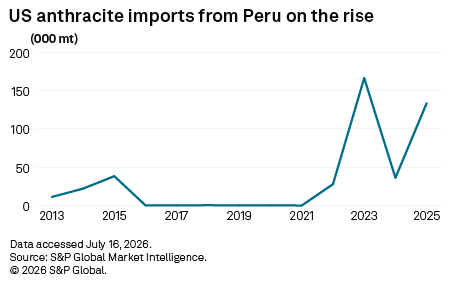
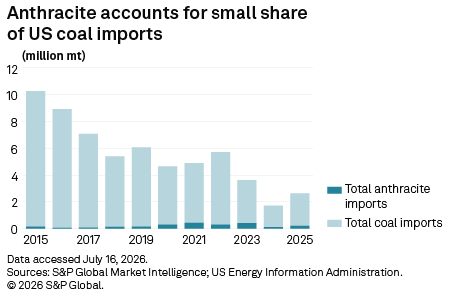
A tariff would likely have minimal impact, as the US produces most of its own anthracite and metallurgical bituminous coal, analysts said. The US imported 121,176 metric tons of anthracite coal in 2024, representing 4.5% of the 2.7 million mt produced domestically that year, according to data from S&P Global Market Intelligence's Global Trade Analytics Suite and the US Energy Information Administration. Of the 2024 anthracite imports, 29.9% came from Peru, with the country's share increasing to 62.1% in 2025.
"We have concerns about a serious threat to the ongoing existence of this industry and since anthracite is so concentrated in Pennsylvania as the only domestic source of this critical material to the steel industry, we see it very clearly as a threat," Greg Driscoll, chair of Blaschak Anthracite Corp., a miner in Pennsylvania, told Platts, part of S&P Global Energy.
The Trump administration used the same trade law in mid-2025 to impose 50% tariffs on steel, aluminum and some semi-finished copper imports.
Peru anthracite production rises
US producers of anthracite coal, concentrated solely in Pennsylvania, have pointed to increased anthracite production in Peru and said it is flooding the US market.
Peru's total coal production increased 1,030% from 2000 to 2023, according to the International Energy Agency. The US imported $37.3 million, or 215,220 mt, of anthracite coal in 2025, of which $23.9 million came from Peru, according to Market Intelligence data.
 |
The US also imports smaller quantities of anthracite from the United Kingdom and China. Pennsylvania produced about 2.7 million mt of anthracite coal in 2024, dwarfing the total imported.
Pennsylvania's anthracite producers first requested 100% tariffs on all anthracite coal imports in a July 25 memo to the Commerce Department.
Producers expressed concern when anthracite imports from Russia were sold in US markets at lower prices after Russian companies received rail subsidies for coal shipments. But the influx of imports ended when the US placed sanctions on Russia following the invasion of Ukraine in 2022.
Now, US anthracite producers are focused on the negative effects of Peruvian imports.
"The fact that there are no regulatory costs associated with anthracite production in Peru, we see this as an unfair competition that we can't possibly match," Driscoll said.
Investigation targets steelmaking materials
The Section 232 investigation also includes metallurgical bituminous coal, a grade used in blast furnaces. Most US metallurgical coal, also known as coking coal, is considered bituminous.
Metallurgical bituminous coal is used to produce coke for blast furnace steelmaking, while anthracite is used as a carbon source in electric arc furnace (EAF) production. Steel producers Cleveland-Cliffs Inc. and U.S. Steel Corp. operate blast furnaces, while most domestic steel production relies on EAFs.
 |
The Commerce Department investigation excludes other forms of bituminous and sub-bituminous coal and briquettes, as well as lignite, coke and coal gas.
US imports of metallurgical bituminous coal come almost entirely from Canada, which accounted for $85.6 million, or 412,086 mt, in 2025 — encompassing 99.7% of all US imports for the year.
The US produced 64.9 million mt of metallurgical coal in 2024, according to Energy Information Administration data, and exported 51.4 million mt, worth $9.7 billion, Market Intelligence data shows.
The US has a wide variety of metallurgical coal types and significant reserves, said Natalie Biggs, Wood Mackenzie's global head of base metals markets.
"The amount of imports of any metallurgical coal or bituminous coal from other countries into the US is pretty minuscule," Biggs said.
Industry sees limited effect on downstream costs
The Section 232 investigation could result in tariffs on imported coal products if the Commerce Department determines there is a national security risk.
Anthracite coal producers say new tariffs would not raise costs for downstream producers.
Anthracite coal is a small piece of the steel industry and the EAF market, Will Rich, vice president of business development at Pennsylvania producer Reading Anthracite Co., told Platts.
"In the grand scheme of the steel industry, particularly the EAF market, our ingredient, our piece of the puzzle, is so small and so insignificant to their total cost structure that no one should see this downstream," Rich said.
Imposing tariffs on imports of anthracite would help producers protect labor and ancillary businesses, Rich said.
If tariffs boost domestic production, the increase would be marginal and would not raise costs enough to be reflected in steel prices, Biggs said. She warned that a more significant concern could be retaliatory actions by other countries, such as Peru and Canada.
"I don't think it would be groundbreaking for coal markets or the markets in general," Biggs said of anthracite coal imports.