28 Jul, 2026
UK fintech Revolut must bulk up balance sheet to take on traditional banks

Revolut Ltd. needs a much bigger balance sheet if it is to take business and clients from traditional banks in its next growth phase.
The fintech plans to spend £10 billion on broadening its product range and international footprint over the next five years, aiming to secure new regulatory authorizations after being granted a long-awaited UK banking license in early 2026.
Entering traditional banking segments such as mortgages and savings accounts is key to the company's goal of becoming the primary bank for its customers. To really threaten traditional banks, Revolut would need to attract more deposits from customers and raise its loan volumes, analysts said.
"Revolut's biggest challenge is moving from being a frequently used secondary account to becoming customers' financial home," Phoebe Hodgson, banking and payments analyst at GlobalData, said in a written comment. "To achieve this, it must increase lending capabilities, payroll integration, savings products, mortgages, and broader financial planning services."
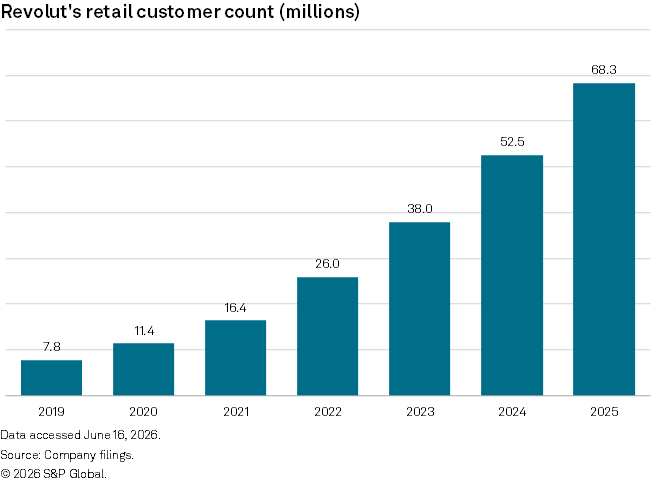
Revolut's app gained 16 million new users in 2025, bringing its total retail customer count to 68.3 million, according to its filings. That number is increasing rapidly, with roughly one million new users every 16 to 17 days, Revolut Chair Martin Gilbert said June 17 on the Billionaire Business podcast.
How many of these customers would choose Revolut as their primary financial provider remains to be seen since the app is still largely used to hold small amounts of money for foreign-exchange and travel payments. Previous compliance and customer support issues still haunt the company, which is seeking to remedy them by enhancing internal controls and risk management.
Changing behavior is difficult, and primary banking relationships are "sticky," Hodgson said. It may be particularly hard to persuade older and wealthier clients, who value trust and reliability, according to the analyst.
Bulking up
Revolut's loan-to-deposit ratio of 6.2% as of 2025-end was a fraction of that booked by the four largest UK banks, S&P Global Market Intelligence data shows.
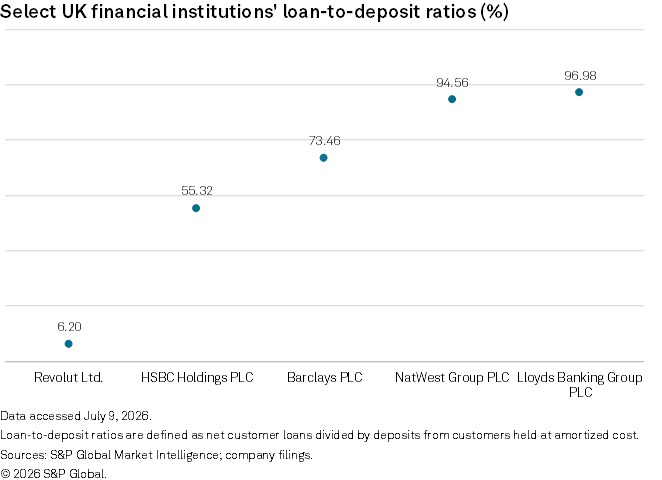
The company is not likely to "go large" on lending any time soon given that building up the loan book fast would require "tons of capital," said John Cronin, founder of financial sector research firm SeaPoint Insights. Expanding in mortgages, for example, comes with high capital requirements, Cronin said.
Loan volumes will still grow over the next few years — perhaps to more than £10 billion — but this will still be well below the loan levels even of other challenger banks, Cronin said. UK specialist lender OSB Group PLC, for example, has a loan base of about £26 billion, he said.
Revolut's deposit volumes are also still very low compared to those of the average retail banks in markets the company operates, Cronin said. One example is Ireland, where the company has "penetrated households en masse" but holds less than €1 billion of the €250 billion of deposits in the market, Cronin said.
Medium-term outlook
Growing lending to become "a real competitive force" in the UK and the US would require more capital, which does not appear to be Revolut's "game plan" for now, Cronin said.
"It just seems to me that they can convince the market that, if their customer number and geographic presence is still on a fast-growth trajectory, and they also have deposit growth coming through, that will be a growth story for the next decade," Cronin said.
Revolut applied for a US national bank charter in early March 2026, days before receiving a full UK banking license, for which it originally applied in 2021. The company announced plans to roll out mortgages in Ireland, Lithuania, France and Spain between 2024 and 2026, but has delayed many of these.
"It will remain challenging for Revolut to fully compete with established high street banks in the near to medium term, given their entrenched customer bases, broader product offering, and long-standing relationships, particularly in lending and SME banking," said Maria Rivas, senior vice president for European financial institutions at Morningstar DBRS.
Continued progress in strengthening governance, controls and compliance will be key as Revolut grows its UK operations given the heightened regulatory scrutiny it has faced in the EU, where it already holds a banking license, Rivas said.
Expanding into the more heavily-regulated traditional banking space could hamper Revolut's rapid scale-up. In 2025, EU authorities restricted Revolut from launching new products in the bloc and its EU arm from acquiring clients or business outside of Europe over lapses in risk management, the Financial Times noted in a June 10 report.
– View funding round data on Revolut's company profile page.
– Sign up for Earnings IQ alerts to get results as soon as they're released.

Competitive edge
While Revolut is not likely to become a global bank "on the scale of HSBC or Citi" in the next five years, it is likely to be "one of the world's largest digital retail banks, with deeper penetration into wealth management and premium banking," Hodgson said. Revolut's competitive edge is its ability to service clients in multiple markets via a single technology platform, the analyst said.
Unlike traditional banks, which often operate fragmented systems and local brands, Revolut can scale rapidly and introduce products globally, Hodgson said.
Revolut believes its latest figures demonstrate that it can win more primary customers and eventually meet all of their financial needs. The number of customers who chose Revolut as their primary bank increased 45% year over year in 2025, with lending volumes also doubling amid new product rollouts and expansion of existing offerings, CEO Nik Storonsky said in the company's annual report.
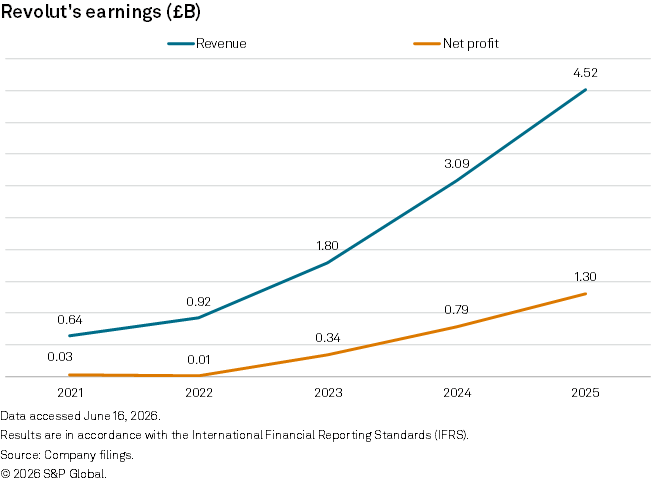
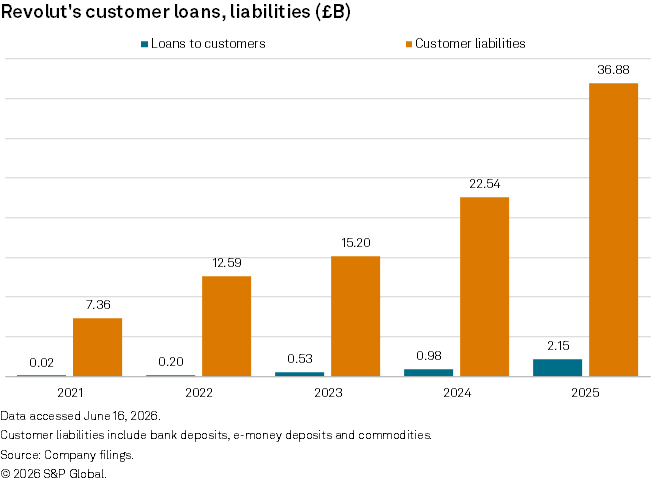
The company's earnings and customer balances have increased significantly over the last five years. Revenue grew sevenfold to £4.52 billion and customer liabilities rose fivefold to nearly £37 billion between 2021 and 2025, company filings show.
Battle for customers
Big banks have recognized the threat Revolut poses to some of their operations. JPMorgan Chase & Co. CEO Jamie Dimon said he is "jealous" of Revolut's fast growth in the UK, where the US group is operating its own Chase digital brand.
"We learned a lot by watching some of these folks. And we got to get faster and better sometimes," Dimon said at a May 27 conference.
ING Groep NV CFO Ida Lerner made similar remarks at a June 4 conference, saying Revolut has been "very successful" in growing into universal bank services from its initial niche. The Dutch group should have been able to fill the gaps that allowed Revolut and other fintechs to grow, but product and geographic fragmentation prevented that, Lerner said.
Société Générale SA CEO Slawomir Krupa said in October 2025 that the French group is taking Revolut's plans to expand in the country "very seriously." A couple of weeks after that, a funding round set Revolut's valuation at $75 billion from $45 billion previously. The valuation could reach $115 billion in a potential secondary sale being considered, Bloomberg reported June 5.
While European markets are competitive and "very immobile" when it comes to customers switching banks, this is not the case everywhere, independent analyst and Revolut investor Max Kapris said in an interview. In Mexico or somewhere in Latin America, Revolut could become a primary account "from day one," Kapris said.
Revolut has "a corridor country strategy," focused on regions linked to each other, like Spain and Latin America, or Mexico and the US, Kapris said. The company is able to capitalize on its strength in foreign exchange, person-to-person money transfers and multi-currency accounts, and broaden its offerings from there, he said.
Revolut aims to boost customer numbers "more than anything," as each customer is "another node in an expanding network." Every transaction made with Revolut rather than incumbent banks "builds on the attachment and trust" and weakens traditional relationships, Kapris said.
The fintech is now fully licensed as a bank in the UK, the European Economic Area, Mexico and Australia. The UK banking license is a signal to regulators in the US, Switzerland and New Zealand that Revolut "has met the bar," paving the way for the company to become a registered bank there too, Kapris said.