10 Jul, 2026
NYC targets lower premiums with city-backed property insurance program

By Hailey Ross
|
NYCEDC Strategic Investment Group EVP Brinda Ganguly (left) and NYCHDC Vice President of Strategic Operations Alex Merchant (right) present field questions at a July 8 informational meeting related to their plans for a city-backed property insurance program. Source: S&P Global Market Intelligence |
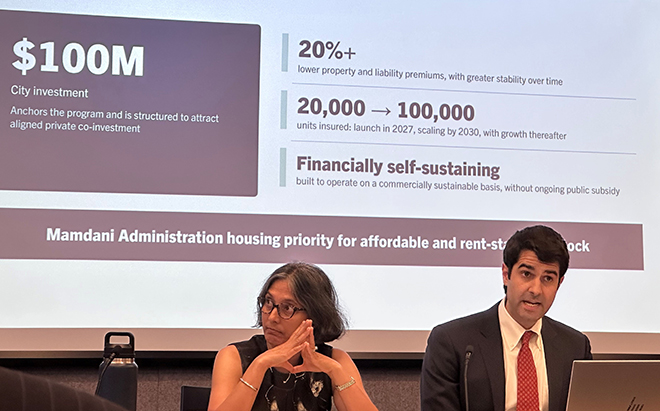
A planned New York City-backed property insurance program will lower insurance costs by eliminating intermediaries in reinsurance, leveraging the city's property data, and taking advantage of the city's lower cost of capital, according to executives from the city's government housing agencies.
The program, first announced in April, is intended to reduce property and liability costs for both income-restricted affordable and rent-stabilized housing units within city limits. The goal is to issue new insurance policies through the program for 20,000 homes in 2027.
Alex Merchant, vice president of strategic operations at New York City Housing Development Corp. (NYCHDC) said he is eager to ensure "actuarially justified risk management strategies" are incorporated into the city-backed program, during a July 8 public informational meeting hosted by NYCHDC and the New York City Economic Development Corporation (NYCEDC).
"We're looking to take advantage of existing alternative structures that take out intermediary costs and provide direct access to the reinsurance market," Merchant said. "That is a standard avenue for cost savings."
Working out the details
The finer operational details are still up in the air as the city hunts for an insurance partner to turn its goals into action.
The NYCEDC, NYCHDC and the New York City Department of Housing Preservation and Development jointly issued a request for expressions of interest (RFEI) on June 24, inviting industry stakeholders to submit proposals for the structure and operation of the homeowners insurance program.
The program needs to be "financially self-sustaining," Merchant said. On behalf of New York City, the NYCEDC is planning to commit up to $100 million over a three-year period to get the program off the ground.
Merchant said several factors should facilitate the program's success, including the city's "unique" level of insight and "extensive data" on the properties that would be part of the program.
"We inspect these properties, we have access to financial records, often going back many, many years," Merchant said. "We believe that information will augment actuarial modeling so we will be able to, for at least some portion of the market, better price risk and provide a lower cost in an actuarially indicative way."
Merchant added that the city will have the "scale and structure" to create a path to "directly access the insurance market."
"That means we'll be able to market a concentrated portfolio — New York City, multifamily, affordable housing — to people who are looking to balance risks locally," Merchant said. "And in that way turn something that might be an issue into an opportunity."
The initial $100 million will be invested in the balance sheet of the insurance provider, Brinda Ganguly, executive vice president of the NYCEDC Strategic Investment Group, said during the informational meeting, adding that the city is expecting to see a financial return on the investment.
"We are not looking to maximize what that return is, so there is some delta there that can be used to offset the cost of premiums for owners," Ganguly said. "We do view financial return as a proxy for accountability, discipline and the ability for this insurance provider to continue to scale and write more policies over time."
Pinnacle Actuarial Resources Inc. is working alongside city agencies in both actuarial and advisory capacities during the early stages of the project.
Responses to the RFEI are due by Aug. 6. The city expects to select its insurance partner by the first quarter of 2027 and intends for that insurer to have insured more than 20,000 units by the end of 2027.