15 Jul, 2026
FCC to vote on repealing broadcast ownership cap

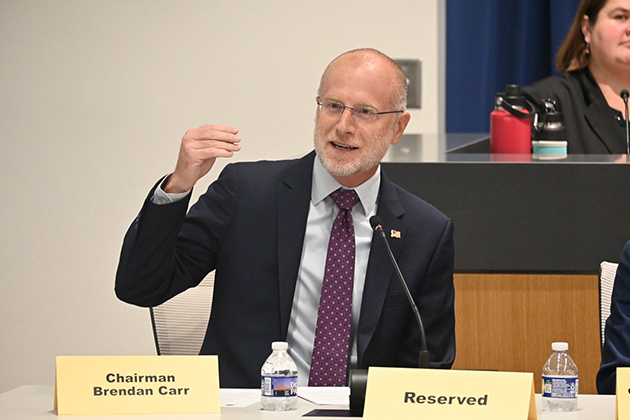
| FCC Chairman Brendan Carr said the agency will vote on replacing the national broadcast ownership cap in August. Source: Federal Communication Commission. |
The Federal Communication Commission will vote Aug. 6 on an order that repeals restrictions on ownership of broadcast television stations.
The national ownership cap prohibits a single broadcast station group from owning stations that together reach more than 39% of US TV households. FCC Chairman Brendan Carr will propose to replace that blanket prohibition, which already includes a discount for certain types of stations, to a granular, case-by-case review process that evaluates individual transactions.
The agency in a news release said the new approach would foster a more competitive media market while still allowing the FCC to reject deals it deems not to be in the public interest.
While opponents of the change have previously argued that the FCC lacks the authority to change or abandon the cap given that it was set at 39% by Congress, supporters say the cap no longer reflects the realities of the modern media market and unfairly constrains the broadcast industry.
"The FCC's decision to review the national television ownership cap is a welcome and long-overdue step toward bringing broadcast regulation into the modern media marketplace," Nexstar Media Group Inc. spokesman Gary Weitman said in a statement emailed to S&P Global Market Intelligence. "These rules were last updated before Netflix Inc. streamed a single movie, before the first iPhone and before Instagram existed, and they continue to single out local broadcasters based on a competitive landscape that disappeared with the VCR."
Nexstar is presently fighting a legal battle to close its $6.2 billion acquisition of TEGNA Inc. If the deal finally culminates Nexstar, the nation's largest TV station operator, would expand its reach to 265 full-power stations in 44 states and the District of Columbia. It was approved by the US Department of Justice and FCC and then technically completed on March 19. However, a challenge by DirecTV LLC and several state attorneys general led to a federal judge granting a restraining order that has left the transaction in legal limbo.
Congressional action
The national ownership cap was originally adopted as a structural safeguard to prevent any one broadcaster from getting too much power over local news and programming. Originally set at 25% by the FCC in the 1940s, it was later raised twice by Congress, once in 1996 and again in 2004. In the latter piece of legislation, Congress said the FCC should not consider making any rules related to the 39% cap when conducting its quadrennial media ownership review.
Paul Weiss Rifkin Wharton & Garrison LLP's Kannon Shanmugam and William Marks in a white paper said the FCC lacks the authority to relax the cap given the statutory language on the books.
"Congress intentionally set the cap at 39% and made clear the FCC has no authority to alter that cap," they wrote. Recent Supreme Court cases concerning the major-questions doctrine, including Loper Bright Enterprises v. Raimondo, mean that courts will not defer to an agency's changing interpretation of an established law.
"Congress would have spoken more clearly if it intended to vest the FCC with unbridled authority over the national-ownership cap in a manner that fundamentally reshapes the nationwide broadcasting market," they said in the white paper. "The agency's interpretation of the Act will receive no judicial deference."
Public interest
The FCC argues it has statutory authority under the Communications Act to modify or repeal the ownership rule. While Congress has directed the commission to change its rules at certain times, it has never withdrawn the agency's authority to regulate or change ownership limits.
In its current formulation, the rule has generally presumed that deals exceeding the 39% threshold would not be in the public interest, which Carr says is no longer the case.
"Many local broadcast TV stations are getting hollowed out as a result and turning into little more than mouthpieces for programming produced in New York and Hollywood," Carr wrote in a July 15 op-ed published in Breitbart News. "That is not what Congress or the FCC intended."
Carr said relaxing ownership rules would allow broadcast station owners to better compete with large media and technology companies. National programmers can now distribute programming to 100% of the country through their own streaming services or deals with virtual cable companies such as YouTube TV. Cable channels, social media platforms and streaming services have no similar restrictions on their reach.
"Today, the cap is not protecting local broadcasters, it is preventing them from gaining the same scale that their competitors are free to enjoy," Carr wrote in the op-ed. "In other words, the national cap is now doing the exact opposite of what the FCC intended."