


09 Mar, 2026
Industrial loan company activity surges, undeterred by long road to approval
By Claire Lawson and Xylex Mangulabnan
Industrial loan company applications and approvals are picking up pace, but advisers still expect them to remain few and far between.
Regulators' favorable posture toward bank charter applications from traditional de novos and nonbank hopefuls has led to a surge in all charter types, including industrial loan company (ILC) charter applications. A year into the second Trump administration, seven ILC charter applications have been filed, the highest activity since the global financial crisis.
Approvals have also increased, with the Federal Deposit Insurance Corp. issuing three conditional approvals since Jan. 22, matching the total number of approvals granted between 2006 and 2025. The increase coincides with FDIC Chairman Travis Hill expressing support for ILCs.
"These ILCs would be subject to fairly significant, enhanced expectations compared to typical [insured depository institutions]. They have much higher leverage ratios, " Hill said during a call with reporters discussing the fourth-quarter 2025 banking profile on Feb. 24. "Things like that were persuasive in allowing the applications to move forward."
Still, advisers do not expect a surge in ILC activity as seen with national trust bank charters, as the approval process remains lengthy and complex.
"The minute people felt that there was going to be regulatory openness, interest increased and interest is going to continue to increase," said L.E.K. Consulting Partner Aaron Byrne. However, whether companies can "put forward a strategic proposition and put in place the necessary infrastructure remains to be seen."
In it for the long haul
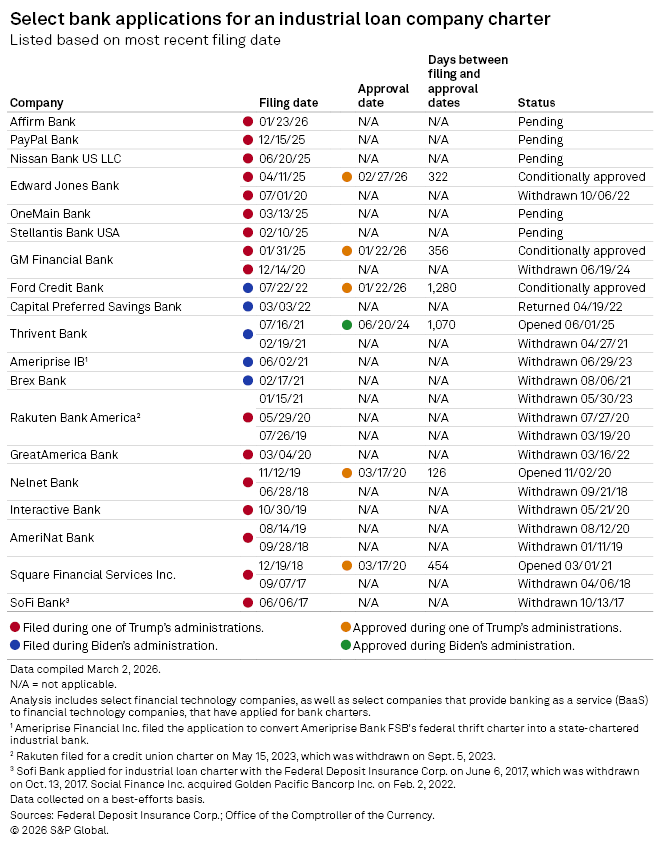
Applicants GM Financial Bank and Ford Credit Bank received the FDIC's conditional approval for deposit insurance on Jan. 22, marking just the fourth and fifth such approvals since 2006. The FDIC granted conditional approval to Edward Jones Bank on Feb. 27.
All three ILCs' paths to approval mirror the typical process riddled with withdrawals, re-filings and long-pending applications. GM originally applied in December 2020, withdrew in June 2024 and then refiled in January 2025, shortly after the new administration took office. Similarly, Edward Jones applied in July 2020, withdrew in October 2022, and then reapplied in April.
Ford never withdrew, allowing its application to remain pending for 1,280 days since its July 2022 filing.
"I don't know why it takes them a year to ensure the deposit insurance application for a car company to have an ILC charter," Davis Wright Tremaine Partner Max Bonici said in an interview with S&P Global Market Intelligence. "How long does it take the [Office of the Comptroller of the Currency] to charter a national bank under this administration, right? And if there's any discrepancy between the two, what's going on?"
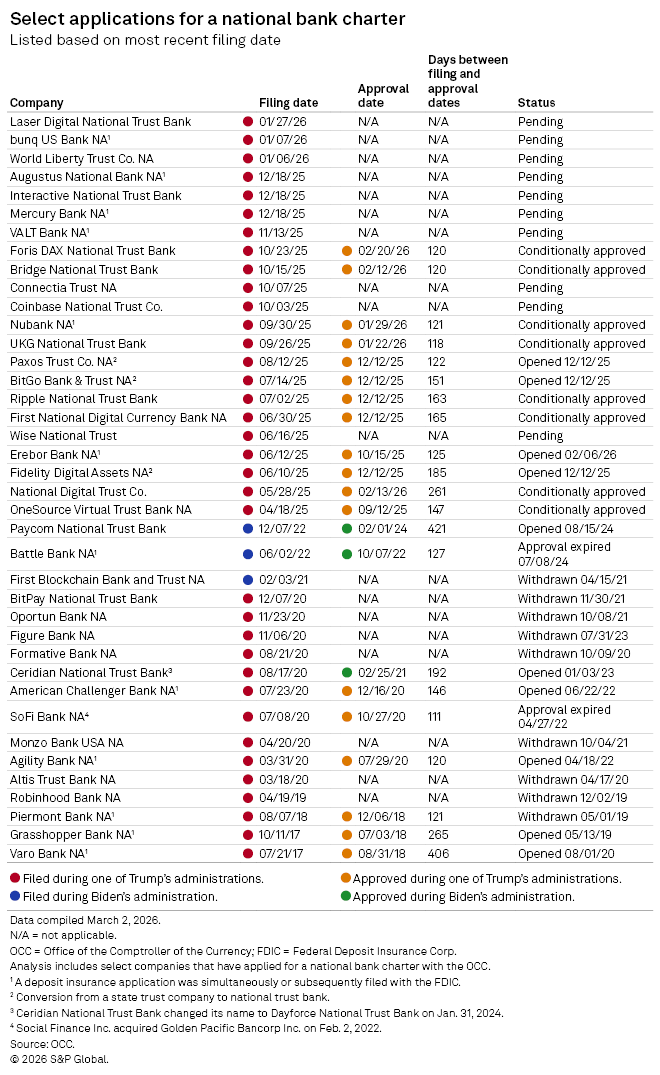
Since the start of US President Donald Trump's second term, national bank and national trust bank charter applications have surged, with 22 applications filed and 12 approvals as of March 2, averaging 150 days to approval. In the first term, the administration recorded 14 applications and six approvals, with a 195-day average pending application period.
In comparison, during the Biden administration, there were three total applications and three approvals, with an average of 274 days to approval.
New ILC hopefuls still expect yearslong timelines. Affirm Holdings Inc. announced Jan. 23 that it applied for an ILC charter, but Chairman and CEO Max Levchin said during an earnings call that the approval process could take years, and that the company may never receive approval.
The transition from not holding a bank charter to becoming a chartered institution is lengthy because it is a "fundamental shift for an organization," said L.E.K. Consulting Managing Director Will Callender.
Who is allowed in?
The seven ILC applications seen since the start of 2025 nearly match the nine applications filed during the entirety of Trump's first four-year term.
There were five ILC applications and one approval during the Biden administration, granted to Minneapolis, Minnesota-
"We had one approval, and that's almost the bare minimum they could do, right? And what did they approve? They approved something that looked like a community bank," Bonici said. "And that was what the administration fundamentally was comfortable with. Now we're in a new reality. But has the FDIC actually changed?"
Recent approvals have been a good start, but are not much different from other companies that now hold ILCs, Bonici said, including fellow car companies, BMW Group and Toyota Motor Corp., which own BMW Bank of North America and Toyota Financial Savings Bank. ILCs can be owned by companies that are not bank holding companies, allowing companies such as auto manufacturers to establish finance units.
Applicants in the past year include other car companies, Stellantis Bank USA and Nissan Bank U.S. LLC, neobanks PayPal Bank and Mercury Bank NA, and nonbank financial companies Edward Jones Bank and OneMain Bank.
It remains unclear whether the FDIC will approve new uses of the charter until there is a slate of approvals, Bonici said. Edward Jones Bank's approval was not surprising, as it engages in financial activities rather than commerce, he added.
ILC charters benefit companies that lend and seek a lower cost of deposits, and potential future applicants would have similar profiles to recent ones, Callender said. These include neobanks looking to scale up, fintechs using partner banks, larger digital asset firms and large retailers. But each filing is unique and difficult to compare to others, as nonbanks have different reasons to pursue charters, Byrne added.
"This presents an interesting environment for growth of banking charters in domains that we've not seen in many, many years," Byrne said.
National trust bank charters, which have seen a greater increase in applications in 2025 and 2026, benefit companies interested in deposit custody and payment rails that have less need for funding, Callender said.