12 Nov, 2026
US states gearing up for clean energy push in 2027 after Democratic wins
By Karin Rives
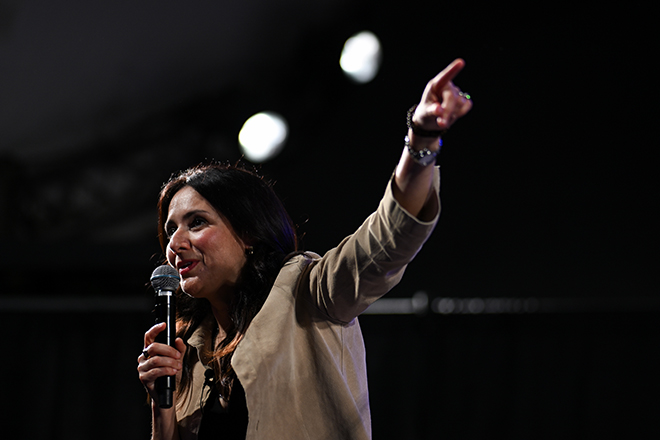
| Texas Democratic governor-elect Gina Hinajosa campaigned on energy affordability and stricter grid oversight. As a legislator she once favored a package of bills aimed at curbing fossil fuel emissions, signaling what could be new policies for the oil-heavy state in coming years. Source: Brandon Bell/Getty Images News via Getty Images. |
A week after Democrats made major gains in state elections, lawmakers are busy preparing a flurry of bills directed at the US energy sector.
Legislation requiring power distribution companies to install battery energy storage and another allowing community solar projects will be reintroduced in the Pennsylvania state legislature in coming weeks, sponsors of the bills confirmed. Under the Commonwealth's first Democratic trifecta in 33 years beginning in January 2027, the measures now have a good chance of becoming law.
In Wisconsin, another state where Democrats will hold the governorship and both chambers of the legislature, legislation that sets renewable energy targets for power companies could also make it across the finish line, according to the sponsor of that bill. Arizona's newly elected Democratic majorities are expected to push for clean energy policies as well.
With congressional policymaking limited by a White House unlikely to rein in fossil fuels, attention is turning to state politicians pledging to speed up America's lagging energy transition.
"City halls and state houses are developing policy as we speak," Chris Wheat, executive of the coalition America Is All In, told a Nov. 9 panel at the United Nations COP31 climate conference in Turkey.
Democrats on Nov. 3 secured trifectas in six states; Arizona, Michigan, Minnesota, Nevada, Pennsylvania and Wisconsin, and gained control of the governor's mansion in Georgia, Iowa, Texas, Ohio and Nevada. They also secured new seats on public service commissions and flipped five state attorneys general positions. About 75% of Americans will live under a fully Democratic leadership.
'We need to catch up'
Angelito Tenorio, a Democratic member of the Wisconsin Assembly, said he has been "working the phones" since Election Day with plans to take his Senate Bill 1150 across the finish line in 2027. The previous version of the bill, which would set clean electricity and emission targets for the state's power companies, died in committee.
"In Wisconsin, we have a very proud tradition of conservation, environmentalism, labor, progressivism, but because of the past 16 years of Republican control of the legislature we've just fallen so far behind," Tenorio said in an interview. "Our neighboring states, Minnesota, Michigan and Illinois all have to commitments to 100% clean energy. We need to catch up."
Rep. Peter Schweyer, a Democrat serving in the Pennsylvania House, said he has already discussed reintroducing his community solar bill with the chair of the chamber's energy committee. The expectation is to move it out of committee in early 2027, he said in an interview.
Until the 2026 midterms, the Pennsylvania state House had difficulty getting anything passed through the Republican Senate, Schweyer said.
Yet, lawmakers in the Keystone State and beyond face pressures to not only to deliver on energy affordability and other voter priorities, but also to craft robust legislation that will not burden already-stressed state budgets.
Schweyer said his staff is investigating whether there may still be federal grants available under the 2022 Inflation Reduction Act to help subsidize his community solar bill and avoid relying solely on state tax incentives.
Tall ambitions, complex challenges
Power companies in Arizona, another state that has gone from Republican control to what is now an all-blue government, could also see new legislation affecting their operations.
Lauren Kuby, a Democratic state senator re-elected on Nov. 3, said she will prioritize legislation codifying Arizona's renewable energy portfolio. State regulators in March repealed the standards and the rules have remained in limbo ever since.
"It's an embarrassment to the sunniest state in the US that we no longer have a renewable energy standard," Kuby said in an interview. "And we will see if we can make that a statewide legislative effort."
That would mean "democratizing" ratepayer voice in the Salt River Project, the state's second-largest utility that is not regulated by the Arizona Corporation Commission, Kuby said. Other priorities for Democrats in 2027 include community solar legislation, a bill barring Arizona utilities from using ratepayer funds for lobbying, and the repeal of a law prohibiting Arizona from inventorying carbon emissions.
"We're going to look into everything," Kuby said. "There's a lot of excitement, a lot of expectations."
It is on Democrats to work with partners to bring forth legislation that tackles complex issues, "because nothing's simple, nothing's easy," the Arizona lawmaker said.
'A material shift'
Lawmakers in other states echoed the same challenges.
Before he reintroduces his bill early next year requiring Wisconsin power companies to set clean energy targets, Tenorio said he wants to discuss its provisions with the state's electric utilities and cooperatives, as well as labor, environmental and community groups to make sure the legislation "is feasible and enforceable."
"Because it takes all of us to get this type of initiative done in Wisconsin," the lawmaker said.
The renewed ambition among state legislators has not gone unnoticed.
The midterms represented a "material shift," said Jules Kortenhorst, co-chair of the Energy Transitions Commission, a global network of leaders from the energy and financial sectors, industry and nonprofit groups.
The transition away from fossil fuels at the state level will "accelerate, with Democratic statehouses and governors making sensible decisions with techno-economics and affordability in mind," Kortenhorst predicted in an email. "That is a huge win for the scale-up of clean energy."