20 Nov, 2026
Power crunch, community resistance hamper data center expansion - S&P webinar

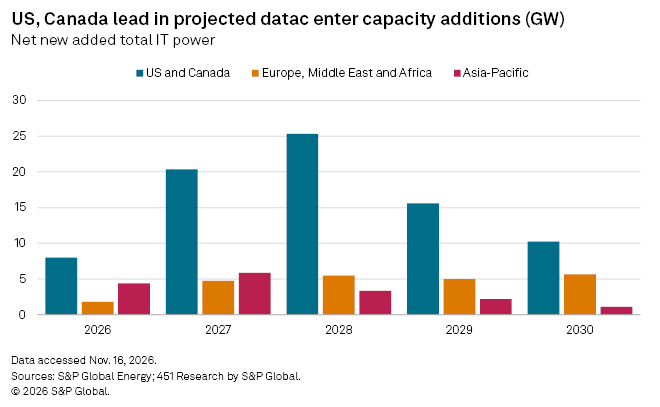
➤ US net new data center IT power capacity is projected to more than double year-over-year to 20 gigawatts in 2027.
➤ Data center M&A activity has slowed as industry investment shifts toward infrastructure build-out and energy procurement.
➤ Grid interconnection delays and slow progress on behind-the-meter generation are threatening developers' ability to deliver planned capacity.
Power shortages, permitting delays and community opposition are affecting developers' ability to meet growing demand for AI computing, experts said during an S&P Global Market Intelligence webinar.
"Power is the number one constraint, and it is not getting any less," said Reid Tucker, principal at KPMG focused on infrastructure, capital projects and climate advisory within the technology sector.
US and Canada net new data center IT power capacity is projected to more than double to around 20 gigawatts in 2027 from about 8 gigawatts in 2026, before reaching around 25 GW in 2028, according to data presented during the "Data Center Investment Outlook: M&A, Monetization, and the AI-Driven Growth Cycle" webinar.
Access a replay of the webinar (may require registration).
The expansion comes as investment in the sector shifts away from acquisitions and toward building capacity. Global data center M&A and investment activity has slowed, particularly in the US, where consolidation has reduced the pool of assets available for acquisition.
Data center M&A and investment transactions totaled nearly $39 billion so far in 2026, down from more than $69 billion in 2025 and more than $62 billion in 2024.
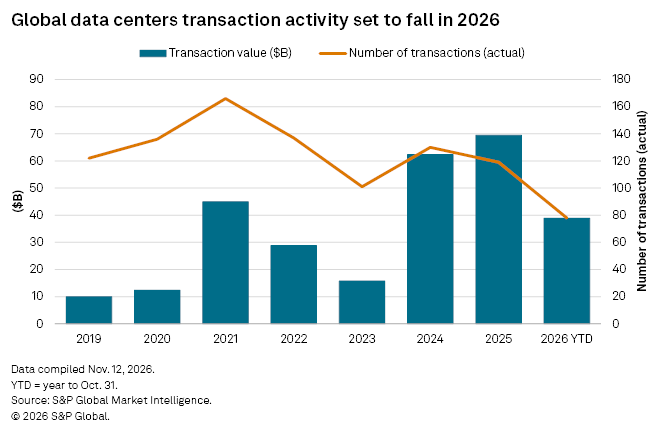
With fewer assets available for acquisition, attention is shifting toward infrastructure build-out and securing the energy needed to support it. Hyperscalers are continuing to pursue new capacity, increasing pressure on developers to secure power and to navigate permitting and community opposition.
Power bottleneck challenges capacity pipeline
Delivering the projected capacity will be difficult because of the time grid interconnections can take to complete.
"Interconnection processes take years to get power connected to the grid, and interconnection with the grid is still the preferred approach," Tucker said.
Developers are increasingly looking to renewable energy, battery storage and behind-the-meter generation to secure supply or bridge delays in grid connections. These alternatives face bottlenecks of their own.
About 15 GW of behind-the-meter projects were planned or announced for 2027, but only about 2 GW was under construction, said Kelly Morgan, research director for data centers at 451 Research by S&P Global.
"One of the key issues they are seeing is that behind-the-meter projects seem to be delayed," Morgan said.
Permitting hurdles, turbine shortages and a lack of workers to build power plants are among the factors contributing to these delays. This calls into question how much behind-the-meter capacity will be available to bridge the gap until grid power becomes available.
Community opposition complicates development
Securing power does not guarantee a project will be built, as developers are facing growing community resistance over power and water consumption, battery storage, on-site generation and other effects of large data centers.
This is particularly acute in Europe, where power shortages in established hubs are already pushing development into secondary markets and locations outside major cities, said Mai Barakat, senior analyst at 451 Research.
"There is massive pushback, and a lot of permitting has been blocked because communities have simply said no," Barakat said.
Barakat said developers increasingly need to engage communities before applying for planning permits, rather than trying to explain the benefits of a data center after development has begun.
In the US, opposition remains highly localized. Communities have raised concerns about issues including water consumption, battery storage, nondisclosure agreements and behind-the-meter gas generation.
Morgan said around 66 GW of US projects that are not yet under construction and are planned to start coming online after 2028 could face delays or new regulations. New requirements may not stop projects altogether but could increase costs and extend development timelines, the panelists said.
Hyperscalers are adapting their build-out strategies
Power and permitting constraints could also change where and how hyperscalers build data centers.
Companies have portfolios of potential sites and can shift projects to locations where power and permits are easier to secure. The industry could build smaller, distributed data centers.
"If requirements are put in place for data centers above 70 megawatts, or above 100 megawatts, all of a sudden a lot of proposed data centers come in just below that, at 69 megawatts," Morgan said.
Overall demand is not expected to slow significantly, but the development process is likely to become longer and more expensive. Developers who can secure power while working effectively with utilities, local authorities and communities will be better positioned to deliver the planned pipeline of capacity.
|
Disclaimer: This content may be AI-assisted and is composed, reviewed, edited and approved by a human at S&P Global. S&P Global uses generative AI to create content in accordance with our Terms of Use.