05 Nov, 2026
Fed faces challenges measuring maximum employment

By Brian Scheid
Monthly US job growth and the unemployment rate, two key labor market indicators, may be leaving the US Federal Reserve with an incomplete view of how close the economy is to maximum employment, one Fed economist told S&P Global Market Intelligence.
The Fed has long used these two indicators to gauge the health of the US labor market as part of the central bank's dual mandate from Congress to keep prices stable throughout the domestic economy and maintain employment at its maximum level.
Yet millions of jobless Americans may be out of work but not count as unemployed in government statistics, while the growth of gig work, consulting and other nontraditional employment may fall outside the formal scope of data. While US inflation has again drifted away from the Fed's a 2% goal, largely due to soaring energy prices from the war in Iran, Fed officials have a hazier view of how close the domestic labor market is to maximum employment.
"It's becoming more difficult to measure employment," said Amanda Michaud, principal research economist at the Federal Reserve Bank of Minneapolis, in an interview.
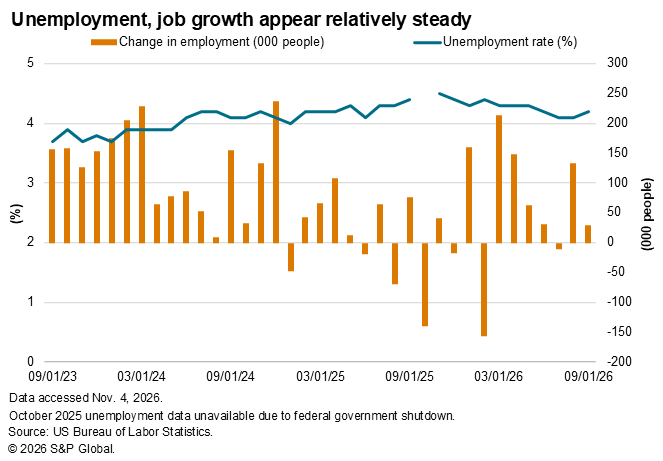
Since November 2021, the US unemployment rate has drifted above 4.4% just once and has averaged 4% over those nearly five years, a historically low rate for that stretch of time.
Low unemployment has been a chief driver of the Fed's current effort to fight higher inflation with higher rates, a cycle the central bank is pursuing because Federal Reserve officials believe employment is at or near maximum levels.
"We've been hit with a ton of shocks, a ton of uncertainty, and I've been truly surprised by how steady the labor market has been," Michaud said.
But the unemployment rate, the metric most cited when discussing the health of the labor market, is being pulled down by multiple factors. These include changing demographics within an aging population, few entrants into the workforce as population growth slows, stricter immigration enforcement and a decline in layoffs and quits.
"Those factors alone suggest that unemployment should be kind of low; it's not a reflection on the health of the labor market; it is just long-range factors that come into play," Michaud said.
Frictional factors, including the typical churn of job loss and new entrants into the market, could push unemployment higher, even without a landmark shift in market conditions.
"That can drive up the unemployment level but not signal that we're far from maximum employment; it is just a natural force that happens," Michaud said.
Unemployment is an incomplete barometer of labor market health because it only accounts for people who are not employed and are actively seeking employment. But the majority of Americans hired out of non-employment would be classified as non-participants in the workforce, not unemployed, since they either are not actively searching for a job or have not searched in weeks.
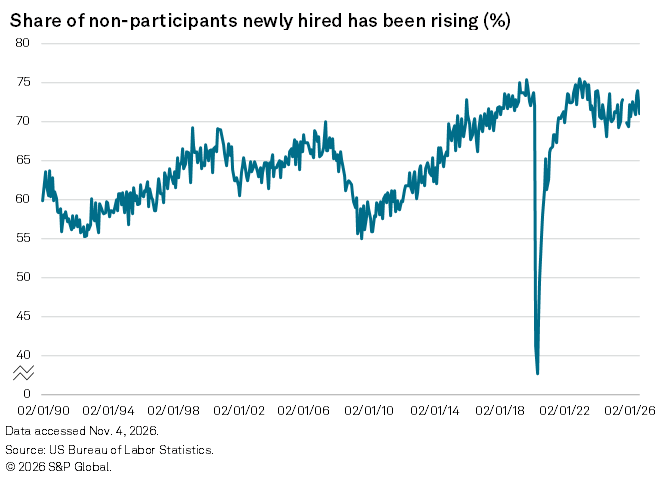
In September, 71% of Americans hired from non-employment were not in the labor force, while 29% were classified as unemployed prior to their hiring. In August, 74% of newly employed Americans were classified as non-participants in the labor force before they were hired, nearly a record high.
"The majority of people who are hired today are non-participants," Michaud said. "That suggests there's lots of labor still available out there that's not counted in unemployment."
This means that monthly job creation, even monthly job openings, offers an imperfect view of the market's health.
"If the economy wants more people to work and the incentives are provided, I think the US economy has shown repeatedly that we will bring more people into the labor force," Michaud said. "You have this reserve of people who will work if the contract is right, and if the economy is really hot or is really strengthening, they will go to work."
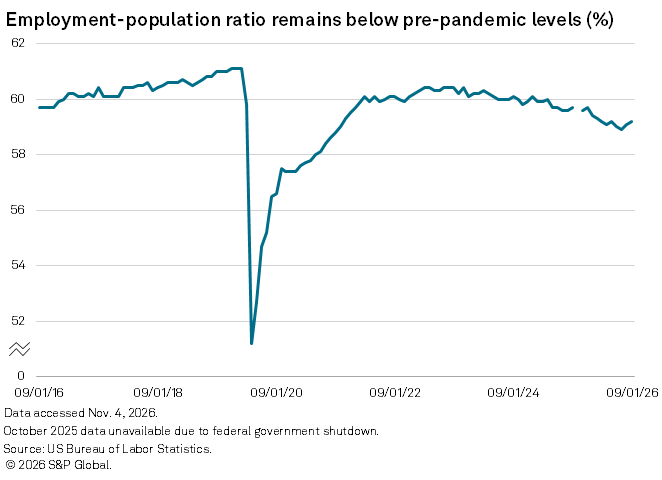
One metric popular with economists for measuring labor market health is the employment-to-population ratio, which measures the share of the working-age population now employed.
That ratio was 59.2% in September, down 50 basis points from a year ago and 180 bps from pre-pandemic levels.
But the ratio does not measure unutilized, potential labor. So if the ratio declines, the cause is unclear. Current shifts in the ratio may result from demographic changes, such as declining immigration.
Michaud tends to look at a "want-to-work" measure, using government data to model unutilized labor, one metric for slack in the labor market.
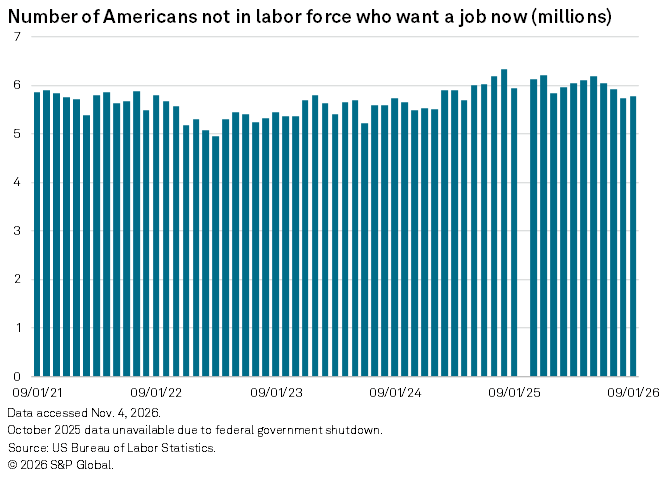
For example, in September, nearly 5.8 million Americans not in the labor force wanted to work, according to the Bureau of Labor Statistics' latest data. This is down from more than 5.9 million a year earlier.
"Potentially the best way to measure labor market health would be to look at so-called slack in the market, which could be measured by the level of unutilized labor, by looking at the number of Americans who want a job, but may not be actively looking," Michaud said.
However, these measures all have limitations, especially as the domestic labor market changes. The advancement of the gig economy, with employment that may not appear in official data, and potential job losses from AI advancement, complicate measurement.
"I do think that we're missing something," Michaud said. "I don't have the answer, but from my collective knowledge of working with this data for a while and talking to people… this is a feeling out there."