05 Oct, 2026
West must mobilize to narrow China's minerals lead: Friedland

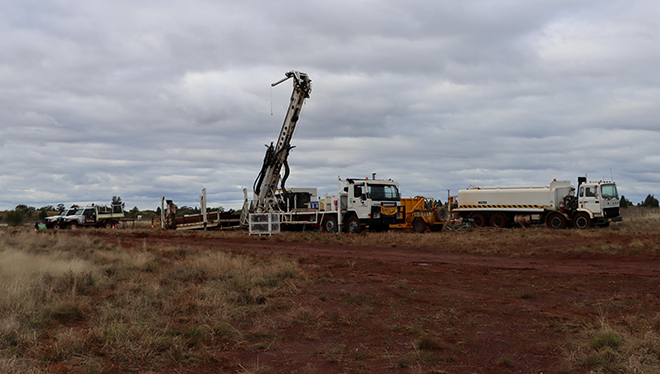
| Exploration drilling at the Syerston scandium project in New South Wales, Australia Source: Sunrise Energy Metals Ltd. |
➤ West trails China by 30 years in rare earth processing
➤ China's rare earth curbs target Western manufacturers
➤ AI may accelerate critical mineral discovery
The West needs an unprecedented mobilization of government, academia and industry to help narrow China's lead in the critical minerals sector, according to Robert Friedland, chairman of Ivanhoe Mines Ltd. and Sunrise Energy Metals Ltd.
The US remains decades behind China in processing, supply chains and industrial expertise, Friedland says, with much of China's advantage comprising accumulated know-how, versus patents or technology developments.
Beijing's rare earth restrictions have shifted the focus from mines to factories, and companies that depend on magnets, semiconductors and advanced electronics are discovering that access to critical minerals can matter as much as access to capital or technology.
At the same time, AI could transform the mining industry as exploration budgets rise and major discoveries become harder to find. Friedland believes AI-driven exploration could help unlock new deposits of copper and other critical materials, accelerating Western supply chain efforts.
Friedland recently spoke with Platts, part of S&P Global Energy, about the global race to secure critical minerals and company strategies. The following interview has been edited for clarity and length.
|
|

Platts: You said critical minerals were at the heart of the Trump-Xi meeting, yet the main outcome appears to be a two-month extension of the rare earth truce. Is that meaningful progress, or are both sides simply buying time?
Robert Friedland:
First of all, Xi Jinping hasn't been to the United States in 10 years. Pretty long time! We need time to assess each other and come to a mutually acceptable compromise without blowing each other up. I hope and pray that this personal diplomacy between Donald Trump and Xi Jinping actually creates a less-worse situation between the two world's largest economies.
Look, the world economy is balkanizing: each nation-state is in a panic about its supply chain so they can continue to exist. But what's making it worse is that now each major corporation is panicking about its supply chain. So, it's no longer just the nation-state; it's Apple Inc. Computer, Google LLC, Oracle Corp., or anybody.
China's rare earth export controls are creating a two-tier market, in which Western manufacturers pay far more for critical materials than their Chinese competitors do. Is Western manufacturing itself the real target of these trade restrictions?
Of course! Jim Farley runs Ford Motor Co. [as CEO]
I will give you another example! When Steve Jobs made the first iPhone, it used 18 elements from the periodic table. This is an iPhone 17. It's now up to approximately 74 elements. And if one is missing, they can't make the phone. If one out of 74 elements is missing, they have to make it inferior. The way we're going, we'll go back to a Nokia smartphone. Remember those?
Everything is being weaponized. I don't think the average person understands how intense this is becoming.
Does the United States have leverage in these negotiations?
America entered into an incredibly intelligent policy to threaten to put tariffs on copper. And a lot of people thought, "Oh, that's a stupid idea. That's a tax." Tariffs are a tax paid for by the American people. But just the threat of the tariff caused all the copper in the world to come to the United States, because, you know, people will buy it and ship it here in the hope of getting a 15% or 30% windfall if the tariff comes.
So that means there's no copper in China. So if we're on the American side of the table, and you're the Chinese, we say, "Oh, you guys want some copper? We'll trade you some copper for these other metals." But we're on the back foot because China is still the dominant player in all these critical raw materials.
What is the biggest challenge facing the West: mining, processing or manufacturing?
We lost the middle of our economy, the processing. We lost the whole ethos because all the money went into attractive technology like the internet, broadband, wireless and Netflix.
Mining accounts for less than 1% of the S&P 500's valuation, the lowest it's ever been in human history. If you don't put money into all these things, we'll have to catch up now. We have not been building steel mills and nuclear power plants in the United States for more than 40 years.
How long will it take for the United States and its allies to catch up with China?
We're probably 30 years behind. Approximately 30 years of catch-up, maybe longer. The processing technology is very challenging. It isn't just 17 elements. It's thousands and thousands of different chemical compounds that contain these common metals that are very difficult to produce with high purity and reliability, and China is quite far ahead.
They've been working at it for 50 years, probably longer. I mean, they have millions of people in China working in the rare earths industry. A lot of what they do is not even patented; it's an art!
But, here is the news: If we could make the Colorado School of Mines about 10 times bigger, have 20 more Colorado Schools of Mines, have all of academia put their effort into it, and get a lot of government funding, then maybe we could catch up with China in 10 years. Maybe. I would think it'd be longer, but maybe AI could speed that up a little bit.
Your Syerston
It could eliminate it totally. World scandium production is currently between 60 and 70 tons. We can cheerfully do triple current world production for 40 years without even bothering to drill anymore.
Scandium is a rare earth and is trading at about $6 million a ton. Germanium is trading at $9 million per ton today. Copper is $14,000 a ton. These numbers are really crazy numbers. Scandium, a rare earth, is about four times as strong as steel and almost twice as strong as titanium. It's critical for defense. If my drone is lighter than your drone, it'll either go faster or carry more payload.
Turning to copper, prices have surged in recent years. Do prices need to move even higher to encourage new mine development?
Of course. The copper price is just higher. Because the price isn't as high as you think. The diesel prices just exploded. The sulfuric acid price exploded. Electricity prices are exploding. So, the profit margin is a little better, but it's not as good as you think because there's so much inflation built into the supply chain.
Think of it: about 20% to 25% of all the copper in the world being produced needs sulfuric acid, H2SO4. The price has increased 10 times in the last year.
Unless we can get the Strait of Hormuz fully open, that would threaten about 20% of global copper production. It's terrifying that the world's most valuable chemical is in short supply.
Finally, where do you think the critical minerals story goes from here?
This subject that we're talking about will be even more topical a year from now, two years from now, or five years from now. It's just not going away, based on what I'm seeing with my own eyes. You lose your sovereignty if you can't make the stuff you need.
This story is so big that they can't explain it well to the American people.