05 Oct, 2026
Top 20 European banks by market cap, Q3 2026
By Deza Mones and Beenish Bashir
Large French and UK banks' market capitalizations fell sharply in the third quarter as debt levels and inflation rose in France and the UK saw the threat of higher bank taxes.
France's Société Générale SA recorded a market cap drop of 11.4%, the steepest among Europe's biggest banks, according to S&P Global Market Intelligence data. BNP Paribas SA's
French public debt hit record-high levels at €3.596 trillion as of June-end, equivalent to 119% of GDP, while inflation rose 3.0% year over year in September, up from 2.4% in August, according to data from the country's National Institute of Statistics and Economic Studies.
These pressures, alongside high European interest rates, put increasing attention on the presidential election and likely legislative elections in 2027, ING senior economist Charlotte de Montpellier wrote in a Sept. 30 commentary. Against this backdrop, France's risk premium is likely to remain elevated in the coming months, De Montpellier said.
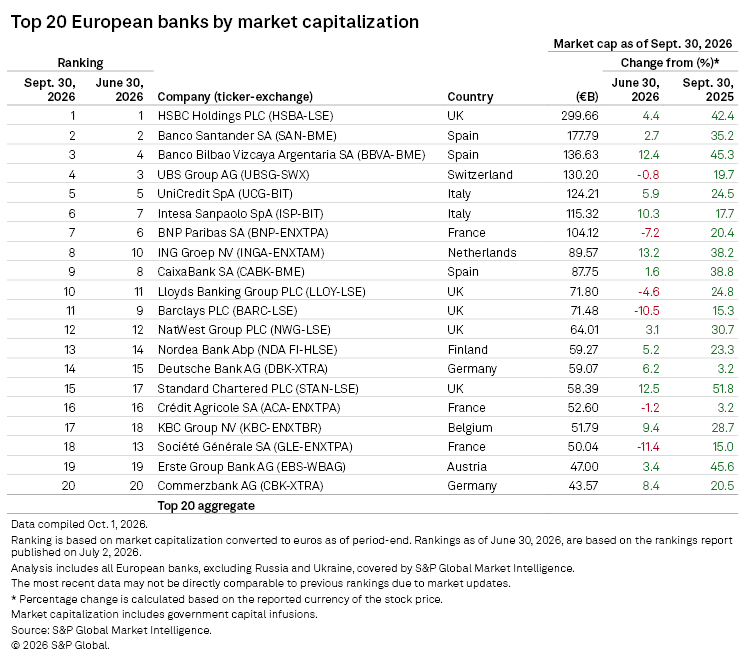
French macroeconomic headwinds helped erase the share-price gains SocGen saw in early August, which were driven by a second-quarter profit beat and the launch of a €1.5 billion share buyback. SocGen also unveiled its 2029 new strategy under which it targets a higher return on tangible equity goal and more cost savings.
In the UK, Barclays PLC
There have been growing industry fears of a UK bank tax hike, although Barclays' outgoing CFO Anna Cross has said a potential increase in UK bank taxes would have a "relatively small" impact on its earnings, and Lloyds CFO William Chalmers said it would have a "minimal impact" on medium-term targets.
New UK Chancellor John Healey reportedly invited the chiefs of the UK's biggest banks for an Oct. 6 pre-budget meeting. Media speculated that subsequent bank share price drops stemmed from fears of higher taxes.
Barclays' shares fell 4.7% on July 28 following the release of its second-quarter results, with analysts saying that the performance of the group's equities trading and prime brokerage were weaker than its Wall Street rivals.
Barclays anticipates higher costs for 2026, as it plans to raise investment banker bonuses and spend up to £300 million in the second half to simplify its tech platforms and processes, alongside other investments. In August, the company announced a shake-up of its investment bank, appointing Bank of America's Mike Joo as co-CEO alongside Adeel Khan, who leads global markets.
|
Swiss giant UBS Group AG booked a 0.8% dip in its market cap as the bank suffered another setback in its battle against tougher capital rules. A new parliamentary proposal requiring UBS to hold 90% of top-tier capital against its foreign subsidiaries would translate to about $16 billion in additional common equity Tier 1 capital demands, according to the group's estimates.
Against the grain
On a yearly basis, UK-headquartered Standard Chartered PLC
Other notable gainers include Austria's Erste Group Bank AG, HSBC, Dutch bank ING Groep NV and Spain-based CaixaBank SA.