05 Oct, 2026
Private equity leans more heavily on earnouts in exit deals
By Dylan Thomas and Shambhavi Gupta
The number of private equity earnout deal structures has hit the highest level in at least five years, as managers aim to narrow the buyer-seller divide and close exit deals.
The value of global private equity and venture capital exits featuring earnout provisions totaled $77.22 billion this year as of Sept. 28, surpassing any full-year total recorded since 2020, according to S&P Global Market Intelligence data.
Sales of private equity portfolio companies accounted for 42.5% of all earnout deal value through nearly three full quarters of 2026, their highest share since at least 2020.
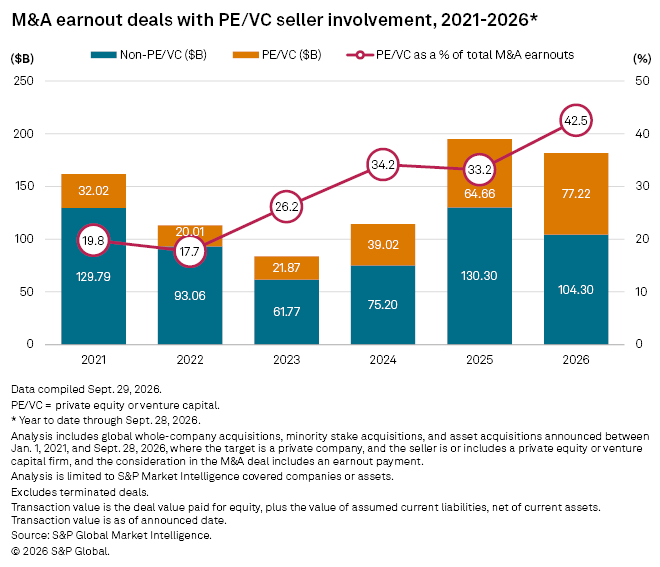
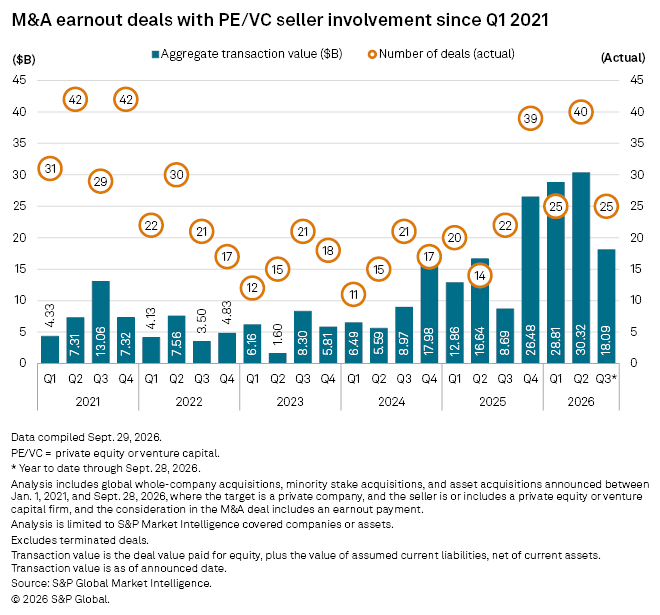
When private equity agrees to an earnout in the sale of a portfolio company, it gets only a portion of the agreed-upon purchase price at closing. The buyer agrees to make additional payments if the company hits future performance targets.
Private equity managers generally prefer a clean break with a portfolio company that allows them to return profits to investors and move on to the next deal, said Jalpit Amin, a partner in law firm White & Case LLP's global M&A practice. But they're increasingly relying on earnouts to close exits.
A host of factors, including the "unrealistic valuations" private equity managers paid several years ago to acquire businesses they're now ready to sell, as well as the threat of AI disruption looming over industries like software, are making it harder to achieve planned-on valuations at exit, he said.
"Earnouts are the easiest way to bridge that valuation gap, even though everyone ultimately ends up fighting [over them] down the road," Amin said.
Rolling the dice
Earnouts were a feature in 24% of private-target M&A transactions in 2025, up from 17% of deals during the 2014–2022 period, according to M&A advisory SRS Acquiom Inc. The data excludes deals in the life sciences industry, where earnouts are much more common due to issues such as regulation and commercialization of new medical developments.
While valuation gaps remain a primary motivation for earnouts, Kip Wallen, a senior director at SRS Acquiom, said buyers seem to be turning to earnouts for "risk abatement" against an uncertain macroeconomic backdrop.
"The uncertainty in the market makes it so difficult to value these targets," Wallen said. "How do you value a target that's susceptible to tariffs that are constantly being challenged in the courts? Or if you've got a company subject to diesel prices [or] any sort of petroleum or oil price fluctuation?"
Earnouts spread some of that risk to sellers, who rarely get a full payout. According to SRS Acquiom research, while sellers got some additional payments in more than half of deals with earnout provisions, buyers ultimately paid just over 21% of the maximum earnout value.
|
That's part of the reason private equity sellers are reluctant to rely on earnouts, said M&A attorney Jeremy Levy of Troutman Pepper Locke LLP. More common is a "sponsor rollover," where the exiting fund manager agrees to retain a minority stake, lowering the purchase price for the buyer.
"When a sponsor is exiting a platform, their objective is to return capital to their limited partners. They want as much cash as they can get all at once," Levy said.
Largest PE earnout deals
The health care sector accounted for eight of the 10 largest private equity or venture capital portfolio company sales to feature an earnout component this year through Sept. 28, according to S&P Global Market Intelligence data.
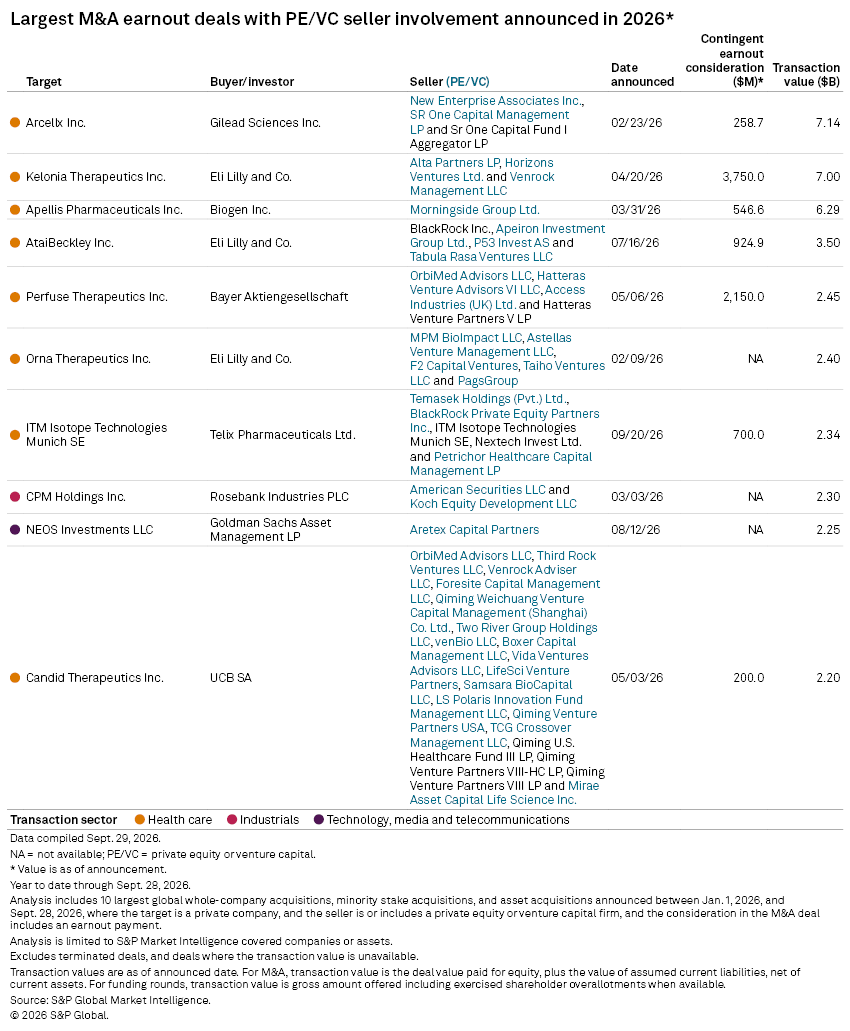
Topping the list was the $7.14 billion sale of clinical-stage biotechnology Arcellx Inc. to Gilead Sciences Inc. Former venture capital backers New Enterprise Associates Inc. and SR One Capital Management LP agreed to make roughly 4% of the exit transaction's value contingent on Arcellx achieving at least $6 billion in sales for its in-development cancer therapy by Dec. 31, 2029.
Over half the value of Alta Partners LP, Horizons Ventures Ltd. and Venrock Management LLC's $7 billion exit of clinical-stage biotech company Kelonia Therapeutics Inc. was tied up in an earnout. Acquirer Eli Lilly and Co. paid $3.25 billion at closing and agreed to make additional payments if Kelonia achieves future clinical, regulatory and commercial milestones.
Outlook
Amin said he expected earnout use in M&A to remain elevated for some time, given the way AI, rising energy prices and higher-for-longer interest rates are clouding the macroeconomic outlook — and the wedge all that uncertainty can drive between buyers and sellers.
"Earn-outs are going to be here for a while, at least until things stabilize," he said.