06 Oct, 2026
Most US bank stocks trade lower in September

By Robert Clark
US bank stocks diverged from the broader market following the Federal Reserve's interest rate increase on Sept. 16, which brought down sector valuations.
The market cap-weighted S&P US BMI Banks index returned 0.1% from Aug. 31 to Sept. 15, outperforming the S&P 500's negative 1.2% return. However, for the remainder of the month, the bank index fell 6.9%, while the S&P 500 rose 0.9%. For all of September, the bank index recorded a total return of negative 6.8% and the S&P 500 declined 0.3%.
In an S&P Global Market Intelligence analysis of 203 banks, the group had a median return of negative 3.5% in September. Only 15 of the 203 banks recorded a positive total return last month. Capital Bancorp Inc. was the top monthly market performer in the analysis, returning 8.8%. On the last day of the month, the Rockville, Maryland-based bank announced a sale to Marietta, Ohio-based Peoples Bancorp Inc.
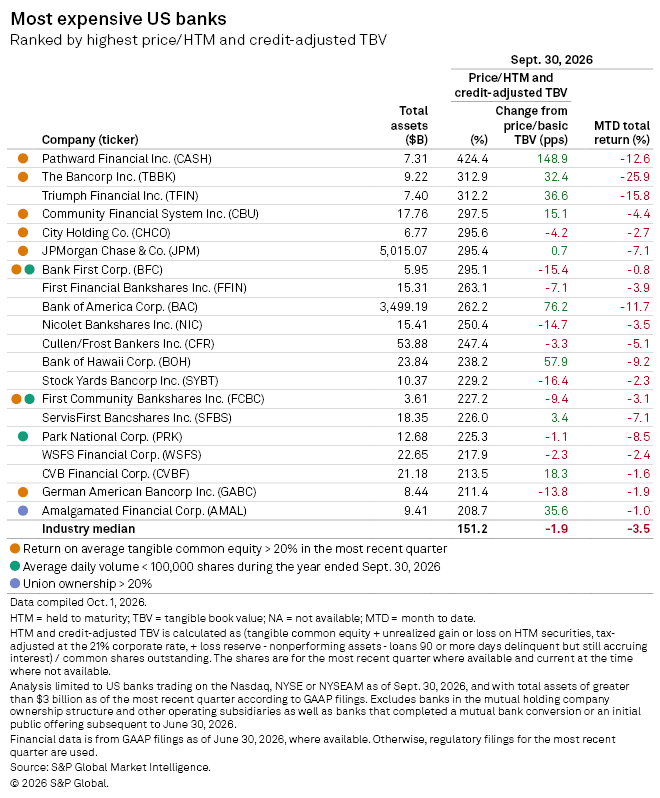
The median price to adjusted tangible book value (TBV) of the banks included in the analysis was 151.2% at Sept. 30, down from 156.8% as of Aug. 31, but up from 140.0% as of Dec. 31, 2025. Only 13 of the banks traded below 100% of their adjusted TBV, while 28 were above 200%.

S&P Global Market Intelligence analyzed US banks trading on the Nasdaq, NYSE or NYSE American with total assets of more than $3 billion. The analysis excludes banks in the mutual holding company ownership structure and other operating subsidiaries, as well as banks that completed a mutual bank conversion or an IPO subsequent to June 30, 2026.
Adjusted tangible book value is calculated as the sum of tangible common equity, loss reserves and unrealized gain or loss from held-to-maturity securities, tax-adjusted at the 21% corporate rate, less nonperforming assets and loans 90 or more days past due but still accruing interest, divided by common shares outstanding.

Least expensive banks
BCB Bancorp Inc. was the cheapest bank in the analysis for the third consecutive month, ending September with a price to adjusted TBV of 67.0%. It was one of the top market performers with a 0.5% monthly return. On Sept. 16, the Bayonne, New Jersey-based bank announced a slew of balance sheet maneuvers, including problem loan sales and a capital raise completed later in the month, which will significantly impact its third-quarter financial data.
In a Sept. 16 filing, BCB projected that those transactions could reduce its basic TBV per share to $7.75 as of Sept. 30 from $14.73 as of June 30. It also projected tangible common equity to tangible assets falling by 160 basis points to 6.95% and the loans-to-deposits ratio declining to 87.1% from 99.9%. BCB might not be eligible for the analysis as it estimated Sept. 30 total assets to be barely over the $3 billion threshold.
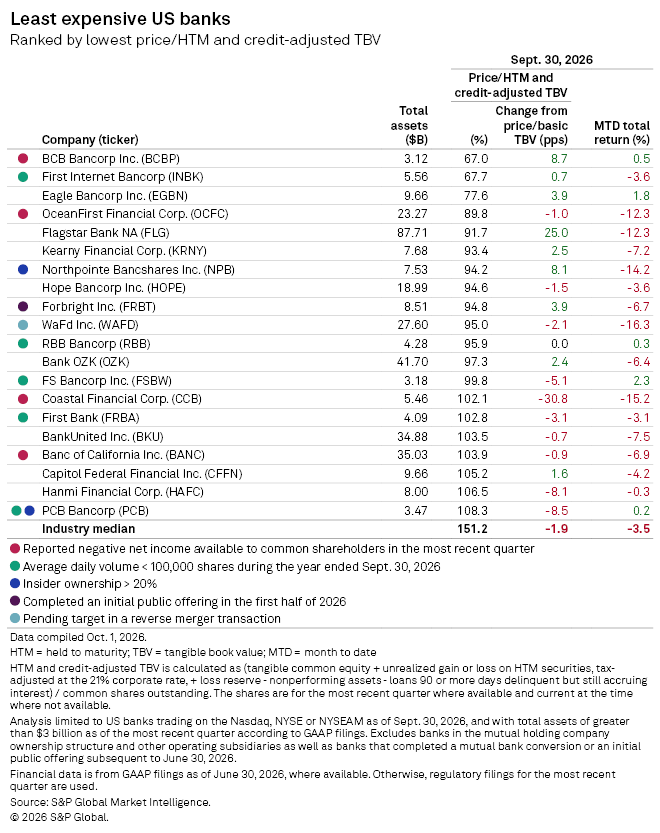
First Internet Bancorp ranked second for the lowest price to adjusted TBV at 67.7%. Its September total return was slightly worse than the industry median at negative 3.6%. Last month, the digital bank completed a private placement of subordinated notes.
Hicksville, New York-based Flagstar Bank NA, which had the fifth-lowest valuation, is starting to ramp up commercial real estate loan originations. Flagstar's negative 12.3% total return in September was the eighth-worst in the analysis.
No. 10 WaFd Inc.'s monthly return was the second-lowest at negative 16.3%. The Seattle-based bank announced a reverse merger transaction with Jacksonville, Florida-based EverBank Financial Corp. on Sept. 7. According to an investor presentation, the 2027 earnings-per-share accretion for WaFd, assuming fully synergized cost savings on a calendar-year basis, is estimated at approximately 29%. The TBV dilution is projected at approximately 8.6% with an earnback period of 2.0 years. The combined entity ranks as the 43rd-largest US bank based on pro forma total assets.
No. 14 Coastal Financial Corp., a banking-as-a-service (BaaS) institution, was another weak market performer last month, with the stock declining 15.2%. The catalyst was Morristown, New Jersey-based Valley National Bancorp's announcement of the acquisition of Coastal fintech partner Bluevine Inc. Among the banks in the analysis, Coastal recorded the highest return in August at 14.9% and the lowest return in July at negative 47.1%.
Banc of California Inc., ranked No. 17, has been a rumored takeover target, but analysts downplayed the chances of a deal happening in the near term. The Los Angeles-based bank's total return was negative 6.9% in September.
|
Most expensive banks
Despite a return of negative 12.6% in September, which was the sixth-lowest in the analysis, BaaS bank Pathward Financial Inc. ranked No. 1 for highest valuation for the third month in a row. As of Sept. 30, its price to adjusted TBV was 424.4%, down from 485.9% at the end of August, but more than 100 percentage points above any other bank analyzed. The company's President Anthony Sharett announced his resignation, effective Oct. 23.
The Bancorp Inc. was the weakest market performer last month with a negative 25.9% return, but remained the second-most expensive bank in the analysis. Most of the BaaS bank's stock price decline occurred on Sept. 9, following the announcement from the day before that its top fintech partner Chime Financial Inc. is acquiring Stride Bank NA parent Central Service Corp. Additionally on Sept. 8, another of The Bancorp's fintech partners, Block Inc., disclosed that it applied to the Office of the Comptroller of the Currency to establish an uninsured national trust bank. A week earlier, The Bancorp had unveiled a restructuring plan that would streamline the organization and result in a lower noninterest expense base.
No. 3 Dallas-based Triumph Financial Inc. and No. 9 Bank of America Corp. also posted monthly returns below negative 10%. Bank of America lowered its operating leverage guidance for 2026 and lost national deposit market share in the year ended June 30.