08 Oct, 2026
Italy's biggest banks enter megadeal danger zone


| M&A transactions involving Intesa Sanpaolo, UniCredit and Monte dei Paschi are set to reshape Italy's banking landscape. Source: Sean Pavone/iStock via Getty Images Europe. |
Italy's largest lenders face a period of uncertainty and elevated risk as they undertake a series of complex acquisitions that will transform the country's banking sector.
The country's three biggest banks — Intesa Sanpaolo SpA, UniCredit SpA and Banca Monte dei Paschi di Siena SpA (MPS) — are all engaged in M&A bids larger than any executed since the 2008 global financial crisis, according to S&P Global Market Intelligence data.
The proposed transactions face a series of significant hurdles, including political and regulatory resistance, shareholder opposition and complicated integrations of the target businesses.
"Each deal presents its own risks, challenges and rationale," Fabio Ianno, vice president, senior credit officer, Moody's Ratings, said in an interview.
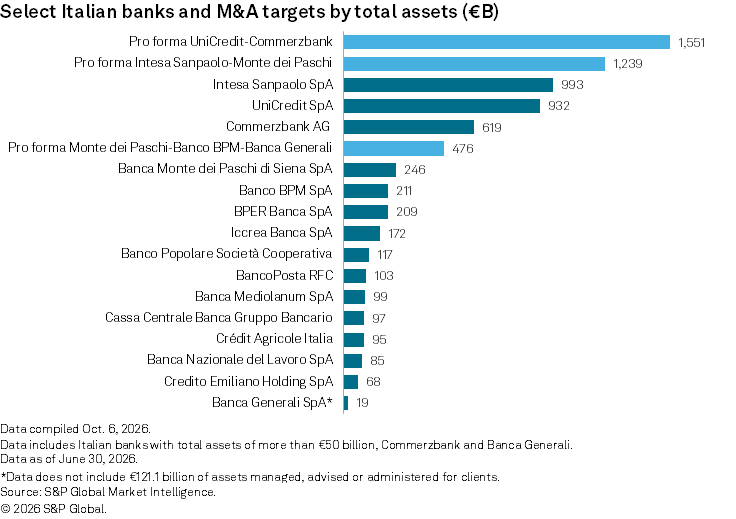
Intesa, Italy's largest lender by total assets, made a €31.4 billion offer
MPS, in response to Intesa's move, is proposing a €34 billion double deal for domestic peers Banco BPM SpA and Banca Generali SpA. Meanwhile, UniCredit is closing in on a €40 billion deal for German lender Commerzbank AG.
The nature and scale of the deals differ significantly from recent M&A undertaken by Italian lenders, Luigi Capitanio, EMEA strategy and business design leader, banking and capital markets leader for Deloitte Central Mediterranean, said in an interview.
Italian banking M&A was for many years characterized by "consolidation aimed at trying to survive," Capitanio said. "The market is now seeing transactions that are more transformative in nature with the intention to develop more diversified and more modern business models," he added.
The most obvious risk to Intesa and MPS's bids is that only one of the banks can succeed. MPS is hoping that a successful move for one or both of BPM or Banca Generali will kill Intesa's interest due to the increased complexity the businesses would bring to MPS's footprint and the intensification of already sizable antitrust issues faced by Intesa's bid.
Intesa said it will drop its offer for MPS if investors approve either of the bank's bids at an Oct. 29 meeting. The warning was issued on Oct. 3 alongside an €800 million increase of its offer for MPS.
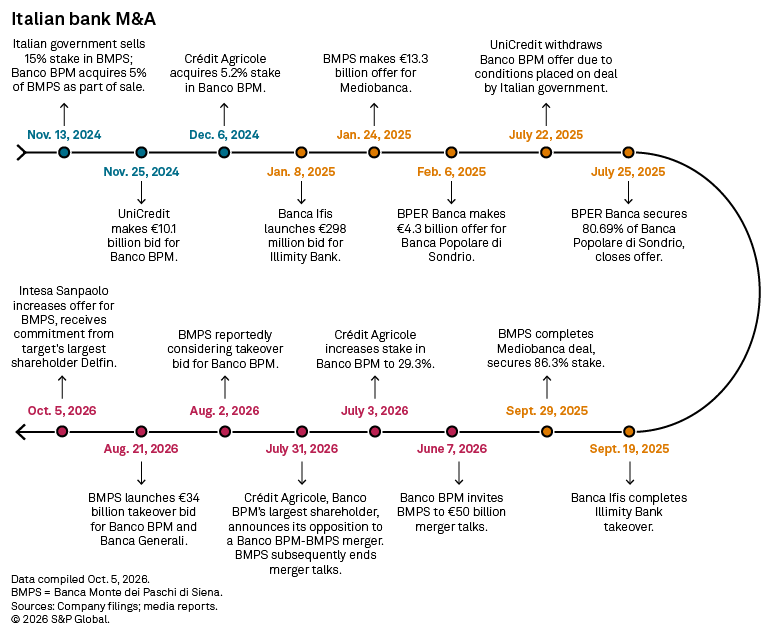
MPS's task of securing the requisite support — two-thirds of the vote represented at the meeting — for the deals will be difficult, said Luigi Tramontana, Italian bank equity analyst at Kepler Cheuvreux.
"Monte dei Paschi's shareholder base is fragmented, divided, so getting a majority will be extremely difficult," he said in an interview. "Some big shareholders are commenting against the proposed deals because they prefer Intesa's offer."
Delfin, MPS's largest shareholder with 17.6% of the bank's capital, has already agreed to tender its shares to Intesa, the bank announced in a separate Oct. 3 statement.
If MPS can survive Intesa's improved offer, it must then convince BPM's largest shareholder, Crédit Agricole SA, to support the takeover. Crédit Agricole, which owns almost 30% of BPM
"I'm not sure Monte dei Paschi's bid for BPM will succeed," Gilles de Bourrousse, senior fixed income analyst, financials at Paris-based Octo Finances, said in an interview. "Crédit Agricole's stake would be diluted to around 10% of the new enlarged group, while the transaction would do little to enhance its strategic position in Italy."
MPS's ongoing integration of Mediobanca Banca di Credito Finanziario SpA and its history with M&A also raises questions about its ability to successfully absorb two more institutions simultaneously, de Bourrousse added. MPS's purchase of Banca Antonveneta SpA just before the 2008 financial crisis resulted in the near-collapse of the world's oldest lender, requiring repeated government bailouts before its recent recovery.
"The bank's track record in executing acquisitions of this size and complexity remains limited," de Bourrousse said.
Intesa's tests
For Intesa, MPS's offers for BPM and Banca Generali further complicate an already ambitious move for the Tuscan lender. To address antitrust issues, Italy's largest lender's bid for MPS involves offloading more than half of MPS's retail banking branch network to BPER Banca through a purchase agreement with Italian insurance giant Unipol, which will take a larger stake in BPER in exchange.
Even with this pre-emptive breakup of MPS, Intesa could still face regulatory pushback, Arnaud Journois, senior vice president, European financial institution ratings at Morningstar DBRS, said in an interview.
"Considering the deal would create probably one of the largest banks in the eurozone, one of the key obstacles is regulators' approach to such a large group in a European context," he said.
A successful acquisition of MPS would shift focus to Intesa's financial rationale for the deal, which is optimistic, said Tramontana. Around 50% of the synergies outlined in the takeover are derived from revenue, which tend to be more dependent on external factors beyond management control, like the macro and market environment in which the bank is operating, he said.
"If there is a weak point in the proposed deal, it's represented by the revenue synergies, which are very aggressive," Tramontana added.
|
German opposition
UniCredit's purchase of Commerzbank, the most progressed of the three Italian megadeals, still has significant hurdles to address before CEO Andrea Orcel can declare victory. The bank has gradually built a 48% stake in the Frankfurt-based lender since 2024, most recently acquiring 17.6% of Commerzbank's shares in a voluntary public exchange offer that launched in March.
While the stake gives UniCredit de facto control of Commerzbank, the failure of the offer to secure a larger share of Commerzbank's capital reflects significant opposition to the takeover from Commerzbank's management and shareholders, as well as the German government, which owns 13.3% of the bank.
The German government is demanding that Commerzbank remain listed, maintain its headquarters in Frankfurt and preserve its role in financing German midsized companies, while German workers' unions have warned that UniCredit's failure to convince employees of its plans threatens the prospect of a smooth transition.
"Converging these interests is the trickiest part, putting everything to a common goal to ensure this is going to be positive for all the different parts," Nicola De Caro, senior vice president, European financial institution ratings at Morningstar DBRS, said in an interview.
Nasty surprises
The ongoing fallout from domestic peer Banca IFIS SpA's recent takeover of illimity Bank SpA should also offer a valuable reminder to Italy's three largest lenders about the risks that remain from M&A once a deal is done.
Ifis in September said it would be required to write down a further €170 million of non-performing loans at Illimity following a central bank inspection. This came days after the bank's CEO resigned and brought total writedowns, adjustments and financial impairments to around €400 million
Nasty surprises such as unexpected credit losses and litigation risk, which prevented banks from buying MPS during its most vulnerable years, are a perennial danger in banking M&A, said Ianno.
"What can be a little bit more worrying are implications that the bank did not foresee," he added. "This has happened very often in bank acquisitions."