21 Oct, 2026
India's IPO market rebounds as large equity offerings draw investor interest
By Yuvraj Singh and Beenish Bashir
India's IPO market rebounded in the July-September quarter, and activity is expected to continue for the rest of the year with the country's largest-ever share sale open from Oct. 21 until Oct. 23.
Jio Platforms Ltd., the digital and telecommunications unit of Reliance Industries Ltd., India's largest company by market capitalization, is seeking to raise more than 300 billion Indian rupees, making it the largest IPO in the country's history. Mukesh Ambani, Asia's second-richest businessperson and the chairman of the vast energy-to-telecommunications conglomerate, is the majority owner of Jio Platforms.
Other major IPOs expected to launch in the current quarter include two companies backed by Walmart Inc.: payments app PhonePe Ltd. and e-commerce platform Flipkart Internet Pvt. Ltd. Quick-commerce platform Zepto Ltd., which previously delayed its listing, is also expected to launch an IPO soon.
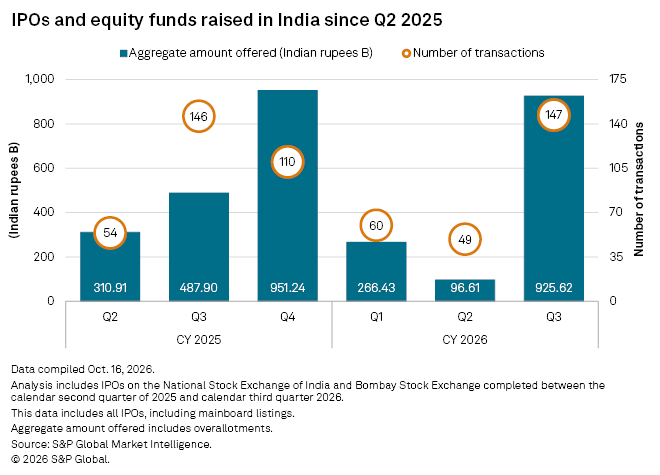
IPO activity picked up in the third quarter with 147 companies raising more than 925 billion rupees, according to S&P Global Market Intelligence data. The first half of 2026 was relatively subdued, with 60 IPOs in the first quarter and 50 in the second quarter, according to data.
"In the first half of 2026, India's capital markets experienced some strain caused by uncertainty regarding the global economy, constant withdrawal of foreign investments and worries about high valuations. Hence, investors became more choosy and companies started reassessing the prices and timing of their IPOs," said Piyush Jhunjhunwala, founder and CEO of trading platform Stockify.
"The bounce back in the third quarter was a result of ample liquidity in the domestic market, an active IPO process and improved price discipline," Jhunjhunwala told Market Intelligence on Oct. 16.
A healthy pipeline in the coming quarters
Equity fundraising in India and several other Asian economies has been dented by the US-Israel war with Iran, which added to geopolitical uncertainty and sent energy prices soaring. India, the most populous country in the world, imports most of its crude oil. Still, the country remains the fastest-growing among the world's major economies. GDP grew by a surprising 7.8% in the April-June quarter and the nation's central bank expects GDP to grow 7.1% in the current fiscal year ending March 31, 2027.
More than 250 companies filed draft offer documents between April and September across the mainboard and small and medium-sized enterprise platforms. An increasing number are also choosing the confidential filing route, said Chintan Hefa, executive director at Grant Thornton Bharat, in comments to Market Intelligence. Hefa specializes in IPO and capital markets advisory.
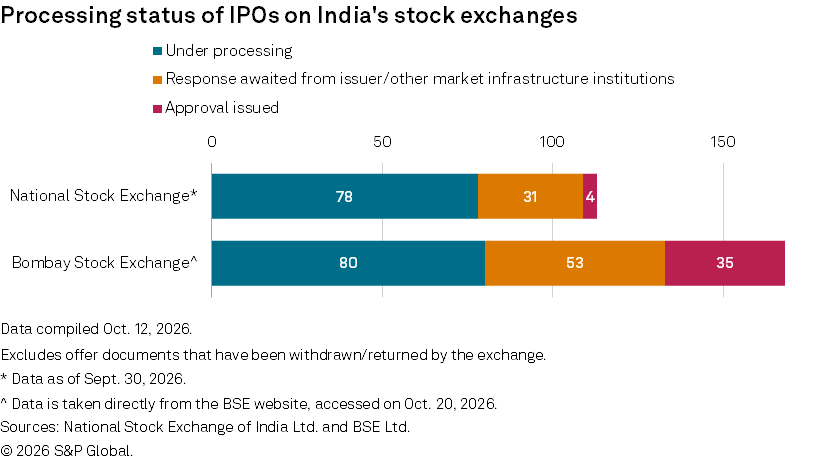
As many as 113 IPOs are at various stages of approval on the National Stock Exchange, while 168 are pending on the BSE Ltd., after a tepid first half of 2026.
"Geopolitical uncertainty and the spike in crude prices after the US–Iran conflict broke out in late February weighed heavily on investor sentiment through the first half of 2026 and the primary market felt it acutely," said Smita Mazumdar, a professor at the Great Lakes Institute of Management.
Foreign investors withdrew funds from emerging markets such as India in favor of safer overseas assets. "Foreign sovereign and institutional investors are among the largest participants in pre-IPO placements and anchor books, so their presence sets the tone for wider subscription levels," Mazumdar said. When these investors withdrew their money, much of the support underpinning large equity offerings was lost.
A strong 2025 was followed by a market lull
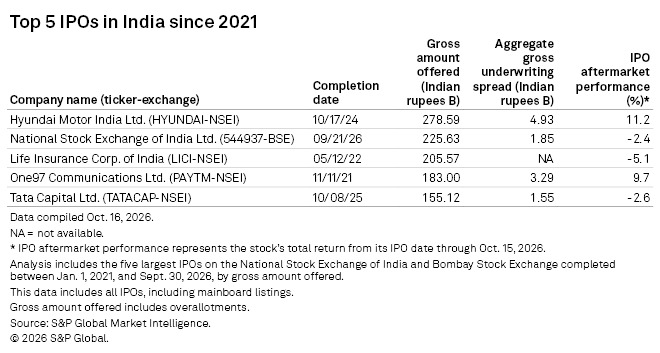
Nonbank lender Tata Capital Ltd. raised 155 billion rupees in August 2025, while ICICI Prudential Asset Management Co. Ltd. raised 106 billion rupees in December. Popular start-ups, including eyewear company Lenskart Solutions Ltd., Billionbrains Garage Ventures Ltd., the parent company of the digital investment platform Groww Invest Tech Pvt. Ltd., and e-commerce platform Meesho Ltd., also went public during the period.
|
IPO activity then entered a lull due to geopolitical uncertainty, before several companies returned to tap the markets in the third quarter to meet a regulatory deadline and rising demand for several marquee offerings.
The approval for IPOs by the market regulator, the Securities and Exchange Board of India, is usually valid for 12 months. As several companies were unable to meet the deadline due to the uncertainties and market weakness, the regulator granted a one-time extension under which approvals expiring between April 2026 and September 2026 remained valid until Sept. 30.
"The relief was sensible, but it also removed some of the urgency to launch, which deepened the lull in the first half of the year," Mazumdar said. "As the September deadline approached, that deferred supply came to market all at once."
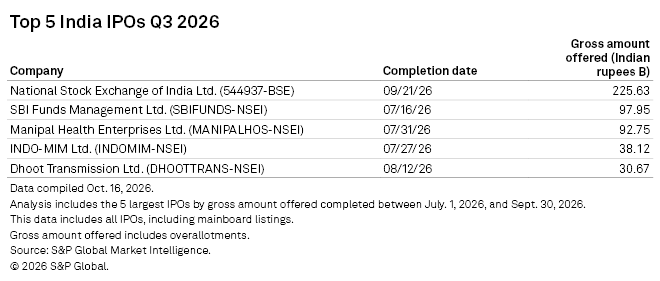
Two of the year's most anticipated offerings before Jio Platforms were SBI Funds Management Ltd. in July and the National Stock Exchange of India Ltd. (NSE) in September. SBI Funds, the asset-management arm of State Bank of India, raised about 98 billion rupees, while NSE raised more than 225 billion rupees.
"Their strong reception showed that large, high-quality issues could still attract deep demand, and it gave the wider pipeline the confidence to come to market," Mazumdar said.
Foreign outflows contrast with strong IPO demand
"Foreign institutional investors invested approximately 449.60 billion rupees in the primary market during the first half of fiscal 2027, while selling about 1.64 trillion rupees of secondary-market equities," Stockify's Jhunjhunwala said. "Certain companies that are well-positioned for growth attracted interest even amid uncertainty in the secondary market."
Among the largest IPOs in the third quarter, SBI Funds and NSE were entirely offer-for-sale transactions by promoters and private equity investors, with no fresh shares issued. SBI and Amundi India Holdings sold their stakes in SBI Funds, while a group of investors sold shares in NSE.
About 60% of the funds raised through main board IPOs in 2026 so far have come through offer-for-sale transactions, according to Mazumdar.
"This is not entirely good news for the wider economy at a time when private capital expenditure has been slow to pick up," Mazumdar said. "When IPO proceeds mainly go to selling shareholders, they fund exits rather than new productive capacity or expansion."
However, there are risks to the primary market, with analysts questioning whether all the companies seeking to list are ready.
"A large pipeline is not the same as a ready pipeline," Grant Thornton Bharat's Hefa said. "With global risks still high, market windows can open and close quickly, approvals can lapse and financial statements can go out of date."
Analysts expect investors to focus on companies with transparent governance, predictable cash flows and credible expansion plans. "Geopolitics will continue to affect pricing, but in the coming quarters, I expect the quality of an IPO, more than its timing, to determine its valuation," Hefa said.
As of Oct. 21, US$1 was equivalent to 94.37 Indian rupees.