08 Oct, 2026
Global private equity exit volume falls 17.4% in Q3 as valuation gap persists
Global private equity and venture capital exit volume fell 17.4% year over year in the third quarter, declining to 724 transactions from 876, according to S&P Global Market Intelligence data.
On a quarter-over-quarter comparison, total exit volume fell 4.1% from 755.
Total exit value stood at $227.17 billion, up 5.4% year over year but down 1.8% quarter over quarter.
|
|
In the first nine months ended Sept. 30, total exit volume stood at 2,304, down 6.0% year over year from 2,452 in the same period of 2025, while total exit value rose 55.6% to $918.39 billion from $590.10 billion.
|
|
The valuation gap between buyers and sellers remains the core bottleneck for private equity exits, said Brendon Parry, head of private markets at asset manager TIFF Investment Management.
Disagreements also extend to the durability of target company earnings, particularly in the software sector, he added.
"Every software company now must answer 'disruptor or disrupted?' before anyone discusses price. A lower price doesn't necessarily resolve uncertainty about the durability of the business model," Parry said.
The AI impact
AI is creating uncertainty for software companies. Tools such as Claude Cowork and Claude Code are causing investors to reassess the future of some software-as-a-service companies, said Louis Lehot, a partner in the private equity and venture capital practice at law firm Foley & Lardner LLP.
"Unless the business is genuinely AI-first, has a system of record, and has single-sourced proprietary data, buyers are fewer and further between," Lehot said.
Software is not the only sector affected by AI, as buyers are increasingly favoring companies with lower exposure to AI-driven obsolescence, including businesses in the information technology and industrials sectors.
|
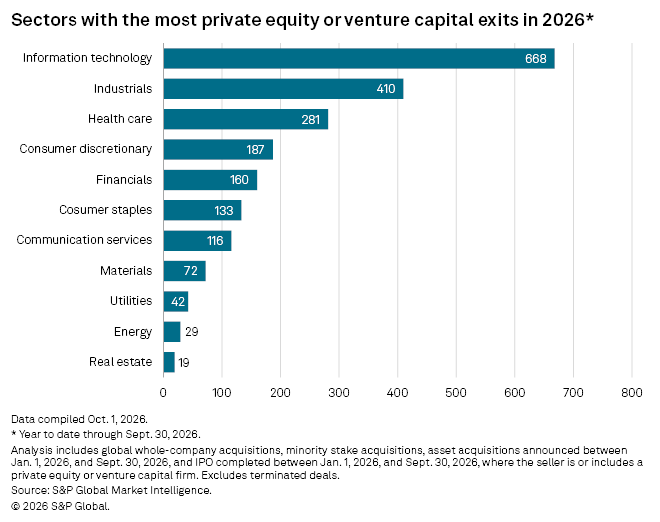
Information technology and industrials recorded the highest number of exits in the first nine months ended Sept. 30, with 668 and 410 transactions, respectively, according to Market Intelligence data.
"Buyers are looking for certainty, stability, and growth prospects. [These] sectors demonstrate these characteristics particularly when compared to other sectors with greater risk of AI disruption," said Peter White, principal, at private equity firm GenNx360 Capital Partners.
IT services, driven by enterprise demand for AI implementation, cloud computing and cybersecurity, have been attracting buyer interest. Industrial and specialty services, including testing, inspection and maintenance, are also acquisition targets because these businesses generate recurring revenue with lower capital intensity, White said.
Top private equity exits
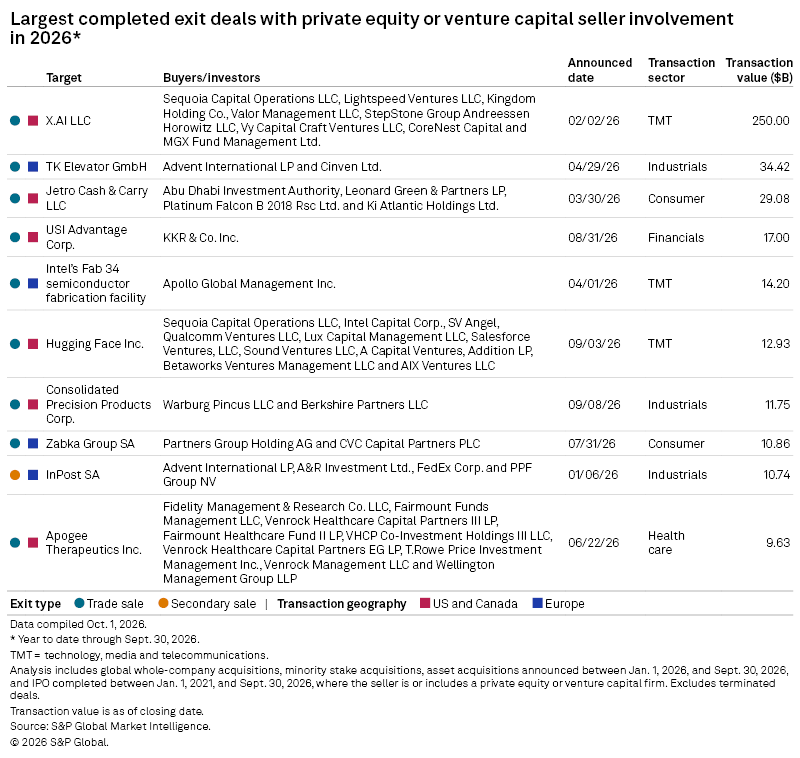
Buyer interest in AI was evident among the largest exits through Sept. 30, led by the $250 billion sale of X.AI LLC to Space Exploration Technologies Corp. The selling investor group included Sequoia Capital Operations LLC, Lightspeed Management Co. LLC, Valor Management LLC and StepStone Group Inc.
Hugging Face Inc., another AI company, was acquired by NVIDIA Corp. from an investor group that included Intel Capital Corp., Qualcomm Ventures LLC, Lux Capital Management LLC and Betaworks Ventures Management LLC.
Both exits were completed through trade sales.
Trade sales dominate
Trade sales remain the preferred exit route, accounting for 548 exits, or 75.7% of total exit volume, in the third quarter, according to Market Intelligence data. Corporate strategic buyers can often realize synergies that financial sponsors cannot, enabling them to justify higher valuations, said Charlie Newman, managing director at management consulting firm Protiviti UK.
"They also tend to offer greater execution certainty and a simpler transaction process than public market exits," Newman said.
General partner-led secondary sales and initial public offerings are gaining momentum, with 160 secondary sales and 16 IPOs in the third quarter, up from 149 and 14, respectively, in the previous quarter, according to Market Intelligence data.
The rise in sponsor-to-sponsor transactions reflects the substantial capital available to private equity buyers and their increasing willingness to support longer-term value-creation plans, Newman said. Exits through IPOs are showing signs of recovery amid stabilizing equity markets and renewed investor confidence in growth-oriented businesses, Newman added.
Year over year, the number of IPO exits in the third quarter rose to 16 from 13, according to Market Intelligence data.
IPO exits remain concentrated among very large companies, however, and are still less accessible to middle-market and upper-middle-market private equity-backed businesses, said Alan Goldfarb, managing partner at private equity firm Orangewood Partners LLC.
Pressure from limited partners to receive distributions is expected to drive exits.
"Fundraising is pacing down meaningfully, and pressure to return capital ahead of the next fundraise should encourage more pragmatic selling decisions," Parry said.