15 Oct, 2026
Glencore deal, government support drive PE investment in critical raw materials
Global private equity and venture capital investment in critical raw materials totaled $9.43 billion in the first nine months of 2026, surpassing the full-year 2025 total of $1.34 billion, according to S&P Global Market Intelligence data.
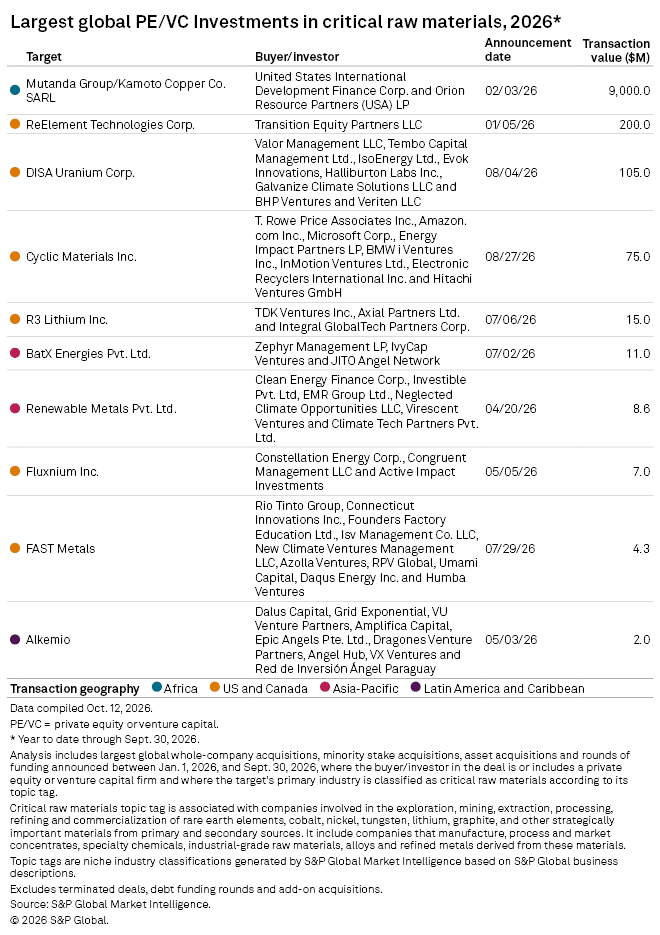
A single deal, Glencore PLC's proposed $9 billion sale of a 40% stake in Mutanda Mining Sarl and Kamoto Copper Co. Sarl in the Democratic Republic of Congo to the Orion Critical Mineral Consortium, which includes Orion Resource Partners (USA) LP, accounted for the surge in deal value in 2026.
Government support, particularly through mechanisms such as offtake agreements, price floors, development finance and sovereign co-investment, is driving more capital in the sector, said Jason Holt, managing partner at Orion Industrial Ventures. "[These] are helping to de-risk major transactions in ways that were not possible a few years ago."
Offtake agreements secure buyers for future production, while price floors guarantee minimum prices for output.
The US, for example, was supporting more than $30 billion in critical minerals projects through letters of interest, investments, loans and other forms of assistance as of February, according to State Department data. The department said the support helped mobilize private capital for mining, processing and recycling projects in the US and overseas.
In November 2025, ReElement Technologies Corp. announced that the expansion of its recycling and processing capabilities was supported by an $80 million direct loan from the Office of Strategic Capital, an office within the US Department of Defense. Two months later, in January 2026, the company received a $200 million investment from Transition Equity Partners LLC, according to Market Intelligence data.
The report includes companies engaged in the exploration, mining, extraction, processing, refining and commercialization of rare earth elements, cobalt, nickel, tungsten, lithium, graphite and other strategically important materials from primary and secondary sources.
It also includes companies that manufacture, process or market related concentrates, specialty chemicals, industrial-grade raw materials, alloys and refined metals.
|
The US attracts capital
The US accounted for 28.5% of global private equity investment in critical raw materials announced between 2021 and the end of September 2026, with cumulative investment in the US reaching $4.4 billion, according to Market Intelligence data. It was the second-largest market globally by cumulative deal value.
Industrial policy, national security concerns and long-term demand from electrification and advanced manufacturing are driving investment in the US critical raw materials sector, said Francesca Price, senior principal analyst at S&P Global Energy Horizons.
"The combination of an unusually strong level of public sector support and growing concern over China's supply-chain dominance has materially improved the risk-reward profile for US projects," Price said.
Concerns over China's dominance have increased investor interest in rare earths and graphite, particularly because China controls much of their processing capacity, Price said.
Other US critical minerals that continue to attract investment include lithium, because of its importance to electrification, according to Price.
R3 Lithium Inc., an operator of a lithium recycling and refining facility in the US, secured a $15 million investment from Axial Partners Ltd., Integral GlobalTech Partners Corp. and TDK Ventures Inc. in July.
Copper offers a significant opportunity
Copper presents a significant opportunity over the long term, given rising demand from electrification, grid expansion and data center development, said Brian Greeley, CFO for critical minerals at private equity firm Appian Capital Advisory LLP.
New copper supply in the global market, however, is constrained by declining ore grades and lengthy project development timelines.
"Closing that gap [between demand and supply] will require substantial new investment, and we expect long-term investors to play a growing role in funding it," Greeley said.
Copper's investment appeal extended beyond the US, as Africa, a major global copper-producing region, accounted for 95.5% of private equity investment value in critical raw materials in 2026, according to Market Intelligence data.
Mutanda Mining and Kamoto Copper Co., the targets of the largest private-equity-backed critical raw materials deal announced through the end of September 2026, are based in Africa, making the region the largest market by private equity investment value in 2026. Africa's entire market share is attributable to this single transaction; excluding it, the region would have no recorded private equity investment.
Africa's abundant geological resources and the growing focus among governments and domestic industrial companies on developing local value chains are helping drive investment in the region, said Holt.
"We are also seeing growing interest in battery materials and specialty chemicals
Holt also expects investment momentum to continue in Latin America, where several countries recently signed a joint declaration on strategic minerals and regional integration.
Argentina-based Alkemio secured $2 million from investors, including Dalus Capital, Grid Exponential, VU Venture Partners, Amplifica Capital, Dragones Venture Partners and VX Ventures, to support the development of next-generation rare-earth refining technologies.
Investment in critical raw material refining, separation, manufacturing and recycling is expected to increase over the longer term as companies work to close strategic supply-chain gaps, Price said.