14 Oct, 2026
Fed rate hikes complicated by AI spending immune to higher borrowing costs

By Brian Scheid
The Federal Reserve's push to fight persistently above-target inflation with higher interest rates could be undermined by the wave of AI investment that is driving US economic growth and may also be immune to incremental increases in borrowing costs.
As Fed officials weigh the likelihood of one or two more 25-basis-point hikes to their benchmark federal funds rate after hiking in September for the first time since July 2023, economists are questioning the effectiveness of rate shifts within an AI economy.
"AI is not sensitive to interest rates because most investors in AI expect returns of 10%, 20%, sometimes 30%," said Torsten Slok, chief economist at Apollo Global Management. "From this perspective, it doesn't matter if the Fed hikes 25 bps because the expected return on AI is expected to be so much higher than the level of the fed funds rate."
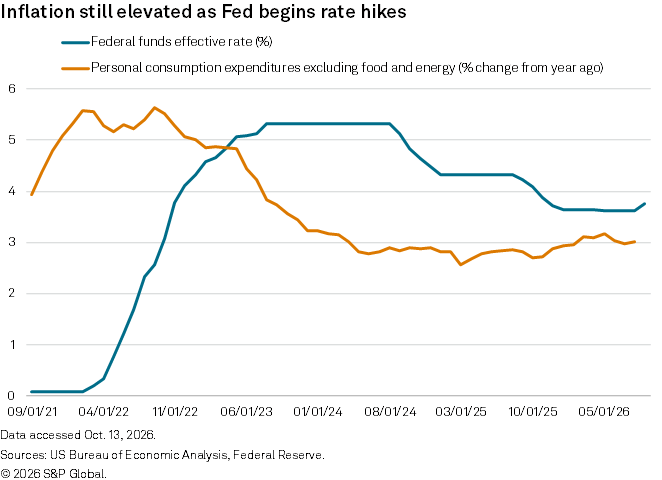
The rate-insensitive AI boom is causing an economic phenomenon when rapid growth in one sector tends to lead to declines in other sectors, Slok said. In this case, AI is likely draining capital and labor from sectors such as housing and automobiles, which will likely be hit harder as rates are hiked further.
The Fed's latest expected rate hike cycle is underway as companies are pouring an unprecedented amount of capital into AI projects, including data centers, power systems, networking infrastructure and specialized chips.
Financing this building will total an estimated $10.3 trillion from 2025 to 2032, about 3.6% of US gross domestic product per year, according to a new paper from Stijn Van Nieuwerburgh, an economist and professor at Columbia Business School.
"The projected build-out would be larger relative to the economy than the major US canal, railroad, electrification, highway, and telecommunications booms," Nieuwerburgh wrote. "It would double the electricity consumption of the entire US residential sector."
This AI boom appears similar to previous technological supercycles driven by the emergence of a new general-purpose technology, with investors piling money into this new technology amidst speculative euphoria and surging stock market prices, said Julius Probst, senior economist at Appcast.
While additional rate hikes could ultimately trigger a sell-off in equities, potentially causing a slowdown in AI investment and debt financing, this is unlikely to happen anytime soon, Probst said.
"What I deem more plausible is that other sectors of the economy slow down or break first as interest rates continue to rise, which would require the Fed to reverse course, or at least pause hikes," Probst said.
On Oct. 13, about 70% of the futures market was betting on one more 25-bps hike before year-end, with close to 20% betting on two hikes and the rest betting the Fed will hold rates steady into 2027, according to CME FedWatch.
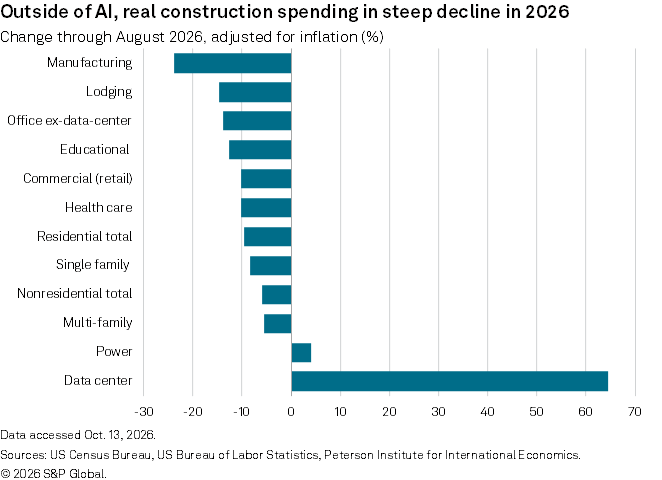
While the Fed has only made one hike, these higher rates may already be limiting investment in sectors outside the AI boom, with construction investment negative in all non-AI and energy projects.
"Resources that have been allocated toward this boom have increasingly been missing elsewhere," Probst with Appcast said. "Interest rates are already having a clear negative effect on several sectors in the economy. Growth is holding up because the AI investment boom is more than offsetting the weakness elsewhere."
Higher rates could ultimately catch up to AI investment, but with strong balance sheets to counter the rise in rates, hyperscalers will likely avoid any significant pain from the Fed tightening borrowing conditions, said Oren Klachkin, a financial market economist at Nationwide.
"We're in the very early innings of the AI build-out and its implications for economic growth and the labor market," Klachkin said. "Overall, I'd say high interest rates pose comparatively less of a risk to consumer spending than business investment, within which non-AI spending is most at risk."