Several high-stakes congressional races and ballot initiatives across the US this election cycle are set to reshape energy policy, with data center power demands and the balance between fossil fuels and renewable energy resources emerging as defining issues on the ballot.
Candidates on both sides of the aisle for the US midterm elections are grappling with how to manage surging electricity demand from data centers while protecting residential ratepayers. This dynamic could redraw commodity trade flows for natural gas, reshape renewable energy procurement and alter the regulatory environment for major utilities.
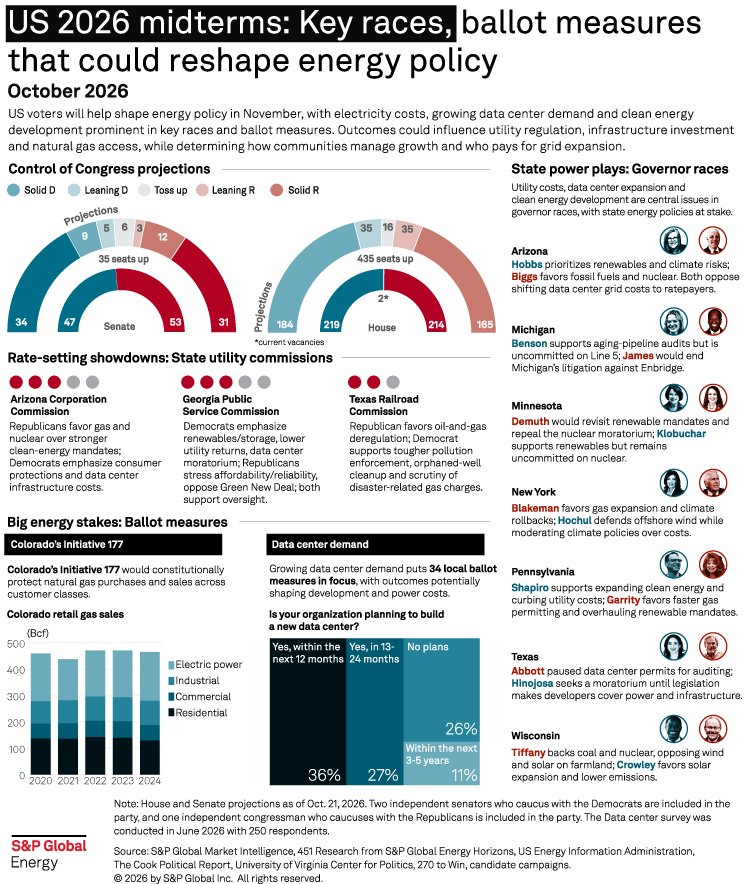
Republicans are seeking to preserve their narrow control of Congress, while Democrats are fighting to expand their ranks and capture one or both chambers. The GOP holds a 53-47 Senate majority, leaving Democrats needing a net gain of four seats for control, and Republicans enter the election with only a slim edge in the US House of Representatives.
The following highlights key congressional races and ballot measures relevant to energy markets:
US Senate races
Alaska
Overview: Republican Senator Dan Sullivan faces former Democratic Representative Mary Peltola in one of the cycle's most competitive statewide races.
Energy impact: Sullivan has touted his record on expanded oil and gas drilling, while Peltola has tried to tie him to higher energy prices and US President Donald Trump's foreign policy decisions.
Michigan
Overview: Democrat Abdul El-Sayed and Republican Mike Rogers are competing for Michigan's open Senate seat.
Energy impact: El-Sayed says new data centers should meet enforceable conditions, including local rate protections. Rogers supports a temporary state-level pause on development but opposes a federal moratorium.
North Carolina
Overview: Michael Whatley, former chairman of the Republican National Committee, faces Democrat Roy Cooper, a former governor of the state, in one of Democrats' top pickup opportunities.
Energy impact: Both candidates oppose the idea of implementing a federal ban on new data centers. Cooper backs municipalities' right to halt development, while Whatley argues the facilities should not receive special subsidies.
Ohio
Overview: Republican Senator Jon Husted and former Democratic Senator Sherrod Brown are facing off in a closely watched special election. Husted was appointed to complete JD Vance's term when Vance became vice president.
Energy impact: Husted is the lead Senate sponsor of the Ratepayer Protection Act, which passed the US House but stalled in the US Senate. Brown has criticized Husted's past support for data center development as Ohio's lieutenant governor.
Texas
Overview: Republican Attorney General Ken Paxton faces Democratic state Representative James Talarico to succeed Republican Senator John Cornyn, whom Paxton defeated in a primary election.
Energy impact: Paxton says large loads should add generation and pay for grid upgrades, while Talarico has highlighted Paxton's campaign finance disclosures showing contributions from data center-aligned donors.
US House races
California-13
Overview: Democratic Representative Adam Gray faces Republican Kevin Lincoln in a closely watched Central Valley district.
Energy impact: Gray serves on the House Natural Resources Committee. A Democratic House majority would likely elevate the panel's oversight role.
Colorado-8
Overview: Republican Representative Gabe Evans is seeking a second term against Democratic state Representative Manny Rutinel.
Energy impact: Evans serves on the House Energy and Commerce Committee and co-authored the House-passed Ratepayer Protection Act. The race could test voter support for bipartisan efforts to address electricity costs and data center demand.
Florida-14
Overview: Democratic Representative Kathy Castor faces Republican state Senator Mike Beltran in a competitive Tampa-area race.
Energy impact: Castor is the ranking member on the House Energy and Commerce Committee's Subcommittee on Energy and would gain influence over the panel's agenda if Democrats win the House.
Iowa-1
Overview: Republican Representative Mariannette Miller-Meeks faces Democratic former state Representative Christina Bohannan in a rematch of one of the nation's closest House races.
Energy impact: Miller-Meeks serves on the House Energy and Commerce Committee and represents a state with wind and biofuels interests. A Democratic takeover would shift the panel's focus toward oversight.
Virginia-2
Overview: Republican Representative Jen Kiggans faces former Democratic Representative Elaine Luria in a high-profile Hampton Roads rematch from 2022, when Kiggans first defeated Luria.
Energy impact: Kiggans serves on the House Natural Resources Committee and supports Dominion Energy Inc.'s Coastal Virginia Offshore Wind project. Control of the seat could affect Democratic oversight of offshore wind and permitting.
Ballot initiatives
Ann Arbor, Michigan, Proposal E
Overview: The measure would amend the city charter to require the creation of a municipal electric utility and an oversight board, replacing DTE Energy Co. as the city's power provider. The city council opposes the measure and has challenged its legality, citing potential costs of more than $1 billion. Supporters dispute that estimate and say the proposal would not require the city to buy DTE assets.
Energy impact: Approval could begin a lengthy effort to separate from DTE and shift control of rates, reliability and clean-energy procurement to a public utility. The measure could also encourage similar municipalization campaigns elsewhere in Michigan, raising financial and operational risks for investor-owned utilities.
California Proposition 45
Overview: The measure would impose deadlines on public-agency permitting decisions for renewable energy and other critical infrastructure and narrow the grounds for challenging project approvals. Business groups broadly support the measure, while major environmental organizations oppose limits on project challenges.
Energy impact: The measure could shorten development timelines and reduce litigation risk for renewable-energy and grid projects, potentially lowering costs and accelerating investment. It could also limit opponents' ability to delay or block projects over environmental and land-use concerns.
Colorado Initiative 177
Overview: The measure would amend the state constitution to establish consumers' right to buy natural gas and producers' and utilities' right to sell it.
Energy impact: The measure would preserve consumers' access to natural gas without directly regulating prices. It could also require state and local governments to revise building codes or other laws that conflict with the right to buy or sell gas.
Data center local ballots
Overview: Voters will consider 34 data center-related ballot measures across 30 counties in eight states. The local measures put questions tied to data center development before voters as communities weigh the economic benefits of new facilities against concerns about electricity demand and pressure on utility bills.
Energy impact: The votes could affect the pace and location of data center development and shape how grid-upgrade and power-supply costs are allocated. Outcomes may influence utilities' load forecasts and capital plans, developers' siting and project costs, and local governments' approach to growth, while determining how effectively residential and small-business ratepayers are shielded from costs associated with serving large new loads. 451 Research by S&P Global tracked 3,173 operational US data centers with about 56.6 gigawatts of net IT power as of the second quarter of 2026, plus 1,140 planned facilities.
Jasmin Melvin, Zack Hale, Nushin Huq, Jason Fargo, Leah Garden and Parker Leipzig, reporters for Platts, part of S&P Global Energy, contributed to this article.
