15 Oct, 2026
DOE energy-efficiency rebates delayed as winter heating season begins

By Karin Rives
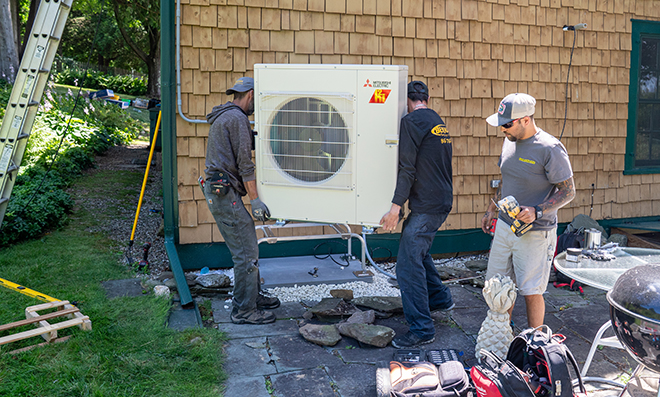
| Workers install a residential heat pump system in Charlotte, Vermont, in July 2025. States say they hope to get their energy appliance rebate programs approved ahead of the 2026-2027 heating season. |
As autumn temperatures begin to set in, West Virginia and Florida are the only US states with federal approval so far to launch revised home energy rebate programs that comply with the Trump administration's energy agenda.
The Home Owner Managing Energy Savings (HOMES) and High-Efficiency Electric Home Rebate (HEEHR) programs, designed to help US households reduce their energy bills, were part of the Inflation Reduction Act enacted more than four years ago.
Many states had already developed their rebate programs when the US Department of Energy halted the $8.8 billion federal initiative for review in early 2025, while others had submitted initial plans to the agency. Some plans had already been implemented.
Now, dozens of states are still waiting for the DOE to approve their reworked energy rebate program applications and plans.
Lowering energy costs for ratepayers is a key concern for the US power industry after a year of rising electricity prices. Utilities nationwide are under pressure from regulators and policymakers to control costs.
"People need this funding," Mark Kresowik, senior policy director for the American Council for an Energy-Efficient Economy, said in an interview. "Every single dollar that goes out for a program that will help a family afford their energy, in this moment when far too many families are struggling to keep the lights on and stay safe and comfortable in their homes, matters."
The DOE said Oct. 14 that it had approved Florida's HEEHR program for launch later in the fall, and that it is working with states with previously launched programs "to bring them into compliance with the revised program guidance."
States looking
The Oregon Department of Energy began to enroll contractors on Oct. 12 in anticipation of a future launch of its rebate program but does not have a timeline for when they can get to work, Jenny Kalez, the agency's communications director, said in a Oct. 13 email. The state is getting the rollout ready to go in hopes of obtaining DOE approval in time for a late fall or early winter launch, she said.
Montana is working on the design of its program while awaiting DOE approval, Madison McGeffers, a spokesperson for the Montana Department of Environmental Quality, said in an email. Early morning temperatures in the capital of Helena hit a low of 26 degrees F on Oct. 14.
"DEQ does not anticipate that rebates will be available this winter," McGeffers said.
Other states such as Illinois, Kentucky, North Dakota and Texas are telling potential rebate recipients that their programs remain on hold pending DOE approval.
1,000 West Virginia applications in 2 weeks
States and energy efficiency advocates were nonetheless encouraged by the fact that two states now have clearance to proceed. Homeowners can save up to $8,000 in rebates under the HOMES program and up to $14,000 under HEEHR.
West Virginia has received more than 1,000 applications from homeowners since Sept. 28, when Governor Patrick Morrisey (Republican) announced that the state's program had final DOE approval, Lars Dalseide, a spokesperson for the governor's office, said in an Oct. 14 email. The state is lining up some 350 contractors to install heat pumps for space cooling and heating, more efficient water heaters and other appliances and to weatherize homes.
"Affordability is one of the biggest challenges facing West Virginia families, and lowering monthly energy bills is one way we can help families keep more of their hard-earned money," Morrisey said in a statement.
Ambiguous guidance
Unlike many other initiatives under the Biden-era law, the energy rebates were spared congressional and administration cuts. However, the DOE in its review removed environmental justice language and barred homeowners from using the rebates to replace appliances running on oil and natural gas with electric ones.
If and how the fuel-switching prohibition will be enforced is uncertain. The new DOE guidance also says a home can "retain existing fossil-fuel HVAC systems when installing a heat pump, even if the heat pump will not become the primary source of heating and cooling."
"You cannot rip out your fossil fuel-fired equipment and completely replace it with electric equipment and claim a rebate, but you can leave the equipment in place," Tim Ballo, a supervising senior attorney with Earthjustice, said in an interview.
Because the DOE guidance does not specify what share of a home's total energy consumption each system would need to supply, states may allow homeowners to use a hybrid system, Ballo said.
At least one state read the guidance to say that rebates can in fact be used to help pay for the cost of installing a new heat pump for space heating and cooling "even if the heat pump will replace a non-electric system." The rebates just cannot be used to pay for removing a non-electric system, a spokesperson for that state said.