07 Oct, 2026
Capital compromise more likely for UBS than Swiss exit, M&A

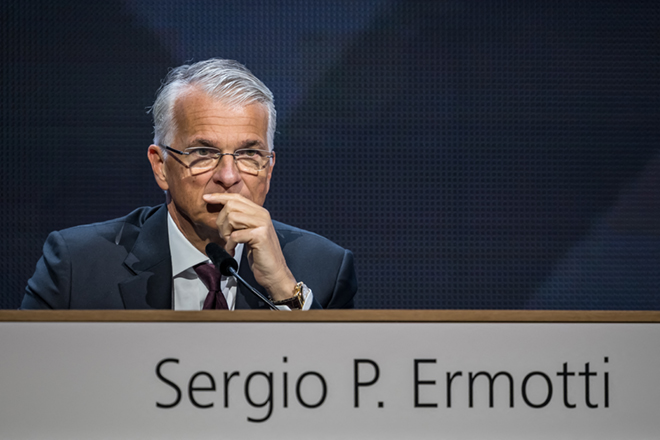
| UBS CEO Sergio Ermotti has described proposed capital rules from the Swiss government as excessive. Source: AFP via Getty Images Europe. |
UBS Group AG is more likely to forge another compromise in the new Swiss capital regime than redomicile or merge with a peer, according to industry analysts.
The bank faces a material increase in core capital requirements after the upper house of the Swiss parliament on Sept. 23 approved proposed rules that require systemic institutions to capitalize their foreign subsidiaries with 90% of common equity Tier 1 (CET1).
UBS has pushed back against the decision, saying the proposals would lead to a "further excessive tightening of Swiss capital requirements, which are already among the most stringent globally." The situation has spurred speculation that UBS might seek to move or merge with another bank.
"We think the most likely outcome is still a compromise between the bank and the Swiss government," said Jesse Norcross, senior financial sector strategist at ING.
While an exit cannot be ruled out completely, Norcross said in an email, both a move or a merger are less plausible options.
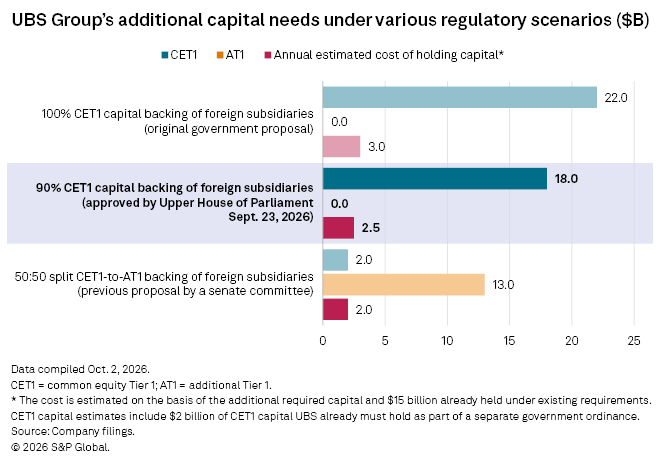
If the current proposal was implemented, UBS would need an additional $16 billion of CET1 capital on top of the $2 billion it is already required to hold. The group has estimated additional costs for holding the extra capital at $2.5 billion per year.
The Swiss government originally proposed that systemic banks back foreign units with 100% of CET1 capital. A compromise scenario for an even-split backing of 50% CET1 capital and 50% additional Tier 1 (AT1) notes would be acceptable, UBS CEO Sergio Ermotti said, though still costly.
Investor push for relocation
UBS investor Artisan Partners on Sept. 30 called on the bank to leave Switzerland, saying in a letter to management the country is "no longer an attractive or desirable location" due to the new capital regime. The proposed rules create an "excessive, punitive and unnecessary" cost for UBS as the extra capital it would need to hold will earn zero investor return and result in an estimated $36 billion forgone market capitalization, Artisan Partners said.
"Aside from the temporary friction and cost of changing domicile, there is no compelling reason for UBS to remain a Swiss company," Artisan Partners said in the letter.
The investor's statement came after Semafor reported Sept. 25, citing unnamed sources, that UBS had resumed discussions about relocating. Management has so far publicly rejected any relocation plans.
Relocation, M&A risks
While Artisan Partners' reasoning "looks directionally correct, the $36 billion of forgone market capitalization they estimate seems based on a very strong bull case, while the costs of relocating or merging are also not directly clear," ING's Norcross said.
"Moving the holding company and the listing to the US would not solve much on its own," said Johann Scholtz, bank equity analyst at Morningstar DBRS. "The risk is that UBS simply swaps trapped capital in the US for trapped capital in Zurich."
In such a scenario, UBS AG, the parent bank in the current structure, would remain a Swiss bank, and Swiss regulator Finma would require the entity to be fully capitalized on a stand-alone basis, Scholtz said. If UBS wants to transfer foreign business out of UBS AG into an entity based abroad, all client contracts related to the transfer would have to be redrawn, Scholtz said.
"A Swiss booking center is part of the product, not just an address, and changing the contracting entity changes what the client bought. Many of those clients chose Swiss jurisdiction deliberately, often to stay outside US reach, so a move would carry a significant risk of client attrition," Scholtz said.
UBS is attractive, but given the size and complexity of the group and its business focus, the execution risk of a merger or takeover "would be very high," RBC analysts said in a Sept. 28 note.
"We see the UBS merger talk as speculation at this stage, though it may help sentiment by raising concerns in the political discussion that UBS might relocate from Switzerland," analysts at Zürcher Kantonalbank added in a Sept. 25 note.
Long process
Analysts do not expect a final decision on the new foreign-unit capitalization rules by the end of 2026, pointing to a potentially lengthy parliamentary process. The lower house of the Swiss parliament and the National Council have to vote on the rules by year-end, but any new proposals would delay the proceedings.
A new compromise proposal for a potential 75% CET1 capital backing of foreign subsidiaries has already been floated in the lower house of parliament, according to a report by Swiss newspaper NZZ am Sonntag.
"We expect further debate throughout 2026, with the final terms likely to be approved in 2027 and implementation not expected to begin before 2028," said Maria Rivas, sector lead, European financial institution ratings at Morningstar DBRS.
The foreign unit rules are part of a larger package of reforms proposed after the collapse of Credit Suisse, aimed at enhancing too-big-to-fail bank requirements. The reforms will primarily affect UBS as the only global systemically important bank in Switzerland, which acquired Credit Suisse in early 2023.
As part of the rescue deal, CHF16.5 billion ($20 billion) of AT1 notes were written off, triggering multiple lawsuits by creditors in the US, Switzerland and the UK.
UBS currently backs foreign subsidiaries with a mix of capital and debt, of which 45% is CET1 and about 15% is AT1 instruments, according to a Swiss government factsheet. AT1s can be converted in CET1 capital if a bank runs into trouble.