


19 Jan, 2026
Handelsbanken to post steepest YOY drop in Q4'25 profit among big Nordic banks
By Adrian Jimenea and Marissa Ramos
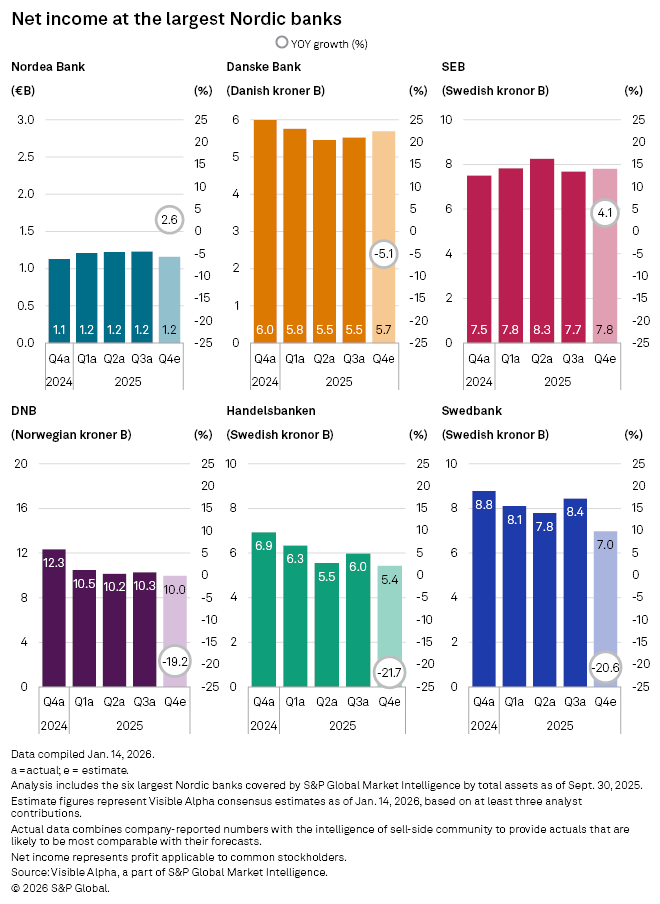
Svenska Handelsbanken AB (publ) is expected to post the steepest year-over-year decline in fourth-quarter 2025 net income among the Nordic region's six largest banks by assets, weighed down by lower lending income and higher operating expenses. The Sweden-based bank's net income for the period is projected to fall 21.7% compared to the fourth quarter of 2024, according to estimates compiled by Visible Alpha.
Swedbank AB (publ), another Swedish lender, is also forecast to see a significant drop in profits, with fourth-quarter 2025 net income expected to decrease 20.6% year over year. In contrast, the net income of larger domestic peer Skandinaviska Enskilda Banken AB (publ) (SEB) is anticipated to increase 4.1%.
Norway-based DNB Bank ASA is expected to report a 19.2% year-over-year decrease in fourth-quarter 2025 net income, while Denmark-based Danske Bank A/S is expected to post a 5.1% decline. The fourth-quarter net income of Finland-based Nordea Bank Abp is projected to rise 2.6% year over year.
Sweden's Riksbank was the most aggressive in easing monetary policy among the Nordic region's central banks in 2025, cutting its policy rate by a total of 225 basis points since 2024, compared to just 50 bps by the Norwegian central bank. Denmark's central bank typically mirrors the European Central Bank's decisions as the Danish kroner is pegged to the euro, and the ECB has lowered rates by 200 bps since 2024.
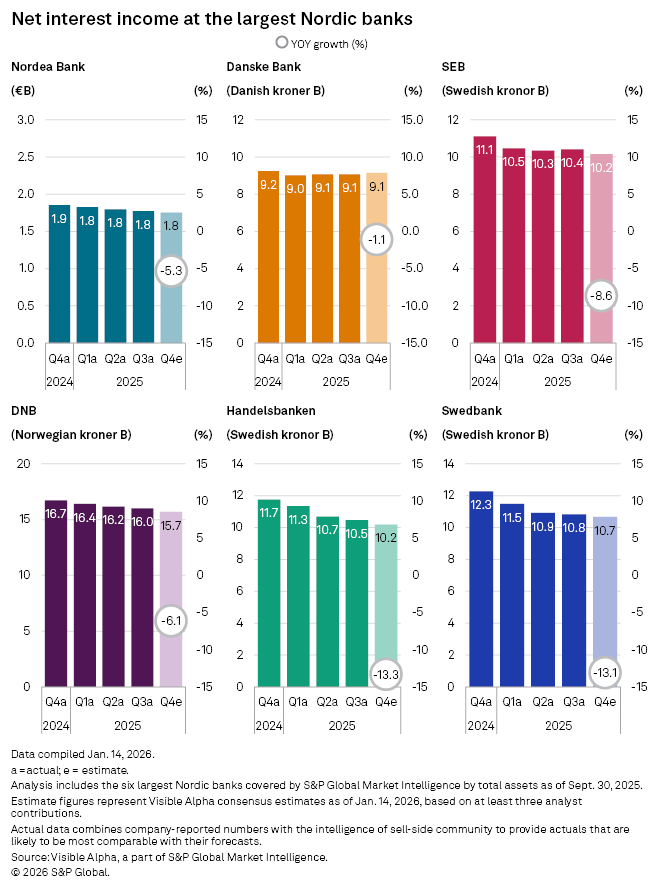
Among the six largest Nordic banks, Handelsbanken's net income is the most susceptible to lower interest rates due to its heavy reliance on net interest income (NII) — the financial metric most affected by central bank policy decisions. In the first nine months of 2025, NII accounted for about 76% of Handelsbanken's total revenue, compared to approximately 65% for Swedbank.
For the fourth quarter of 2025, Handelsbanken is expected to report the largest decline in NII among the six banks, at 13.3%, followed by Swedbank with a 13.1% decrease. SEB, which is somewhat insulated from the impact of lower rates on its profits due to its significant holdings of fixed-rate corporate loans, is projected to report an 8.6% decline in NII.
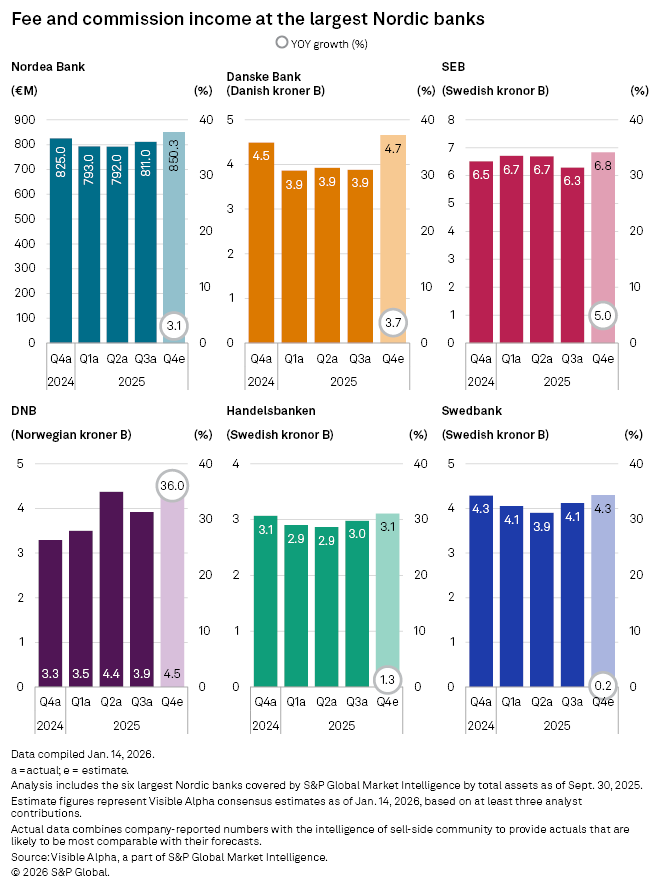
Revenue at the analyzed banks may get some cushion from higher fees and commissions, which the banks have been trying to bolster to prop up profits.
DNB Bank's fee and commission income is anticipated to jump 36.0% year over year in the fourth quarter of 2025. The bank has been touting its acquisition of Sweden-based investment bank Carnegie as a major boost to its fee-generating business.
The other five banks in the analysis are expected to report more modest growth in fee and commission income, with projected percentage increases in the low- to mid-single digits.
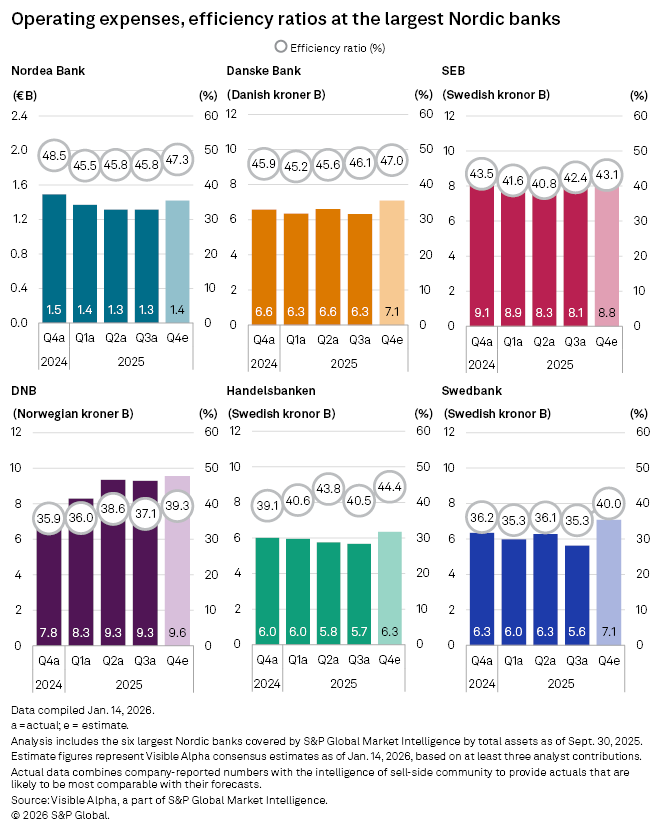
Four of the six banks are forecast to report higher operating expenses in the fourth quarter of 2025 compared to the same period in 2024, with the increase expected to be particularly pronounced at DNB Bank.
"A seasonally higher activity level that we typically see in the fourth quarter compared to the third, all else equal, typically leads to somewhat higher costs in the fourth quarter," DNB CEO Kjerstin Braathen said during a Jan. 7 call with analysts.
The bank expects to incur nonrecurring integration costs related to Carnegie of 250 million Norwegian kroner for full year 2025. "Year-to-date for the third quarter, we've seen such nonrecurring costs of approximately [200 million Norwegian kroner], Braathen said.
Handelsbanken's efficiency ratio — calculated as noninterest expenses divided by operating income — is expected to worsen by 5.3 percentage points to 44.4% in the fourth quarter of 2025 from 39.1% in the same period a year earlier. The bank's operating expenses are projected to rise about 5% to 6.3 billion Swedish kronor from 6 billion kronor.
Market observers have said cost management is a key item for the largest Nordic banks in protecting their earnings from the drag of lower interest rates. Some of them have implemented cost-control measures, particularly relating to wages and the management of head count.
As of Jan. 16, US$1 was equivalent to 10.10 Norwegian kroner and 9.23 Swedish kronor.
Visible Alpha is a part of S&P Global Market Intelligence.