15 Sep, 2025
'Still unstoppable': US power demand drives solar bulls, stock resurgence
By Garrett Hering and Annie Sabater
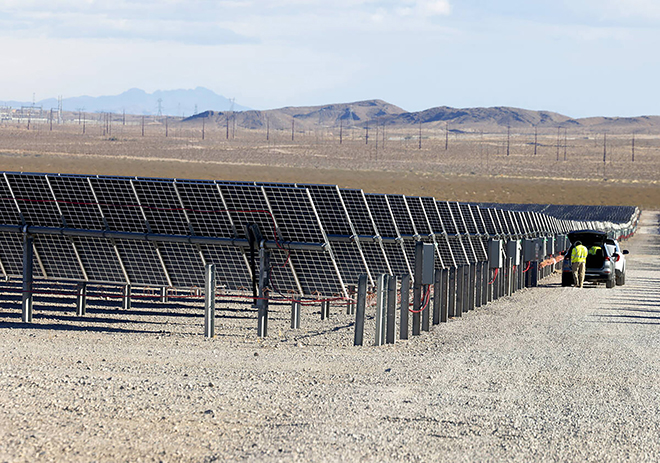
| A solar farm outside of Las Vegas, where industry executives, customers and analysts recently converged for the RE+ trade show. |
US solar industry leaders convened Sept. 8–11 at the RE+ trade show in Las Vegas, doubling down on their ability to continue building the bulk of the country's new generating capacity as unprecedented electricity demand raises the stakes.
Wall Street appears to generally support their bet, despite US President Donald Trump's enactment in July of a sweeping budget bill that largely dismantled Biden-era clean energy tax credits, added onerous foreign entity of concern (FEOC) restrictions and created new regulatory risks.
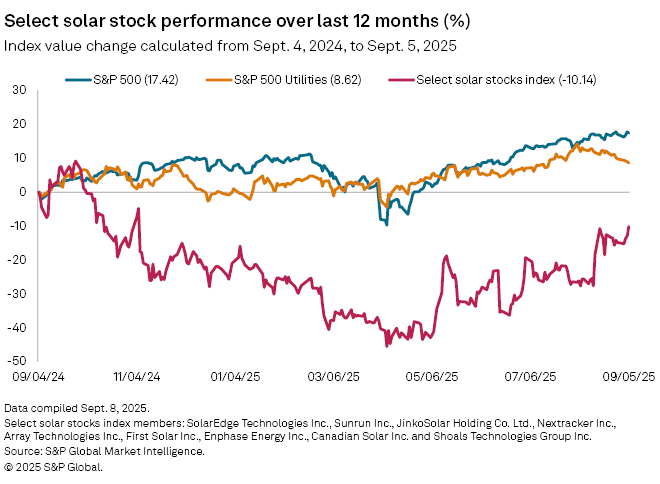
An index of select solar companies compiled by Platts, part of S&P Global Commodity Insights, was down roughly 10% year over year as the event began, contrasting with gains for the S&P 500 and S&P 500 Utilities indexes. But just three months ago, the select index was nearly 50% lower than a year earlier.
As of Sept. 12, the select solar index was up 15.26% year to date.
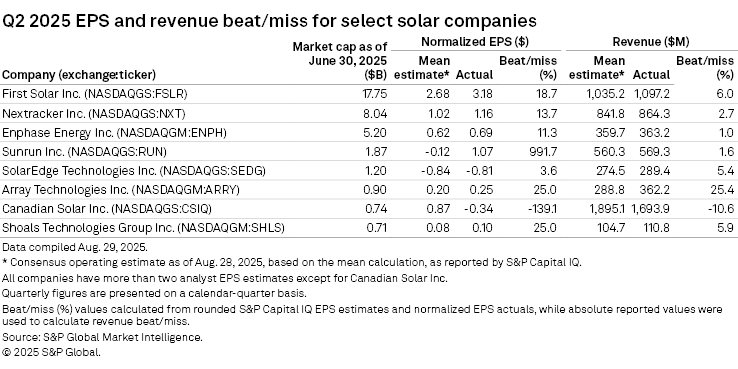
Several publicly traded solar companies rallied over the summer, partly fueled by the US Treasury Department's better-than-expected construction-start rules to qualify for tax credits. That includes tracking system specialists Array Technologies Inc. and Nextracker Inc., electrical balance of system supplier Shoals Technologies Group, Inc., photovoltaic panel maker First Solar Inc., and distributed solar and storage companies SolarEdge Technologies Inc. and Sunrun Inc.
"The policy environment seems to be changing every day, but I think, at the end of the day, solar is still unstoppable," Nextracker President Howard Wenger said in an interview at RE+, echoing comments from last year's event.
Utility-scale trackers are Nextracker's core business, with over 130 GW supplied globally over the past decade. But the company, whose share price has surged nearly 70% this year on its strong financial results and pipeline of future business, has continued to expand its offerings.
On the first day of RE+, the California-based company announced its acquisition of solar panel frame maker Origami Solar Inc. for approximately $53 million in cash, extending a recent shopping spree. Since last year, Nextracker has invested over $350 million to build its business beyond trackers, including its purchase of tracker foundation company Ojjo Inc., solar plant electrical infrastructure supplier Bentek Corporation and several artificial intelligence and robotics technologies.
"We have a grand strategy that is being revealed as we announce these acquisitions, which is the fully connected power plant platform," Wenger said. "It's going to be lower cost, higher performing, and more reliable because of this full turnkey solution."
Asked whether Nextracker might consider migrating further into modules, given its recent move upstream to module frames, Wenger replied, "It's something that we have thought about, but it's not something we can talk about right now."
Nextracker is a top stock pick among some equity analysts covering the clean energy sector.
Jefferies analysts, in a Sept. 11 note to clients, said they emerged from the RE+ conference feeling "constructive across all the utility-scale solar names" and "incrementally" positive on Nextracker and First Solar.
RE+ reinforced a "bullish outlook" for utility-scale solar, the Jefferies analysts said, noting that energy storage has become increasingly inseparable from the solar industry.
"Storage was at the forefront of conversations, illustrating the growing prevalence of batteries as load growth continues to outpace supply," the analysts said.
Investors 'coming around' on home solar
The Jefferies analysts exited the event pointing to a possible recovery for the hard-hit residential solar segment.
"Investor sentiment around resi solar has turned cautiously optimistic following RE+, with expectations for a slightly better 2026 outlook, particularly for [third-party ownership]," the Jefferies analysts said. "We perceive investors are coming around on resi names like [Enphase Energy Inc., Sunrun and SolarEdge] that have been out of favor for most of 2025" given volatility related to Trump's One Big Beautiful Bill Act (OBBBA).
The law will end the Section 25D residential clean energy tax credit, which applies to homeowners who purchase solar and battery systems, after this year. The incentive previously extended into the mid-2030s under Biden's Inflation Reduction Act.
But Sunrun relies largely on the Section 48E investment tax credit for businesses as part of its leasing-focused strategy, and other distributed solar companies are working to rapidly shift their business toward innovative financing models, including pre-paid leases, to continue qualifying for tax credits.
The 48E incentive remains available through the end of 2027, and companies have until the end of the decade to complete projects under safe-harbor rules.
Sunrun's share price has more than doubled in the past three months as executives pressed their case that the largest US supplier of residential solar and storage systems remains well-positioned for robust returns under the new rules.
"Sunrun is extremely good at executing through change and navigating through chaos," Chris Rauscher, the company's vice president and head of grid services and electrification, said in an interview at RE+. "We take very complex environments and simplify them."
Rauscher is optimistic about Sunrun's growing fleet of residential batteries and software-steered "distributed power plants" that can be dispatched to support broader grid reliability.
"I've got over 100,000 customers enrolled in grid service programs nationwide," he said.
This summer, Sunrun was the largest aggregator of home battery systems participating in a July 29 test event in California that discharged an average of 535 MW of output for two hours in the evening, according to a Brattle Group analysis.
The company expects to have more than 10 GWh of networked residential storage capacity online by 2029, up from 3.2 GWh at the end of the second quarter.
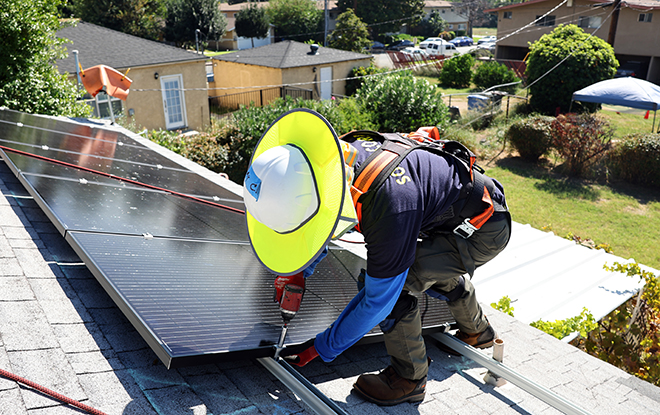
| A solar installer on a rooftop in Pomona, California. The home solar industry is scrambling to adapt to a phaseout of US tax credits. Source: Mario Tama/Getty Images News via Getty Images. |
Raghu Belur, cofounder and chief products officer at Enphase, sees the residential solar business in a similar position to when California in April 2023 implemented a new net metering policy that cut compensation for solar exports to the grid and encouraged batteries. That put pressure on companies to install as much as possible before the new rules took effect, leading to a significant drop off in subsequent quarters.
With the 25D tax credit expiring at the end of 2025, "everybody is in a mad rush, not thinking about the future, and it's understandable," Belur said. "But we know that there is a path beyond 25D."
Now that changes to federal incentives are largely clarified, the executive believes the residential solar industry can adapt with technological and financial innovations.
"The uncertainty is the bigger problem," Belur said.
The tax credit expiration is a "wake up call" for the rooftop solar industry to reduce installation costs, he added, pointing to new solar microinverter and battery products that Enphase is introducing to help speed up installation times.
Enphase also has high hopes that many home solar and storage installers that previously relied largely on cash and loan sales can migrate into sales with pre-paid leases. By doing so, they can "pretty much neutralize" the loss of the 25D incentive and still qualify for the 30% investment tax credit for a few more years under 48E, Belur said.