11 Sep, 2025
AI upskilling: Navigating the urgent need for workforce transformation
This is a special publication from S&P Global Market Intelligence, authored by Ethan Ray, a senior analyst on the human resources and employee experience technologies team at S&P Global Market Intelligence 451 Research; Alex Johnston, a senior analyst on 451 Research's data, AI and analytics team; and Sarah James, leader of the TMT news team within Market Intelligence. For more information about 451 Research, please refer to the 451 Research overview and contact page.
The state of AI integration in the workforce
Generative AI promises to speed up and simplify workflows, but enterprises are quickly learning that successful deployment and adoption are neither quick nor easy.
Companies are moving swiftly to embrace generative AI (GenAI), with adoption rates exceeding both enterprise expectations from just a year ago and rates seen from previous AI technologies. According to S&P Global Market Intelligence 451 Research's Voice of the Enterprise: AI & Machine Learning, Use Cases 2025 survey, a significant majority of organizations have AI either in production (45.6%) or in proof-of-concept stages (41.7%). More than one in four respondents reported that GenAI was fully integrated across their organizations, and almost one in three indicated it had been adopted for specific departments or projects, such as human resources or IT operations.
Yet failure rates are equally alarming. Among respondents whose organizations had invested in GenAI, 46.2% reported that no single enterprise objective had received a "strong positive impact" from that investment. Furthermore, companies are increasingly abandoning early-stage AI initiatives, with organizations reporting that, on average, 46.4% of projects are scrapped between proof of concept and broad adoption. While this data signals that many companies are still in the experimental phase with GenAI, it also shows the highest project failure rates among companies prone to encountering resistance from customers and employees.
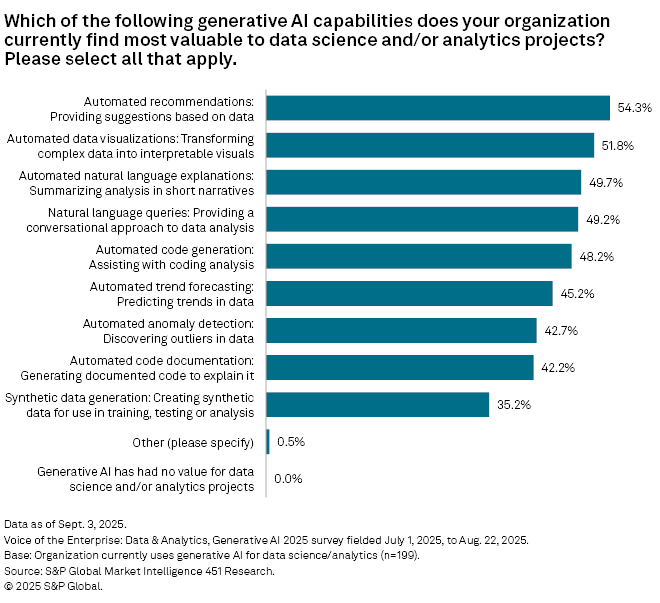
Nevertheless, there are use cases where GenAI is offering unique benefits to enterprises. For data science and analytics projects, 54.3% of respondents surveyed in our Data & Analytics 2025 survey see automated recommendations based on their data as a highly valued use case. A similar 51.8% of respondents cite GenAI's ability to create auto-generated data visualizations, summarize analyses in short narratives (49.7%), and more generally provide a conversational approach to data analysis (49.2%). Notably, these use cases were not possible with previous machine learning models, and aim to make work easier for human employees, rather than replace them altogether. Use cases such as these offer a glimpse of how GenAI — with the right training and adoption strategies — can streamline tasks and potentially speed up operations in the longer term.

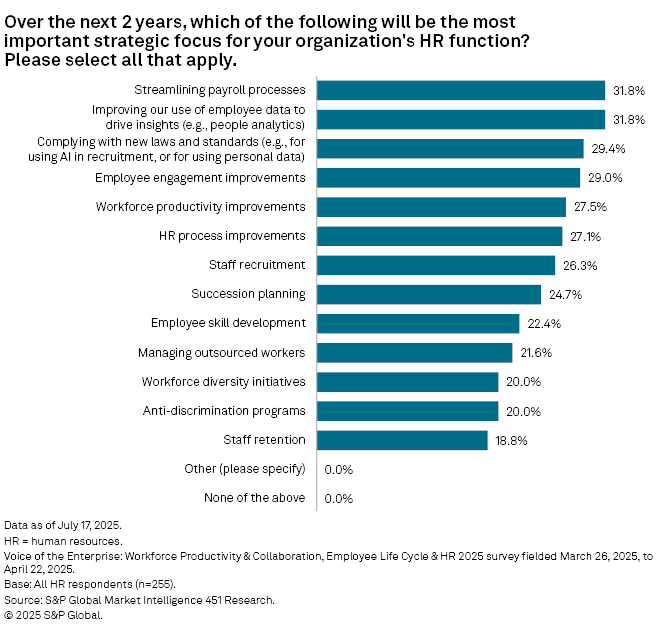
As enterprises explore the complexities of AI implementation, it becomes clear that the path requires technological investment and a commitment to upskilling the workforce. Organizations face a pressing need for upskilling, as 88.9% of surveyed businesses said they will require new technology skills in the next 12 months. Rising employee reductions threaten in-house development, however. With only 22.4% of surveyed HR professionals stating their organization's HR function will prioritize skill development over the next two years, it seems that enterprises are grappling with conflicting priorities. Short-term business pressures and employee apprehensions about AI's impact further hinder effective upskilling initiatives. To succeed in an AI-driven world, organizations must embed a culture of continuous learning, utilize the latest in learning technologies and align upskilling programs with strategic goals. By championing these initiatives, leaders can empower employees to embrace AI and enhance individual and organizational success.

The productivity paradox with AI
Despite significant investments in new technology, organizations are struggling to demonstrate corresponding increases in worker productivity and return on investment. Recent quarterly data indicates that US worker productivity annual growth has fallen below its near-80-year average for the past three quarters, with the second quarter's year-over-year reading at just 1.50%, slightly over half the 2.97% in the equivalent period the year before. The average year-over-year growth rate from the first quarter of 1948 to the fourth quarter of 2024 stands at 2.15%. This recent decline suggests a stall in productivity growth. Along with various macroeconomic factors, inadequate guidance regarding AI implementations could have been a contributory factor. Whatever the reason, the deceleration will likely result in a cautious approach among organizations.
451 Research analysis has identified several challenges for AI implementation, including weak workflows and misalignment between strategic initiatives and daily operations. According to our AI & Machine Learning, Use Cases 2025 survey, the average number of stakeholder groups participating in AI project approvals rose to 4.8 in 2025 from 4.2 in 2023. This increase includes input from end-user groups such as sales, customer service and marketing leadership, alongside a continued expansion of executive management's role. Many of these stakeholders lack the technical expertise of IT leadership or the contextual understanding of infrastructure managers, however. This means education is required to ensure that use cases are well-targeted. As Wharton Professor of Management Matthew Bidwell notes, "One of the interesting things about AI adoption currently is it tends to be very bottom-up. It's a lot of employees experimenting with these tools to figure out how they can get their work done better." Organizations have unleashed AI for their employees, but in a scattered, bottom-up way. While employee experimentation may lead to innovative applications of AI, businesses must implement robust workflows and top-down alignment between strategic initiatives and daily operations if organizational productivity and ROI are to increase.
These drawbacks must also be paired with the most important challenge: the lack of contextual learning and planned upskilling that organizations have provided employees. Only 15.8% of respondents to our Workforce Productivity & Collaboration, Work Execution Goals & Challenges 2025 survey strongly agreed that they had received adequate training on how to use AI tools effectively. A majority (54.5%) disagreed with that statement. There is a disconnect between the lack of upskilling opportunities and the importance that organizations have given to AI, as measured by the proportion that have AI in production or in proof-of-concept stages. This could be a contributory factor to the underwhelming macroeconomic outputs, due to a combination of messy implementations and an underskilled workforce unable to effectively use the solutions suddenly available to them.
Current challenges with upskilling
The urgency for proactive upskilling initiatives has never been more apparent as organizations strive to remain competitive in a rapidly evolving landscape. Almost nine out of 10 businesses surveyed for our Digital Pulse, Technology Skills 2025 survey indicate they will need to access, acquire or develop new technology skills in the next 12 months. This underscores the pressing need for organizations to hire new talent or upskill existing employees to implement their AI initiatives effectively. A concerning trend has emerged, however: According to our Macroeconomic Outlook, Business Trends 2025 survey, the percentage of respondents who planned to reduce the number of full-time employees over the next 12 months rose to 13.3% in the second quarter of 2025 from 10.1% at the end of 2024. Nearly one in four respondents (23.2%) from private employers with 1,000 or more employees indicated that their organization will likely decrease full-time employees over the subsequent 12 months.
In the current macroeconomic environment, it appears unlikely that organizations will ramp up hiring for technology skills. This emphasizes the importance of developing in-house talent through upskilling. Unfortunately, the outlook for such initiatives is also challenging. Only 22.4% of HR professionals surveyed for our Workforce Productivity & Collaboration, Employee Life Cycle & HR 2025 survey state that their organization's HR function will prioritize skill development over the next two years, being outpaced by initiatives including streamlining payroll processes (31.8%), improving employee data analytics (31.8%) and complying with new laws and standards (29.4%). This highlights a potential misalignment between leadership's strategic focus and the evolving demands of labor. This could lead to a workforce that is ill-prepared to leverage AI technologies effectively, further exacerbating the productivity gap.
Employee development and upskilling are often underprioritized for several reasons. Short-term business pressures frequently divert focus from future workforce planning to immediate operational issues. Additionally, organizations struggle to effectively capture and quantify the ROI from upskilling programs, while the perceived costs are presented up-front and more concretely. Misalignments between upskilling initiatives and strategic priorities can occur, particularly when HR is not included in executive-level discussions, leading to a lack of coordination throughout the organization. Some nascent solutions, such as integrating upskilling into performance metrics and aligning upskilling programs with strategic goals, can help organizations better prioritize skill development. Fostering a culture of continuous learning remains paramount to rallying effectively around these initiatives.
From the employee perspective, several factors contribute to reduced interest in AI and technology upskilling. Workload and time constraints often hinder employees from engaging with upskilling opportunities amid their existing responsibilities. Many employees may feel unsupported by leadership or overwhelmed by their burgeoning workloads. Additionally, a lack of motivation can stem from uncertainty about the future or insufficient connections to career progression. As one IT/engineering manager noted, "I'm not going to be in the workforce for that much longer … I do the work that I do very well, but I don't want to jump in and go down a new path that's going to require tons of training and certification exams." Source: IT/engineering manager respondent, 451 Research's Voice of the Enterprise in-depth interview, November 2024.
Furthermore, employees may feel threatened by AI's potential impact on their jobs, leading to resistance to upskilling that appears to embrace this technology. Over one-third (34.7%) of respondents to our Workforce Productivity & Collaboration: Work Execution Goals & Challenges 2025 survey strongly or somewhat agree that they are concerned that AI could significantly alter or displace their job. As Bidwell highlights, "You want your employees to be figuring out and making the best of it, but employees are also legitimately worried that it's coming for all of their jobs. And so how do you engage your workforce and figure out how to make the best use of these technologies when they are also worried that the best use of these technologies might get them out of the job?" Balancing these concerns with proactive upskilling initiatives is essential for fostering a resilient workforce.
The case for upskilling
Organizations embarking on an AI upskilling journey must prioritize fostering social learning environments that encourage employee collaboration and knowledge-sharing. This can be achieved by forming cross-functional learning cohorts, creating forums for peer-led AI experimentation, or hosting internal hackathons to build AI solutions tailored to the organization's objectives and industry. Although these initiatives are still bottom-up, any innovative solution that emerges can be tracked, recorded and formally implemented. To reinforce a culture of continuous improvement, organizations should leverage robust learning tools and public recognition mechanisms — for example, integrating AI upskilling learning pathways into annual performance plans or bonus attainment, and establishing clear AI competencies tied to career ladders. GenAI can further bolster employee upskilling by enabling individuals to develop personalized learning plans and receive suggestions for acquiring the next skill or certification. Its ability to deliver interactive, lower-cost learning assets can offset the need for more expensive platforms, making AI education more accessible and sustainable.
Organizations must also create a dynamic work orchestration that aligns AI augmentation with strategic objectives and addresses current skills gaps. This involves assessing new technological capabilities for their impact on existing roles and ensuring that employees are upskilled for augmented positions or redeployed to more complex tasks requiring higher expertise. By conducting regular skills assessments and mapping them to business goals, organizations can ensure that upskilling initiatives are directly linked to strategic objectives. This proactive approach enhances employee engagement and retention and positions the organization to effectively leverage its workforce in pursuit of competitive advantage, ultimately driving overall business performance.
Finally, leadership must play an active role in championing upskilling initiatives. By clearly communicating the importance of upskilling and providing the necessary resources, leaders can instill a sense of urgency and purpose within their teams. Encouraging a mindset of lifelong learning and adaptability will empower employees to embrace these technologies, even in the face of AI encroaching on their roles. As one VP of Supply Chain & Inventory stated, "Change management will be big, right? If you don't get people believing in it and wanting to do it, it's very hard to get it done. And oftentimes the people you need to help you build the models are the people that are impacted by the AI tool that you're bringing in … that's why we're all constantly talking about, 'Hey, this is to help you, not to replace you, right?" Source: Supply Chain & Inventory VP respondent, 451 Research's Voice of the Enterprise in-depth interview, September 2024. This perspective underscores the necessity of fostering belief in these initiatives among employees. The commitment to upskilling will benefit individual employees and drive organizational success in a rapidly changing market.
Call to action
It is imperative for both employees and organizations to embrace upskilling as a necessary response to the evolving job market and rapidly advancing AI technologies. Those actively seeking learning opportunities will be rewarded through new skill acquisition and expanded job opportunities, while those who do not may face negative consequences, such as job loss or stagnation. By prioritizing upskilling initiatives, an organization can ensure its workforce is prepared to meet future challenges.