


12 Jun, 2025
Ukrainian banks see room to build on strong loan growth

By Beata Fojcik
Ukrainian banks anticipate further lending expansion in the coming months after recording almost 15% year-over-year growth in the first quarter, one of the strongest results in the past six years.
Total gross loans in the sector reached 1.3 trillion hryvnia as of March-end, with the corporate portfolio growing 9.7% year over year to almost 913 billion hryvnia, according to an S&P Global Market Intelligence analysis of Ukrainian central bank data. Retail loans expanded over 21% year over year to 310.9 billion hryvnia.
On a quarterly basis, retail loans grew 5.2% while corporate loans rose 2.4%.
Ukrainian lenders are optimistic about lending growth in the next 12 months, projecting increased demand for business loans in the second quarter as well as higher demand from households for mortgages and consumer loans, Ukraine's central bank said in its April lending survey.
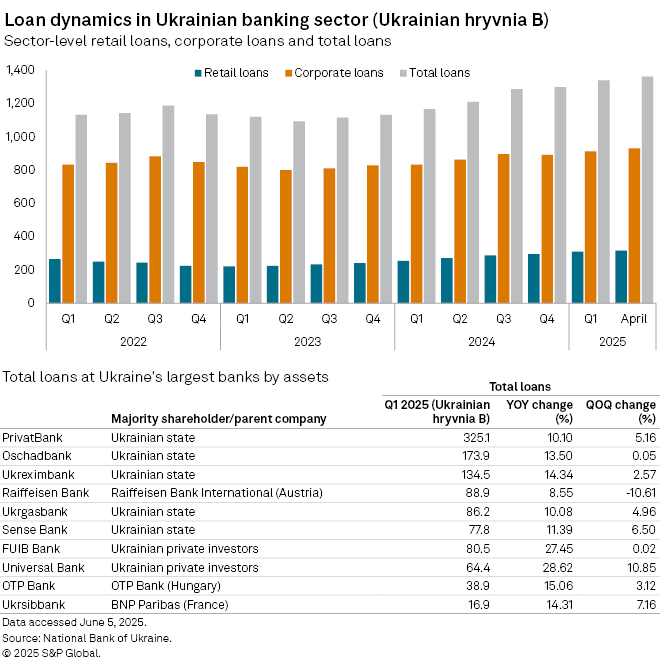
PJSC Universal Bank, JSC First Ukrainian International Bank (FUIB Bank) and the local unit of Hungary-based OTP Bank Nyrt. achieved the biggest year-over-year loan growth among Ukraine's largest banks.
Raiffeisen Bank JSC, the Ukrainian subsidiary of Austria-based Raiffeisen Bank International AG, was the only of the 10 largest lenders whose total loan portfolio declined quarter over quarter, central bank data shows. The lender experienced a quarterly drop in loans granted to other banks, but its gross customer portfolio expanded quarter over quarter from 71.6 billion hryvnia to 77.7 billion hryvnia as of March-end, according to its first-quarter financial report.
US-Ukraine mineral deal impact
The US and Ukraine signed an economic partnership agreement April 30 to establish the US-Ukraine Reconstruction Investment Fund. The fund will be financed by new licenses in critical materials, oil and gas, with 50% of the revenue directed to it. The partnership is expected to help Ukraine attract foreign investment and technologies.
Any US investments under the agreement would likely depend on financing from US institutions, but Ukrainian banks may still benefit indirectly, according to Mykhaylo Demkiv, financial analyst at Investment Capital Ukraine, a Kyiv-based broker and asset manager.
Projects would require local suppliers and service providers, and Ukrainian banks could significantly contribute to financing this secondary tier of the value chain. "While the credit volumes would be smaller, this could still support incremental lending and profitability for the sector," Demkiv said.
The Ukrainian central bank told Market Intelligence that it is too early to assess the potential effects of the agreement on domestic banks. "The NBU will evaluate opportunities and impact as we receive more information," its spokesperson said.
Efficiency, low provisions support profitability
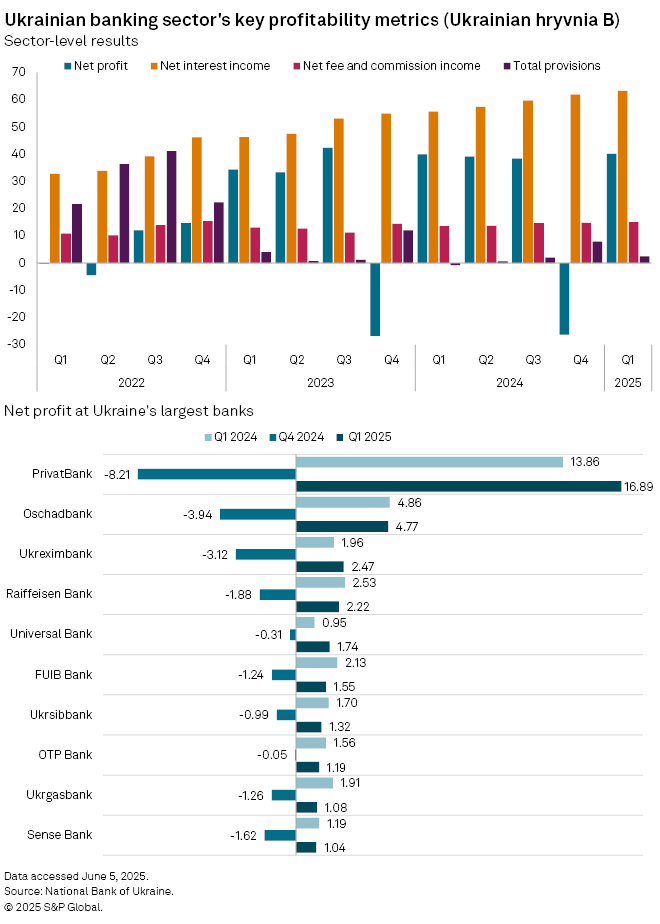
Ukraine's banking sector posted a net profit of 40 billion hryvnia in the first quarter of 2025, roughly flat year over year and rebounding from losses generated in the preceding quarter amid higher tax payments.
Most of Ukraine's top 10 lenders reported lower first-quarter profits year over year. Universal Bank's net profit grew more than 85%, while that of the country's largest lender, JSC Commercial Bank PrivatBank, increased almost 22% to 16.9 billion hryvnia.
"High operating efficiency and low provisioning were at the core of profitability," the central bank said in the Banking Sector Review. Aggregate loan loss provisions amounted to 2.4 billion hryvnia in the first quarter, down from 7.8 billion hryvnia in the preceding quarter.
First-quarter net interest income increased 13.7% year over year and 2.3% quarter over quarter to 63.2 billion hryvnia, while net fee and commission income expanded 10.4% year over year and 1.5% quarter over quarter to 15 billion hryvnia.
"The banking system's overall profitability is normalizing, and income structure is going back to pre-war levels," the central bank said.
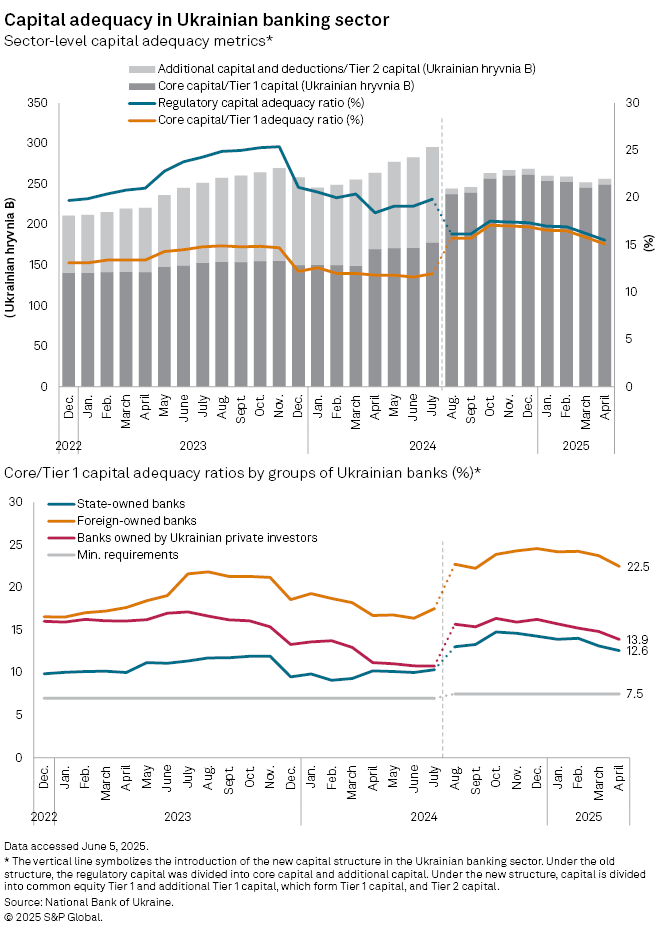
Capital adequacy fell in the first quarter to about 16% for all ratios, after domestic banks adjusted for an income tax hike at 2024-end, the central bank said.
The regulator is launching stress tests for the country's 21 biggest lenders in June. Those assigned higher capital adequacy ratios as a result of the tests will be required to submit and implement their capitalization programs by year-end.
As of June 11, US$1 was equivalent to 41.60 Ukrainian hryvnia.