05 Dec, 2025
Supreme Court to hear case challenging FTC independence
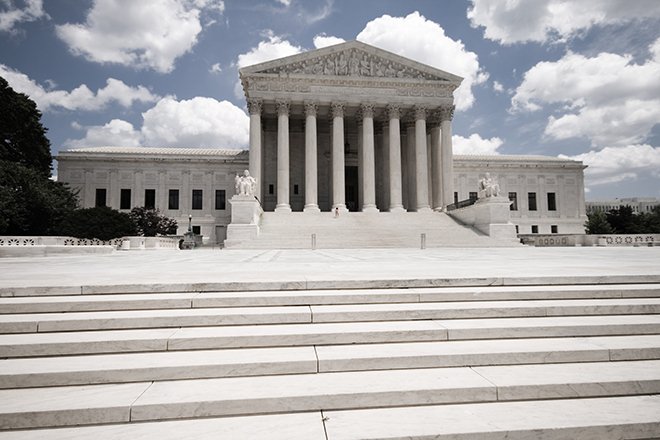
| The US Supreme Court, pictured above, will hear oral arguments in the Slaughter v. Trump case on Dec. 8. Source: qingwa / iStock / Getty Images Plus |
The US Supreme Court will hear oral arguments in the week of Dec. 8 in a case that could challenge the independence of regulatory agencies across the federal government.
The case, Slaughter v. Trump, came after President Donald Trump earlier this year removed two sitting Democratic commissioners, Alvaro Bedoya and Rebecca Slaughter, from the Federal Trade Commission. The move directly challenged the nearly century-old precedent established in Humphrey's Executor v. United States, in which the Supreme Court upheld a law that prevented the president from removing FTC members except in cases of "inefficiency, neglect of duty, or malfeasance in office."
The dispute centers on whether limiting presidential removal power violates the Constitution's separation of powers doctrine. A ruling against the current structure could affect dozens of independent agencies that Congress designed to operate with specialized expertise and bipartisan balance, from the SEC to the FTC.
"The Slaughter case has the potential to significantly reshape long-standing Supreme Court precedent and greatly expand the executive branch's authority over federal agencies," wrote Tara Simpson, senior federal regulatory compliance counsel at America's Credit Unions. "Essentially, it could expand a president's power by allowing the firing of leaders of independent agencies at will. Our understanding of 'independent' agencies could be completely upended."
Executive power
Historically, the FTC has operated with five commissioners, including one chair chosen by the sitting president. The party controlling The White House typically held the majority at the agency, though no more than three commissioners could be of the same political party.
Central to the case is the question of whether the FTC — an independent agency tasked with protecting consumers and promoting competition — exercises executive power. In its Humphrey's Executor ruling from 1935, the court said the FTC's duties were "neither political nor executive, but predominantly quasi-judicial and quasi-legislative." This is because commissioners must "exercise the trained judgment of a body of experts."
In the decades since, this determination has repeatedly been questioned.
"[The FTC] is not just purely an advisory board anymore," said Nicole Brenecki, a New York-based trial attorney. "They have investigative powers … they can impose penalties, require refunds and compensation. They can almost be compared to a court for these issues."
Landmark Legal Foundation, a conservative legal advocacy and education nonprofit group, argues that the Constitution's structure requires full presidential removal authority over executive officers.
"The separation-of-powers principle is a foundation of the Constitution. All executive power is vested in a single President, not a committee," said Matthew Forys, executive vice president of Landmark Legal Foundation. "The First Congress, made up of many Framers, debated whether the President would have to seek approval of the US Senate before removing executive officers. They ultimately decided the President has the sole removal power in what is known as the Decision of 1789."
Landmark has submitted an amicus brief in the case.
Oliver Dunford, a senior attorney at the Pacific Legal Foundation, views the case as an opportunity to restore democratic accountability.
"While affirming the President's authority to remove the heads of the agencies is not a panacea, it will at the very least restore a measure of control and oversight to the President and, through him, to the people," Dunford and his colleagues, Aditya Dynar and Michael Poon, wrote in their amicus brief.
Protecting independence
Supporters of Slaughter argue that independent agencies serve a congressionally designed stabilizing function, and that allowing presidents to remove commissioners based on political disagreements would erode the expertise, continuity and bipartisan balance Congress intended.
"The constitutional question presented in this case — whether Congress may protect FTC commissioners from at-will presidential removal — directly affects the ability of the Commission to enforce antitrust and consumer protection laws without fear of political interference," attorneys John Bergmayer and Elise Phillips of Public Knowledge wrote in their amicus brief.
Defenders of the status quo maintain that Congress intentionally created independent agencies to address complex economic and technical issues that benefit from specialized expertise and longer-term policy horizons than electoral cycles allow. Citing stare decisis, attorneys for Slaughter said eliminating this independence would subject critical regulatory functions to political whims and "profoundly destabilize institutions that are now inextricably intertwined with the fabric of American governance."
"If that power is granted to the President… those firings or hirings can become political and they can start serving a specific political agenda versus just being neutral," Brenecki said. "Granting that power would definitely result in there being more political influence over the FTC."
A ruling in this case — no matter how decisive — is unlikely to put an end to nearly a century of debate over the authority vested in the president as the nation's chief executive, Forys said.
"Regardless of the outcome of this specific case, the debate over the unitary executive theory will continue because the tension between the branches will persist," Forys said. "Presidents of both parties try to assert control over the executive branch to further their policy goals."
Oral arguments in the case are set for Dec. 8.