


11 Dec, 2025
AI eliminating entry-level, tech jobs with effects still in early stages

By Brian Scheid

| AI may ultimately threaten US employment by replacing workers, though impacts appear fairly small so far. Source: Laurence Dutton/E+ via Getty Images. |
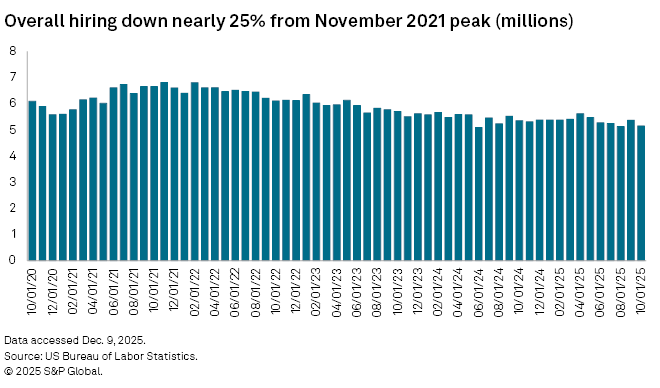
Artificial intelligence could be contributing to an ongoing slowdown in the US labor market as companies boost investments in the technology and reduce hiring as they look to automate open positions.
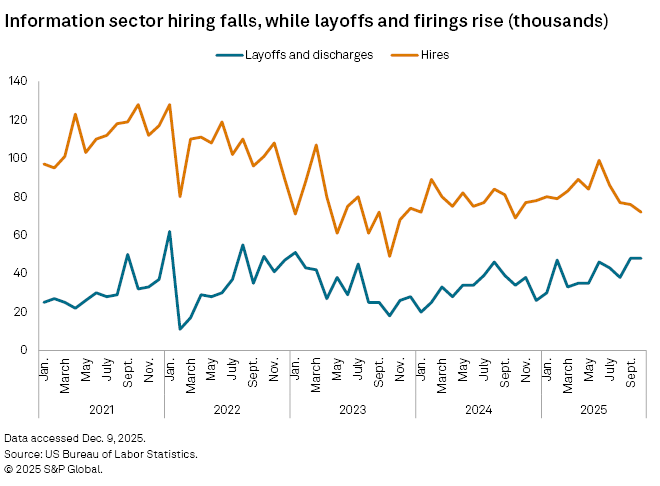
The number of hires in the information sector, which includes tech, fell to 72,000 in October, according to a Bureau of Labor Statistics' report released Dec. 9. This matches the lowest level of monthly hiring for this sector since January 2022 and is down nearly 44% from January 2022. Meanwhile, the number of layoffs and discharges in this sector remained at 48,000 in October, unchanged from September, but up from 20,000 at the start of 2024.
AI's influence over the broader jobs picture appears to be somewhat minimal so far but also seems to be now focused in the tech sector and disproportionately impacting entry-level positions.
"It takes time for the technology to diffuse, and right now it really takes some level of specialized knowledge to apply the technology," said Lucas Hansen, co-founder of CivAI, an AI safety nonprofit.
AI is already able to effectively perform many of the functions of numerous entry-level jobs, but the technology is relatively new and the impact is just beginning to be felt, Hansen said. Ultimately, AI may impact jobs at all experience and wage levels, but for now the most susceptible are entry-level positions with low context and little background information requirements.
This was also mentioned in the Federal Reserve's latest Beige Book, released Nov. 26, a summary of economic conditions from the central bank's 12 districts.
"A few firms noted that artificial intelligence replaced entry-level positions or made existing workers productive enough to curb new hiring," the book states.
Remote jobs are more susceptible to AI, as are jobs where most communication is kept within the company, where weaknesses in the AI tech can be adjusted internally, Hansen with CivAI said.
Exposed jobs
The sectors most exposed to AI transformation include software development, data and analytics, marketing, and accounting, according to an AI at Work report released by Indeed Inc. in September.
The number of entry-level coding or general tech job postings has been among the largest recent declines, said Laura Ullrich, director of economic research in North America at Indeed.
"It's not possible for us to determine if these declines are directly caused by AI, but it is certainly reasonable to believe that AI is at least part of the story," Ullrich said.
The jobs, typically using titles such as "developer" or "analyst," often have average posted wages of $100,000 or more. If AI is reducing the number of these jobs, it signals that these tech advancements are not only impacting lower-wage positions.
"Many of the skills that AI already has are impacting white collar sectors and positions, where wages are relatively high," Ullrich said.
Other sectors such as media and communications may have less overall exposure to AI transformation, Ullrich said. Still, these sectors include positions, such as transcription, that are particularly sensitive to this transformation.
"Overall, I do not believe that AI is replacing a lot of jobs yet," Ullrich said. "Companies are investing massively in hopes that this will be possible soon, and that investment might be displacing hiring."
These new, large investments in AI by many companies may be directly impacting hiring as they hope that any labor gaps will ultimately not be filled by a human.
The biggest impact of AI on entry-level jobs is likely in the software industry, where adoption is more advanced, but automation of customer service and other administrative tasks is taking place across a wide range of industries, said Guy Berger, director of economic research at the Burning Glass Institute.
"There's some evidence of this happening," Berger said. "But it's unclear how much it matters in aggregate and how much it matters relative to the overall business cycle."
Employer ratings down
Since ChatGPT was publicly released about three years ago, overall employer ratings declined only slightly among occupations highly exposed to AI. These ratings fell an additional 0.02 star on a scale of 1 to 5 when compared to other occupations, according to a November study from Glassdoor LLC, a US website where current and former employees review their companies.
Still, the ratings on Glassdoor showed significant differences for early career workers, where the difference was 0.05 star lower when compared to other occupations, and for occupations vulnerable to the current capabilities of large language models, such as translators, software engineers and copywriters.
But these large language models have limits on just how much they can do in the workforce, said Daniel Zhao, chief economist at Glassdoor.
"LLMs already demonstrate impressive, though imperfect, capabilities to summarize text and produce plausibly human-sounding language," Zhao said. "However, LLM capabilities still have room to improve: a chatbot might be close to replacing a first-line customer service agent, but it is not going to replace an author."
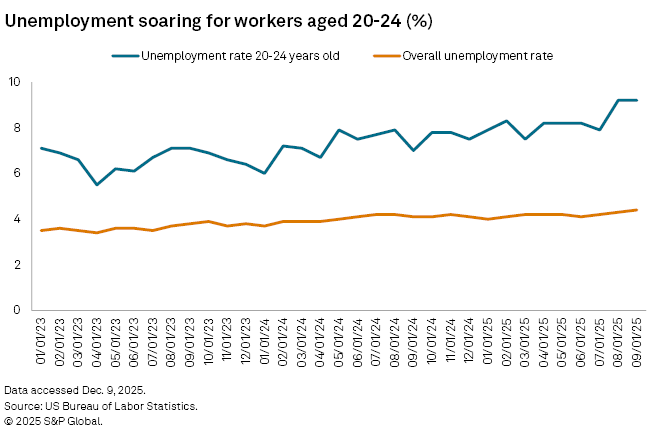
While ratings are in steeper decline for early career workers in fields vulnerable to AI, it is unlikely that AI is significantly harming the job market for potential employees at the entry level, Zhao said. Instead, these younger, potential workers are being hindered by a sluggish hiring environment, and the impact of AI on entry-level job prospects could be overstated.
"AI's capabilities have been improving rapidly, but it is not clear that it will ever reach a level where it can fully replace a wide variety of jobs, rather than remaining a powerful but narrow tool," Zhao said.