


19 Nov, 2025
Utilities eye windfall as Europe's data center demand nears doubling by 2030
By Alex Blackburne and Susan Dlin
|
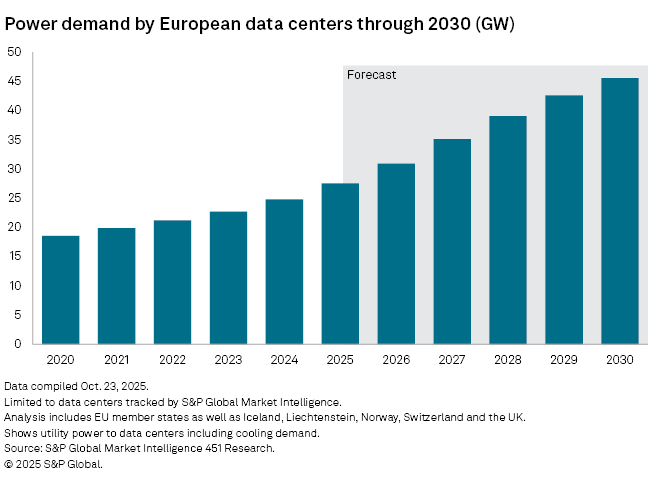
Power demand from European data centers is poised to increase at a compound annual growth rate of more than 10% this decade, reaching 45.6 GW by 2030.
|
Electricity demand from European data centers is set to almost double by 2030, according to the latest forecast from S&P Global Market Intelligence 451 Research, with the wave of investments in AI infrastructure presenting significant opportunities for the region's major power producers.
Companies such as Germany's RWE AG, France's Engie SA, Finland's Fortum Oyj and Portugal's EDP SA are exploring ways to capitalize on the projected growth, much of which is fueled by the proliferation of AI.
RWE's stock recently climbed to its highest level since 2011 after the group gave investors a glimpse of how data centers could affect its business. As well as supplying power to such facilities, RWE is also exploring the sale of former coal sites to hyperscalers.
EDP, which already has more than 3 GW of power contracted with big tech companies globally, similarly sees data center power demand growing across its European markets, such as Portugal and Spain, as well as further afield in the US.
"If this builds up, we will see this incredible amount of demand that will drive electrification," EDP CEO Miguel Stilwell d'Andrade said at the company's Nov. 6 investor day. "It will drive the build-out of renewables over the next couple of years."
Europe's data center power demand hit 24.8 GW at the end of 2024 and is projected to rise 11% by the end of this year, according to 451 Research. Demand is poised to increase at a compound annual growth rate of more than 10% over the remainder of this decade, reaching 45.6 GW by 2030.
The outlook covers the 27 EU member states, as well as Iceland, Liechtenstein, Norway, Switzerland and the UK, and includes hyperscale, leased, enterprise-owned and crypto-mining data centers tracked by 451 Research.
Expansion opportunities
Europe's data center capacity is dominated by the FLAP markets — Frankfurt, Germany; London; Amsterdam; and Paris — which are becoming increasingly constrained, leading operators to look elsewhere for locations.
The market is mostly driven by electricity prices and clean energy access, according to Filippo Bonanno, research analyst at 451 Research. A cooler climate also helps minimize electricity consumption of the data center's cooling systems, improving price competitiveness.
In this context, the Nordic region has emerged as a hotspot, with social media platforms such as TikTok Inc. choosing Norway for their European operations, and Google LLC and Microsoft Corp. expanding in Finland.
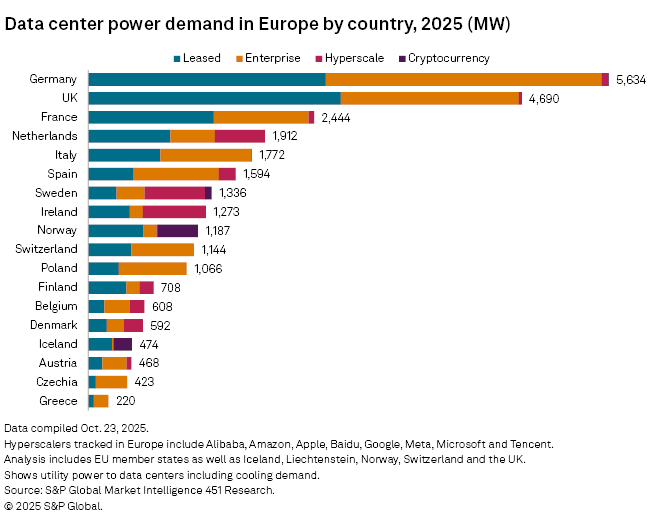
Sweden is the largest Nordic data center market with 1.3 GW of existing power demand — the result of legacy tax incentives that fueled development until 2023 — while Norway is close behind with 1.2 GW, according to 451 Research data. Finland has about 700 MW and Denmark has about 600 MW.
Elsewhere in Europe, the populous business hubs of Madrid and Milan are also becoming increasingly attractive locations, with hyperscalers driving much of the demand, according to Bonanno.
Madrid is a "bridge" between Europe and the Americas, the analyst said, pointing to submarine data cables that land on Spanish shores from Latin America. Meanwhile, Milan is "one of the best-connected metros with a few milliseconds latency to Paris, Frankfurt, Zurich."
Spain as a whole has 1.6 GW of data center power demand today and is seen as a particular growth hotspot given its vast renewables pipeline. Italy, meanwhile, has 1.8 GW of existing demand, 451 Research data shows.
Both Madrid and Milan are set to grow at a compound annual growth rate of more than 15% from 2025 to 2030 in terms of installed data center capacity, Bonanno added.
Utility optimism
Some of Europe's largest power producers are already positioning themselves to benefit from the emerging opportunity in the data center market.
Several are looking to convert or sell sites once used for thermal power stations, with RWE on Nov. 12 announcing the sale of land at a former coal plant in the UK to an unnamed hyperscaler for a book gain of €225 million.
The company is working on "more than 10" similar opportunities across Germany, the Netherlands and the UK, CFO Michael Müller said on the company's third-quarter earnings call.
Germany already leads the way in Europe in terms of power demand from data centers, with 5.6 GW of demand in 2025, according to 451 Research data. The UK is second with 4.7 GW, while the Netherlands is fourth with 1.9 GW.
Analysts at BofA Securities said Müller's comments suggest a potential value of RWE's near-term pipeline of more than €2 billion.
They added that the company's former coal sites will amount to an estimated 16 GW of grid connection capacity by the end of the decade. If even one-third of that were to be repurposed for data centers, that implies more than €5 billion of potential real estate value, equating to about 15% of RWE's market capitalization, the analysts said.
Engie and Electricité de France SA are among other utilities looking at using existing or former generation sites for data centers. EDF announced a deal with OpCore SAS Nov. 17 to build a €4 billion data center at a shuttered coal plant southeast of Paris.
Engie is also looking to leverage its renewables and battery assets to provide 24/7 baseload power purchase agreements to tech companies, with 5 GW of tech power purchase agreements already signed, CEO Catherine MacGregor said on the company's Nov. 6 earnings call.
The data center boom "leads me to state with conviction that in the US, particularly, even those who don't believe in the energy transition believe in energy additions," MacGregor said, adding that the European market is set to grow as data and digital sovereignty rise on the political agenda.
Concrete investments
The optimism in the power sector is underpinned by massive investments being made into AI-fueled tech infrastructure in Europe.
Google announced plans Nov. 10 to invest €5.5 billion into digital infrastructure in Germany through 2029, including a new data center in Dietzenbach, near Frankfurt, Germany's financial center. The investment includes PPAs with Engie and Ørsted A/S.
A day after Google's announcement, another tech giant, Microsoft, unveiled a $10 billion investment into AI computing capacity in Portugal in partnership with START - Sines Transatlantic Renewable & Technology Campus SA, NVIDIA Corp. and NScale Global Holdings Ltd.
Start Campus, located in the coastal municipality of Sines, a hub for oil refining and petrochemicals, is being developed across six phases, eventually ramping up to 1.2 GW in size.
The project is "strategically positioned to leverage Portugal's competitive power prices, renewable energy resources and robust connectivity infrastructure," 451 Research said in a report earlier this year.
RWE's Müller cited Google's investment in Germany, as well as another recent partnership between Deutsche Telekom AG and NVIDIA, as examples that support the company's bullish position on demand growth.
"That's for me a clear sign that [hyperscalers] are now moving forward into doing concrete investments, and that obviously will also drive the power demand," Müller said.
451 Research is a technology research group within S&P Global Market Intelligence.