12 Nov, 2025
EVs could be the next energy resource with vehicle-to-grid programs
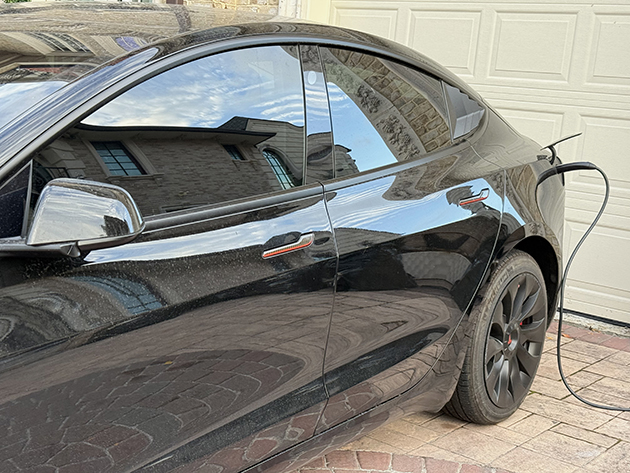
| Some EV and power companies are conducting vehicle-to-grid pilot projects to help meet peak demand. Source: Lindsey Nicholson/UCG/Universal Images Group via Getty Images. |
As power companies race to meet rising energy demand, some are looking to electric vehicles for help.
When charging, fleets of EVs can be synchronized with software to operate as distributed power plants, sometimes referred to as virtual power plants. Using vehicle-to-grid (V2G) technology platforms that rely on a bidirectional charger, EV batteries can also send power back to the grid.
Although V2G remains in the early stages of development, several pilot programs in the US could set the stage for a broader rollout. If scaled up, the technology could become a valuable new tool to meet power demand spikes, especially in the summer, while offsetting vehicle and grid costs for consumers, according to utilities, automakers and technology suppliers.
"We can save money for our broad electric customer base if we're able to orchestrate EVs in the right way," said Paul Doherty, spokesperson for PG&E Corp. subsidiary Pacific Gas and Electric Co. (PG&E), which has been testing V2G in its Northern and Central California service territory. "We won't have to do the distribution grid upgrades if we can smartly manage the loads that are growing using technology, using managed charging, using vehicle-to-grid."
In one pilot project, PG&E is partnering with Nissan Motor Co. Ltd. and other participants to use Leaf EVs to expand a microgrid in Humboldt County, California. The Redwood Coast Airport microgrid, at the Arcata–Eureka Airport, operates in an area with reliability issues due to severe weather.
PG&E worked with Fermata Energy LLC, the bidirectional charger company, to install the chargers at the multi-customer microgrid, which also includes solar and battery storage.
"It will essentially allow them to expand the capacity of the microgrid up there, and it helps with balancing the supply," Doherty said in an interview.
Other project participants include the Schatz Energy Research Center at California State Polytechnic University, Humboldt, and the Redwood Coast Energy Authority, a local community choice aggregator.
This microgrid is part of PG&E's vehicle-to-everything (V2X) pilot program, which also includes vehicle-to-home and vehicle-to-commercial approaches.
However, only a handful of residential customers are enrolled out of 1,000 spots.
"I think that's largely because the technology is still pretty nascent," Doherty said, adding that PG&E is "providing up-front incentives for customers to join."
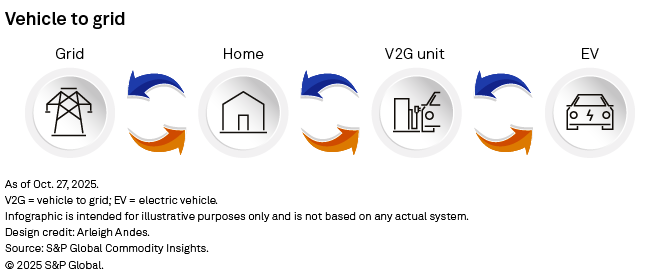
PG&E is also using commercial fleets, primarily electric school buses — from school districts such as Oakland and Fremont that use electric buses — to provide energy back to the grid.
Some Ford Motor Co. and General Motors Co. models have been approved for residential use cases, while models from RIDE, Blue Bird Corp., Micro Bird and Nissan have been approved for commercial fleet use cases.
"We've proven that we can safely and reliably power the grid with our EVs," GM Energy Chief Revenue Officer Aseem Kapur told Platts, part of S&P Global Commodity Insights.
PG&E is working with other EV automakers to get their bidirectional capabilities approved, even amid uncertainty over future production volumes.
Baltimore Gas and Electric Co. is another utility exploring V2G, partnering with Sunrun Inc. and Ford for a pilot program over the past two summers that focused on vehicle-to-grid and vehicle-to-home.
The pilot program used Ford F-150 Lightning trucks.
"[The] Baltimore Gas & Electric program this summer was really exciting because it was the first time in the country — as far as we are aware — that actual residential customers used electric vehicles to export energy to the grid at times of peak demand," Chris Rauscher, head of grid services at Sunrun, told Platts. "It also showed that bidirectional electric vehicles are just batteries on wheels and can provide the same amount of incredible grid support that batteries do."
Participants plugged their EVs into the bidirectional chargers and used the Sunrun app to send energy back to the grid from 5 p.m. to 9 p.m. local time during demand peak every day last summer. The EV would then charge overnight. Participants were compensated for the energy they sent back.
Brian Foreman, of Highland, Maryland, was one of three participants in the pilot program.
"It all is just so seamless," Foreman told Platts. "If you're sitting in the house, the lights don't flicker, you don't notice anything has changed ... and then at 9:00 p.m. when it finishes and the power goes the other way, you don't notice anything either."
"If you weren't monitoring it through the app ... you'd never know that that truck was doing that back and forth," Foreman said.
One reason Foreman bought the truck was because "it could provide backup power to the house and we didn't have a generator."
Benefits and opportunities
V2G or V2X programs can provide various benefits to participants, nonparticipants and the grid, according to PG&E's Doherty.
"Having that ability to ride through an outage using your vehicle and also to power your home when prices are highest, that's kind of the key use cases we see today," Doherty said. "And being able to charge off-peak is also key."
Benefits can be amplified because EV batteries provide more energy than a stationary home battery.
"It varies by the size of the EV," said Kapur of GM Energy. "Our EVs range anywhere from 60-kWh battery pack to all the way up to 200-kWh battery pack." That is five to 10 times larger than typical stationary storage systems, Kapur added.
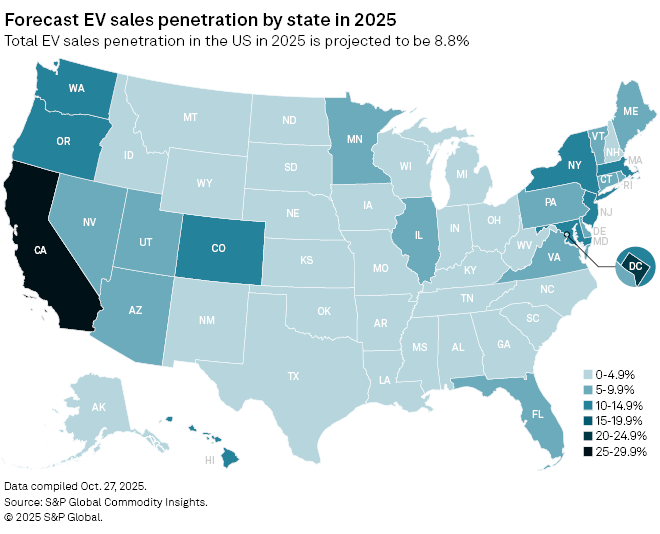
About 6 million EVs have been sold in the US since 2020, according to Commodity Insights. But only a small share of those are equipped for bidirectional charging, including various models from Ford, Nissan, Tesla Inc. and GM.
"We have leaned in and we're going all in," Kapur said. "Given where the energy industry is headed, how energy is becoming more and more important and where the state of the grid is and all the energy demand that the grid is facing, we believe having EVs as flexible grid resources is the North Star."
Other V2G stakeholders echoed the opportunity to help meet the grid's growing energy needs with big EV batteries.
"Today, there's more energy capacity in electric vehicles on the road than there is in all stationary batteries combined," said Sunrun's Rauscher. "This market is really, really going to take off in the next couple of years as you see electric vehicles being bidirectional just as a standard feature."
"It's about six to eight times more, depending on the size of the battery in the car," added Marco Krapels, chief marketing officer at Enphase Energy Inc. "That moves the needle."
Enphase is developing a bidirectional charger, which is expected to come out in the second half of 2026.
"We would be able to unlock a significant amount of flexible capacity onto the grid," Krapels said.
Bidirectional EVs or chargers could be sold to new and existing customers.
"For anyone that drives an EV, you can get more bang for your buck by upgrading to a bidirectional charger," Krapels said.
Challenges remain
However, it may take some time for V2G to increase its market presence.
"This is going to be one of those things where nobody has heard of it until everyone has it," Rauscher said, pointing to the next decade as a possible turning point. "It will come back to a cost decline in the bidirectional charger and the bidirectional functionality, and then utilities getting on board."
Rauscher said reaching scale is key to removing concerns about when and if an EV owner is going to plug in and discharge their battery.
"It doesn't matter once you reach scale," Rauscher said. "Any one individual customer may not plug in, but it doesn't matter because we'll have tens of thousands, hundreds of thousands of customers, and we'll be able to forecast exactly how many customers will be available at any one time."
Hardware costs and charger uniformity are challenges, GM Energy's Kapur acknowledged.
"We believe that these capabilities should be defaulted in every vehicle," Kapur said. "How do we make it more affordable? ... The digital experience needs to be more uniform and consistent. And most importantly, how do we reduce the transaction friction such that the customers can access it at any point and anywhere?"
"The rest of it is really just getting utilities and regulators to see that these bidirectional cars are no different than stationary batteries in terms of interconnection and permitting and programs," added Rauscher.
Krapels of Enphase highlighted the need to convince more utilities and regulators of V2G's potential.
"It's important that utilities [and] utility commissions understand that this ... can scale and meet the demand, that it can be trusted and that it will be there when they need it," Krapels said.