


8 Jan, 2025
Trump tariff threats add to gloomy economic outlook for European banks
By Cathal McElroy and Cheska Lozano
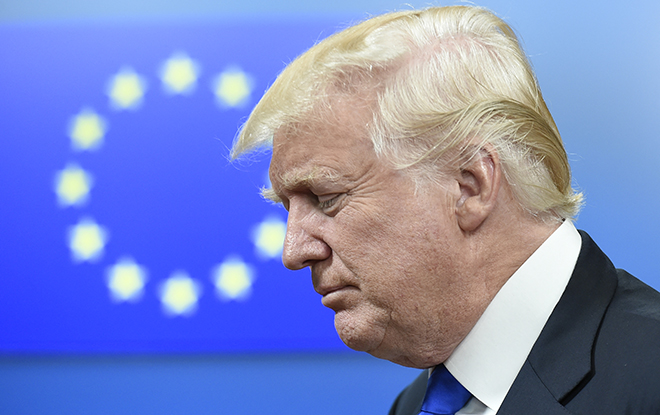
| US President-elect Donald Trump has threatened to hit the European Union and other economies with tariffs of at least 10% on their exports to the US. Source: Thierry Charlier/AFP via Getty Images Europe. |
Potential trade tariffs imposed by US President-elect Donald Trump are compounding the economic challenges facing European banks this year.
Trump
The tariff threats come as the European economy wrestles with chronically weak growth that has weighed on the fortunes of its banks. The EU grew 21% between 2007 and 2022 in dollar terms compared to 72% for the US and 290% for China, according to Spanish foreign policy and international affairs publication Politica Exterior. The European Central Bank also recently downgraded its 2025 and 2026 growth forecasts for the eurozone amid government collapses in the bloc's most influential members, Germany and France.
"Europe is in a very bad situation," independent banking consultant Sam Theodore said in an interview. "No energy independence, no technology independence and no defence independence or self-sufficiency."
Automotive exposure
Germany's economy has slumped since Russia's invasion of Ukraine in 2022 ended its access to the cheap Russian gas that had powered its industrial production. Trump's tariffs, aimed at protecting and creating manufacturing jobs in the US and boosting the country's growth, would add to its economic woes.
The country's automakers could be targeted with tariffs of more than 10%. BMW Group and Mercedes-Benz Group AG make almost a quarter of their sales in the US and Canada, while Volkswagen AG makes just over a fifth.
"The car industry is a big part of German GDP, above 10%," Sonja Forster, senior vice president, European financial institutions at Morningstar DBRS, said in an interview. "So there is definitely a downside risk for banks related to it."
German automakers are already struggling to compete with an influx of cheap electric vehicles from China, which prompted the EU to smack tariffs on Chinese EV imports in October. The automakers' difficulties were underlined that same month when Volkswagen announced the loss of tens of thousands of jobs as its plans to close three factories and shrink its remaining plants.
"It's definitely a sector that we are closely watching," said Forster. "The banks I've spoken to in recent years had been preparing for these structural changes, had reduced their exposure and, in particular, their exposure to suppliers that depend on combustion engines."
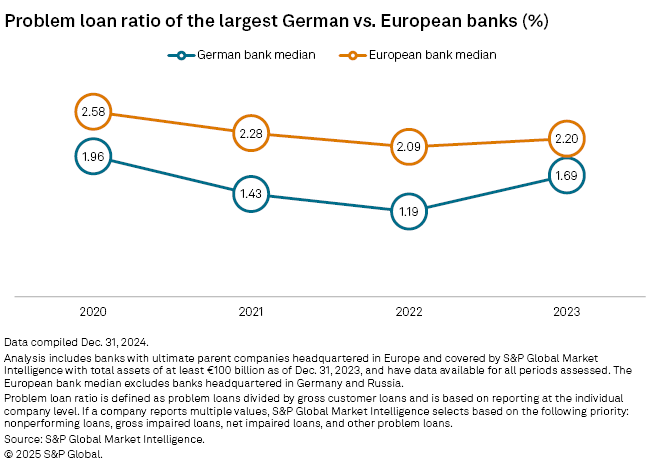
While German banks have typically held a lower proportion of non-performing loans (NPLs) than the European average, that gap narrowed significantly in 2023, S&P Global Market Intelligence data shows. The median NPL ratio among large German banks increased 50 basis points to 1.69%, compared to a 5 bps reduction to 2.05% among Europe's largest banks.
The impact of potential tariffs on Germany's economy even has banks in neighboring countries expressing some concern about their potential impact. "The recent election of Trump has increased downside risk to the eurozone growth and inflation outlook, especially for export-oriented countries such as Germany and the Netherlands," CEO of Dutch bank ABN AMRO Bank NV Robert Swaak said during the bank's third-quarter earnings call in November.
Ireland's tax bill
Trump's trade and economic policies could also pose a specific threat to Ireland and its banks. Ireland's economy is heavily reliant on US tech and pharmaceutical firms, who have based their European businesses in the country primarily to benefit from its comparatively low 12.5% corporate tax rate.
Trump has proposed cutting the US corporate tax rate to 15% from 21%, which could tempt US firms to relocate some of their Irish output to their home market.
"That erodes some of Ireland's tax advantage," John Cronin, European bank analyst at Seapoint Insights, said in an interview. "A lot of the US firms' businesses in Ireland have highly specialized, customized facilities that you can't just uproot overnight, but I would be concerned medium term in terms of what the implications of some of Trump's changes would be."
US multinationals employ almost 14% of the country's workforce directly or indirectly, according to data from the American Chamber of Commerce and the Irish Central Statistics Office. More than half of Ireland's corporate tax bill in 2023 was paid by just 10 US companies.
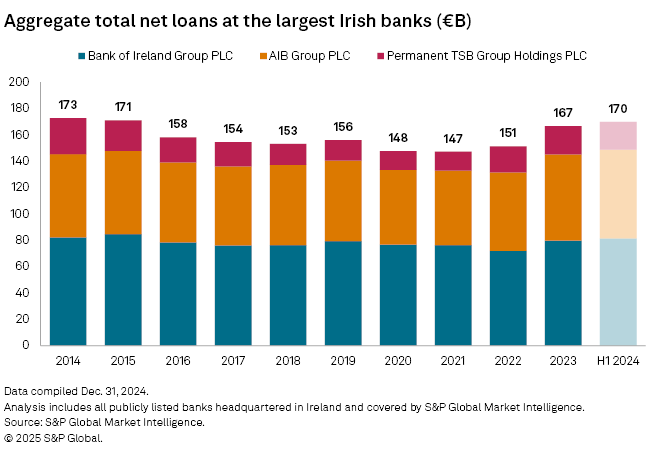
US companies have helped fuel a sustained period of strong economic growth in Ireland, which in turn has enabled the country's banks rebuild their loan books to similar levels seen 10 years ago, despite them being forced of offload large tranches of bad loans during that period. Aggregate total net loans at Bank of Ireland Group PLC, Allied Irish Banks p.l.c. and Permanent TSB Group Holdings PLC reached around €170 billion at the end of the first half of 2024, the highest level since 2015, Market Intelligence data shows.
While Irish banks' direct exposures to US multinationals in Ireland are likely to be limited, a significant exit of US firms from Ireland would still shake the Irish economy and its banks' loan books, said Diarmaid Sheridan, senior director of equity research at Irish wealth management and capital markets firm Davy.
"The concern for Irish banks would be if we were to see a big employment shock, and on the secondary or tertiary impacts of what happens with more localized businesses that have popped up in areas that have large manufacturing facilities belonging to these US firms," said Sheridan.
Regulatory divergence
Europe's economic sluggishness and uncertain prospects prompted former ECB president Mario Draghi to publish a highly anticipated report in October setting out a roadmap to resurrect the continent's fortunes. Among its main recommendations were an increase in annual investment of €800 billion, the full implementation of the European Single Market and a reduction in regulation.
The call for lighter oversight comes as US banks anticipate making further gains on their European counterparts from banking deregulation under a new Trump administration. Trump and his team of advisers are reported to be exploring radical changes to the banking sector that would limit the power of regulators to rein in US lenders' risk-taking.
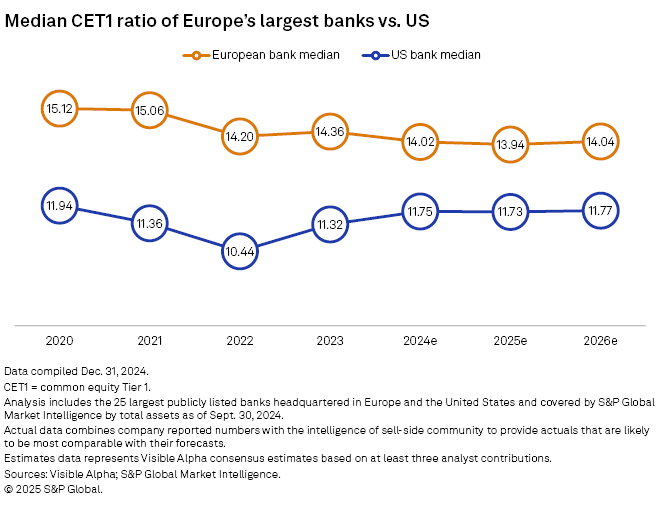
European banks currently hold more regulatory capital than their US counterparts as a percentage of risk-weighted assets and are expected to continue to do so in the coming years, making them less profitable and appealing to investors.
The median common equity Tier 1 capital ratio — a key measure of solvency — of Europe's largest banks is estimated to exceed 14% by the end of 2026, Market Intelligence and Visible Alpha analyst consensus estimates data shows. This compares to less than 11.8% for US banks.
Yet Europe is unlikely to follow Trump's lead in deregulating its banking sector as current rules have proven valuable in preventing the kind of bank failures seen in the US in 2022, Marco Troiano, managing director, financial institutions team at Scope Ratings, said during a Dec. 3 webinar. The eurozone is also still economically and politically fragile, he added.
"I don't think we will see a loosening of regulations [in Europe]," said Troiano. "There is zero appetite to see that kind of scenario."