9 Dec, 2022
How US DOE plans to require all-electric construction in federal buildings

|
U.S. Energy Secretary Jennifer Granholm and the Energy Department have spearheaded many aspects of President Joe Biden's policy supporting building electrification. |
The Biden administration has charted an unexpected path to prohibiting fossil fuel use in many new and renovated federal buildings, using an unfulfilled mandate in a 2007 energy bill passed by former President George W. Bush.
The U.S. Energy Department on Dec. 7 rebooted the long-overdue rulemaking, seizing on a provision in the 2007 law that required a large step down in fossil fuel-based energy consumption in federal building construction. The DOE said the rule would accelerate electrification by phasing out fossil fuels, a policy the Biden administration has supported through landmark infrastructure and climate bills, research and development, and partnerships with states and cities.
"Ridding pollution from our buildings and adopting clean electricity are some of the most cost-effective and future-oriented solutions we have to combat climate change," U.S. Energy Secretary Jennifer Granholm said in a Dec. 7 press release. "For the first time ever, DOE is establishing a firm timetable to reduce the government's carbon footprint in new and existing federal facilities."
In fact, the schedule that the DOE will follow was outlined in the Energy Independence and Security Act of 2007, a bill that prioritized energy efficiency and alternative fuels in the years before the U.S. shale boom. Yet the Biden administration's implementation plan is novel and would overhaul how the federal government powers its buildings.
Path to electrification in 2007 bill
Under the 2007 law, federal agencies were supposed to increasingly reduce the amount of fossil fuel-generated energy that they used in new construction and major renovations beginning in 2010. By 2030, new and renovated federal buildings would consume 100% less fossil fuel-generated energy than a similar structure designed in 2003.
However, the DOE never issued regulations, despite initiating a rulemaking in 2010 and releasing an update in 2014. With the rulemaking incomplete, three of the fossil fuel reduction deadlines came and went in 2010, 2015 and 2020.
The new DOE proposal would target the remaining deadlines in 2025 and 2030, which require 90% and 100% reductions, respectively. The rule would feature a major change from the agency's past proposals: It would only apply to fossil fuels consumed in on-site equipment and building systems, such as furnaces and cooktops, known as Scope 1 sources. The DOE's previous proposals required agencies to also account for fossil fuels used to generate electricity at off-site power plants, or Scope 2 sources.
With electric power purchases no longer part of agencies' calculations, DOE said there was a clear path to compliance: "The new proposal would simply require elimination of on-site fossil fuel usage in the years 2030 and beyond." In practice, this would often mean installing electric heating and cooking equipment instead of gas or other fossil fuel options.
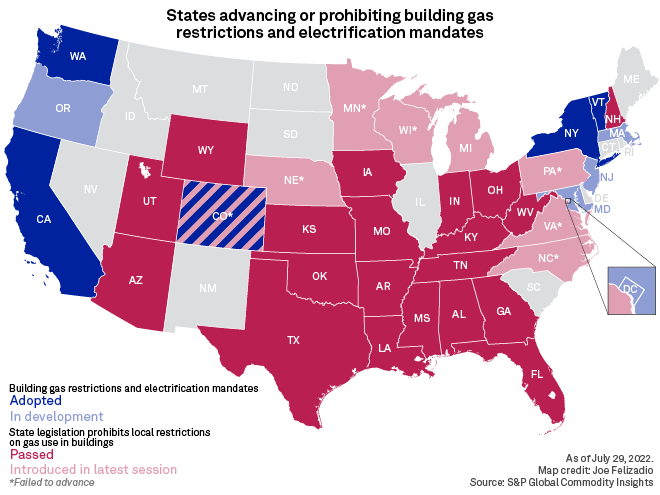
The approach puts the DOE on track to implement a policy similar to the building gas bans that took root in California starting in 2019 and have since spread to several other states. These policies are premised on the idea that the electric grid is increasingly supplied by zero-carbon power generation, and therefore requiring all-electric construction yields long-term climate benefits.
The DOE proposal reflected that thinking. The agency said the rulemaking no longer needs to cover Scope 2 emissions in light of President Joe Biden's December 2021 executive order that set a goal of powering government operations with 100% zero-carbon electricity by 2030.
"By ensuring that federal buildings are designed — either from the ground up, or when being renovated — to rely on the electric grid, the rule ensures that long term, as the grid integrates more carbon-free energies, emissions will be reduced," the DOE said.
Gas industry voices opposition
The proposal drew swift opposition from the American Gas Association, which represents the nation's investor-owned gas utilities and has strongly opposed local gas bans.
"Eliminating natural gas in federal buildings is an impractical, unscientific, and expensive idea that will have no environmental benefit," AGA President and CEO Karen Harbert said in a Dec. 7 statement. "In reality, the demand for electricity fueled by natural gas will only increase and the costs will be borne by every taxpayer."
On Dec. 8, the Natural Gas Council, a coalition of oil and gas trade groups, warned the rule would "be overly expensive and risks crowding out informed consideration of other emissions reduction options." The council recommended a technology-neutral approach.
The DOE acknowledged that the policy may result in increased energy costs and would not necessarily produce immediate greenhouse gas emissions reductions due to continued fossil fuel use in power generation. However, the agency estimated the rule would save taxpayers about $8 million per year in equipment costs. Over 30 years, it would reduce CO2 and methane emissions by an amount roughly equal to the emissions produced by 300,000 homes in a single year, the DOE said.
Rule targets renovations, includes exemptions
The rule would not apply to all federal building projects. It would only cover new construction and major renovations that exceed a cost threshold established in the 2007 law, which rises with inflation. For projects that entered the design phase in fiscal year 2022, the threshold would be just under $3.4 million.
The DOE said the rule would apply to any gut renovation that is "so extensive that it replaces all Scope 1 fossil fuel-using systems in the building." However, the DOE also proposed requirements for less extensive renovations that present "significant opportunities for energy efficiency or reduction in fossil fuel-related energy."
These types of projects could include replacing heating and air conditioning, hot water, and cooking equipment, which have a "major impact on fossil fuel usage," the DOE said. If these renovation projects surpass the cost threshold, agencies would have to replace components and systems with electric or non-fossil fuel equipment designated under the Federal Energy Management Program or Energy Star rating system.
The department also proposed excluding on-site fossil fuel consumption for certain manufacturing and industrial activities and research activities. The rule only would apply to stationary combustion sources, so emissions tied to natural gas-fueled vehicles would not count against facilities.
The underlying law also required the DOE to allow agencies to petition for a less stringent reduction target if it is not technically practicable to meet the target based on a building's functional needs.
The DOE said it would also consider a separate waiver process for the U.S. Defense Department.
S&P Global Commodity Insights produces content for distribution on S&P Capital IQ Pro.