


22 Jun, 2022
US SEC's climate risk disclosure plan draws intense debate

By Karin Rives

| The U.S. Securities and Exchange Commission's building in Washington, D.C. Source: Chip Somodevilla/Getty Images News via Getty Images |
The U.S. Securities and Exchange Commission is sifting through nearly 10,600 public comments submitted on its landmark proposal to require publicly traded companies to reveal climate risks and carbon emissions data in financial filings.
The SEC's plan has become a hot-button issue, pitting Republicans against Democrats, with a rush of statements issued during the final days of the public comment period that ended June 17. If the agency moves forward with the rule, it may be released as soon as December.
The proposed rule has also divided the energy industry. Some businesses view it as an attempt to drive oil companies and other fossil fuel-heavy industries out of business, while companies that already rely heavily on renewable energy sources want the rule strengthened.
The SEC has said that the proposed climate-risk disclosure rule is necessary to bring clarity and consistency for investors and companies alike. The lack of standards today has created an uncomfortable vacuum, SEC Commissioner Carolina Crenshaw wrote when the rule was first proposed in March.
"The result has been frustration — with companies making disparate climate disclosures that vary in scope, specificity, location and reliability; and investors who do not have accurate, reliable and comparable information," Crenshaw asserted.
The rule comes as the European Union, Japan and several other countries are considering standardizing corporate reports on climate-related business risks.
Republicans demand SEC emails
According to an analysis by the Sierra Club, a U.S.-based environmental nonprofit, at least 75% of the comments submitted on the SEC proposal are supportive. But the opposition has been vocal.
Twelve Republican senators and members of the U.S. Senate's Committee on Banking, Housing and Urban Affairs sent a letter to the SEC on June 15 requesting that the agency answer several questions on how the rule was developed and justified. Among other things, they wanted to know how the proposed climate disclosure rule would affect energy prices and other costs attributed to the new reporting requirements and whether those impacts had been analyzed.
The senators also argued that the proposed disclosure rule "raises First Amendment rights because it would appear to compel speech." They requested copies of all emails and text messages related to the rule that SEC employees sent to anyone outside the executive branch or to other federal agencies since January 20, 2021, when President Joe Biden first took office. In addition, the Republican senators asked to see any correspondence including keywords such as "climate justice" and "global warming."
Attorneys general from 24 Republican-led states weighed in on the same day, accusing the SEC of trying to "regulate disfavored industries into oblivion." In a 42-page letter to the agency, they also argued that the proposed rule sidesteps the SEC's "materiality" requirement that underpins all financial disclosures. More than 100 House Republicans added in a separate June 15 letter that the SEC plan "will deservedly draw legal challenges."
Democrats want broader Scope 3 mandates
Democrats, on the other hand, as well as some investor groups, asked the SEC to expand the proposed rule. They say the climate risks companies face are as material to investors as any other business risks and that more transparency is needed.
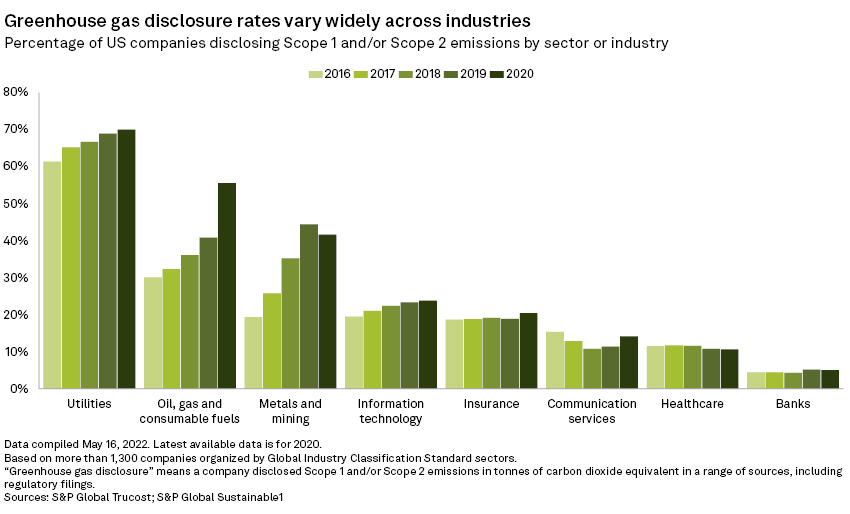
In a June 17 letter, five Senate Democrats on the banking committee asked the SEC to include a "quantitative threshold" for mandatory reporting of greenhouse gas emissions that result from end-user activities that companies cannot directly control, known as Scope 3 emissions.
In its proposed rule, the SEC said that Scope 3 reporting requirements should only apply to companies for which Scope 3 emissions are deemed material or to companies that have a Scope 3 carbon reduction goal. Some small companies would also be exempted from the provisions.
"A study of 25 major multinational corporations found that Scope 3 emissions accounted for 87% of a particular company’s total emissions on average, but only 8 of 25 companies voluntarily disclosed even a moderate level of detail on their plans to address those emissions," the senators wrote. "If registrants are not required to report their Scope 3 emissions, the most carbon-intensive companies that are least prepared for a low-carbon transition will give investors a misleading picture of their portfolio risk exposure."
But reporting Scope 3 emissions accurately is difficult and mechanisms for reporting general climate data are not yet in place.
We "cannot support the SEC mandating disclosure of Scope 3 emissions as proposed," Eric Pan, president and CEO of the Investment Company Institute, an association representing regulated investment funds, said in a statement. "Data gaps and an absence of agreed-upon methodologies would leave deficiencies in any such disclosure."
Unpacking offsets
Others who support the proposed rule worry that the SEC will overlook critical tenets of emissions accounting.
Katherine Ott, Constellation Energy Corp.'s vice president of sustainability and climate strategy, urged the agency to let companies include nuclear and hydroelectric energy resources in the renewable energy credits companies can buy to meet their emissions reduction goals. Ott also asked the SEC to require publicly traded companies to disclose their methodology when using such credits.
Investors need information to "differentiate between companies that match on an annual basis and continue to source energy needs from fossil fuels for significant periods of the year and companies that are achieving the same goals without supporting the continued use of fossil fuels," Ott wrote.
Constellation, which plans to deliver fossil-free electricity by 2040, has signed on to the 24/7 Carbon-Free Energy Compact, a United Nations-led initiative to ensure that every kilowatt-hour of electricity consumed is supplied from carbon-free electricity sources, 24 hours a day.