


14 Feb, 2023
Studies aim to value benefits of additional transmission during extreme events

|
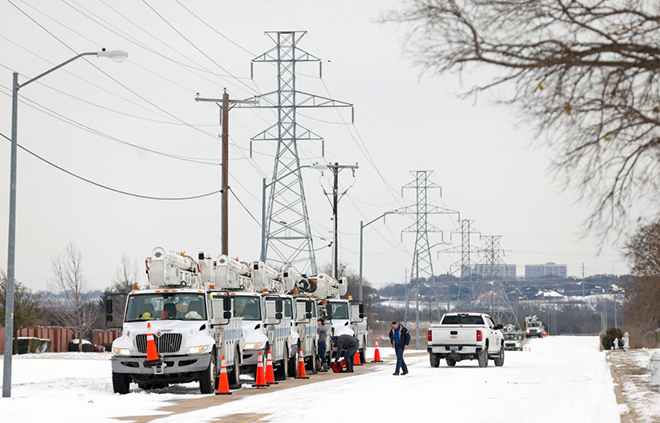
Utility service trucks line up in Fort Worth, Texas, during a storm in February 2021. New research says the state could have saved up to $1 billion in transmission costs during the storm if it had more interconnections to neighboring grids. |
Additional transmission capacity between U.S. regional electricity markets could have saved consumers hundreds of millions of dollars in energy costs by making it easier to transmit power to high-demand areas, particularly during the December 2022 winter storm, according to new studies that industry groups are citing as a reason for more investment.
The American Council on Renewable Energy, or ACORE, commissioned a study by consulting firm Grid Strategies LLC estimating the benefit of an additional 1,000 MW of transmission capacity between various power markets in the Central and Eastern U.S.
The study, released Feb. 8 and discussed at a webinar, estimated the value of the additional transmission capacity during Winter Storm Elliott, which marched across the Central and Eastern U.S. just before Christmas 2022. It knocked numerous power plants out of service unexpectedly and forced both Duke Energy Corp. in the Carolinas and the Tennessee Valley Authority to call for rolling blackouts.
On Christmas Eve morning, a blast of polar air drove up wind energy output across the Midcontinent ISO, the Southwest Power Pool, the Electric Reliability Council of Texas Inc. and PJM Interconnection LLC grids. Wind plants were so productive that they had to curtail their power as prices went negative in western MISO, "likely reflecting the curtailment of wind energy," the study said.
Grid Strategies Vice President Michael Goggin noted during the webinar that even though such extreme events account for about 5% of the hours in a year, they also account for 50% of the value of transmission.
"But if you look at most of the planning processes in this country, they exclude these extreme event hours," Goggin said. "They take the normalized weather year, and you don't really look at the value of transmission during these extreme events; you're missing half the value right there."
Additional transmission capacity between the ERCOT North region and the TVA, for example, was valued at $95 million just for the Dec. 22-26, 2022, period, primarily for the TVA customers who would have received the additional power, the report said.
2022 a costly year
A separate Lawrence Berkeley National Laboratory study, released Feb. 7, measured the value in 2022 of new transmission lines in reliving congestion in wholesale energy markets. Researchers used electricity price arbitrage within a set of 64 location pairs across the U.S.
In 2022 — a year marked by inflation, extreme weather and power shortages — additional transmission could have reduced system costs more than any year since 2012, according to the study. A number of interregional links reached a value of $200 million to $300 million per 1,000 MW of transmission capacity, or $23 to $34 per MWh.
Dev Millstein, a research scientist at Lawrence Berkeley National Laboratory and lead author of the lab's study, said in an email that the price differences demonstrate how transmission allows lower-cost generators to serve load.
"So, for example, if prices spike high in one region because the generators in that area are running at capacity, and the region would need to dispatch additional more expensive local generators (which would drive up local prices), new transmission would provide that region the option to call on cheaper generators elsewhere to meet its electricity demand," Millstein said. "Thus, transmission can help to reduce regional or local wholesale electricity prices during particularly high-priced hours."
Value of transmission understated
While researchers measured the costs of transmission congestion, some say such figures do not demonstrate the human value of a grid that can withstand severe weather.
Allison Silverstein, a former senior adviser for the Federal Energy Regulatory Commission, said during the ACORE webinar that the value of transmission, as measured simply by market transaction value or congestion cost, "grossly understates its importance." As the weather gets more intense, the grid is not keeping up with it, Silverstein said.
"[T]he consequences of having your entire community iced in and out of service, losing parts of your house, losing your food, not taking a shower for multiple days, having to figure out how to feed your kids — all of this creates a set of traumas that is grossly underestimated by the classic customer value of lost load," Silverstein said.
The Berkeley study — funded by the U.S. Energy Department's Office of Energy Efficiency and Renewable Energy — excluded other economic benefits of new transmission lines, such as grid reliability, the authors noted. The value of new transmission is also subject to saturation of transmission projects in an area, they said.
Policy traction
Asked during the webinar if FERC would take action on interregional transmission in 2023, former chairman Richard Glick responded that there is "quite a bit of interest among not only [FERC] commissioners, I think, but also state commissioners, as exemplified a joint task force by the [National Association of Regulatory Utility Commissioners] and FERC on interregional transmission."
Established in June 2021, the task force is scheduled to meet again Feb. 15 in Washington, D.C. (Docket No. AD21-15)
"I think there's strong interest about moving forward with something that will enhance, or require, greater amounts of interregional capacity," Glick said. "Now, it's not easy; you have to figure out what gets built, who decides what gets built, who pays for it — all those issues. But I am optimistic that you're going to eventually see something from FERC on that particular issue."
ACORE President and CEO Greg Wetstone said that while a proposal to extend the investment tax credit to high-voltage transmission projects "ended up on the cutting room floor" during negotiations to pass the Inflation Reduction Act, there is room for bipartisan compromise in a newly divided Congress.
"This is not going to be an easy Congress to legislate in; we're aware of that," Wetstone said. "I just think it's worth recognizing the politics of transmission have changed dramatically in the last three or four years. I mean, this issue was a political orphan for years, and now you see broad recognition. ... I think if there is a tax package that comes through — and that's a pretty big if — we have a real shot at this."
Willie Phillips, FERC's acting chairman, said the agency will proceed with transmission rulemakings in 2023.
S&P Global Commodity Insights produces content for distribution on S&P Capital IQ Pro.