27 Dec, 2024
Power industry challenges teed up for Trump's return

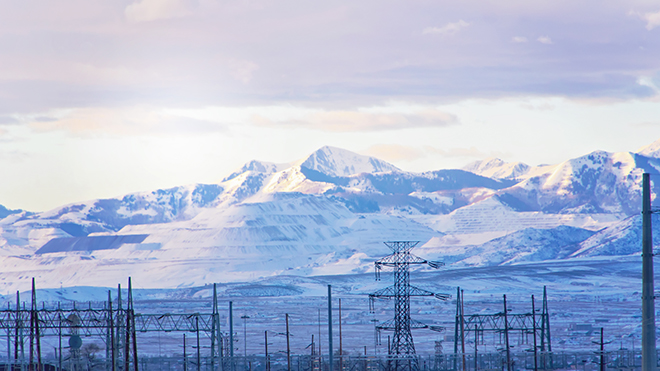
| Observers expect the power industry to put less emphasis on renewables and climate change but continue to prioritize expanding infrastructure in 2025. |
Sweeping new rules for long-term transmission planning and interconnection and stiff limits on power plant emissions dominated power industry policy in 2024.
During 2025, President-elect Donald Trump's incoming administration is expected to focus on deregulation and cutting through red tape that is thwarting infrastructure development as the industry grapples with historic levels of demand from datacenters and artificial intelligence.
While observers expect transmission planning and expansion efforts to continue to dominate in 2025, Republican control of the White House and both chambers of Congress come January could shift how those plans play out.
Investments in renewables will continue in 2025. But experts expect the industry to also focus on expanding transmission capacity and other generation resources to meet the expected explosion of demand.
"We are easily looking at demand wanting to connect to the system that could result in roughly 3% [annual] growth over the course of the next decade," Chris Seiple, vice chairman of the energy transition and power and renewables group at Wood Mackenzie, said during a Dec. 5 webinar.
"That's about 75 to 80 GW over the next five years, which is roughly 15 to 16 GW per year," Seiple continued. "And with the pace that we're adding renewable additions at what we're forecasting, those renewable additions, if they were in the right locations and buying power in the right hours, could meet about 12 GW of demand growth per year."
Transmission planning
Expanding the power grid will also play a key role in meeting expected demand.
Observers anticipate that transmission planning will continue to dominate the federal regulatory agenda in 2025 as the Federal Energy Regulatory Commission works to enforce its landmark Order 1920 issued in May. The order requires transmission planners to use a minimum 20-year planning horizon for regional transmission expansion plans that must be updated at least every five years.
Despite initial pushback from Commissioner Mark Christie, the sole Republican on the commission when the rule was approved, he concurred in part to the order on rehearing after revisions were made to give individual states more planning authority.
Trump will almost certainly appoint Christie or fellow Republican Commissioner Lindsay See, who recused herself from the ruling, as chair or acting chair when he returns to the Oval Office. While the partisan makeup of the commission in 2025 remains unclear, the chair will have considerable impact on how FERC ultimately decides to pursue Order 1920 enforcement.
Rob Gramlich, president of consulting firm Grid Strategies, said the states' expanded role in transmission planning and Christie's support of the rehearing order increase the likelihood the rule will survive the incoming Republican administration.
"A lot of people would say that the generic Republican regulator would be less inclined to enforce rules than the generic Democratic regulator," Gramlich said. "But I'm hopeful the commission will follow through on compliance and insist on firm compliance with the rule."
But Christie only concurred to the rehearing order in part, perhaps signaling he may continue to try and moderate the rule during its implementation under a Republican chair. Initial compliance filings for Order 1920 are due in June 2025.
Permitting reform and interconnection
Permitting reform and cutting through red tape are also expected to take center stage in 2025 as Trump vowed to "stop the wave of frivolous litigation from environmental extremists that hold up critical energy development projects."
While retiring Sen. Joe Manchin's (I-W.Va.) bipartisan permitting reform package failed to gain the necessary support during 2024, experts anticipate the new Trump administration to take a new look at the issue as well as try to remove environmental protection barriers to energy development.
Permitting reform could be especially beneficial for interconnection reform. As of September, 2,000 GW of projects were in the interconnection queue with a wait time of about 5 years. While FERC Order 2023 made some changes to the interconnection process — including prioritizing projects that are closest to commercial operations — stakeholders generally agree more reforms are needed to get projects online faster and meet expected demand.
Cutting red tape for both developers and transmission planners could allow the industry to more easily tap into that 2,000-GW project backlog. Permitting reform could also reduce costs in the transmission planning process as planners would spend less time and money adhering to regulations when evaluating Order 1920 compliance.
"A well-planned grid saves the most money in terms of building out the energy system," Christina Hayes, executive director at Americans for a Clean Energy Grid said at the Atlantic Council Global Energy Forum on Dec. 3. "A well-planned grid, looking at the costs and benefits, would save households $300 a year."
Climate change and power plant emissions
With the fate of renewable tax credits in the Inflation Reduction Act uncertain amid a likely reconciliation fight in 2025, experts expect the industry to put less emphasis on climate change and clean energy when Trump returns to power.
The US Environmental Protection Agency's power plant emissions rule, which effectively requires all existing coal-fired power plants planning to operate beyond 2039 to capture 90% of their CO2 emissions, will likely be on the chopping block in 2025, according to Peter Hsiao, partner at King & Spalding.
The Trump administration will then try to replace that rule with a less stringent version, but that will take time and face its own legal challenges.
Hsiao noted that the affordable clean energy rule issued during Trump's first term, which repealed the Obama-era Clean Power Plan, was struck down by a federal appeals court in 2021. Hsiao expects environmental groups to challenge any new replacement rule similarly to how they did during Trump's first administration.
But some experts said lighter power plant emission standards could reduce coal-fired plant retirements and promote reliability as the power grid experiences continued threats from severe weather and surging demand.
"I don't see action on [the EPA rule] having a huge impact on the broader need for more transmission over the next decade or two," said Larry Gasteiger, executive director at WIRES, a trade organization that advocates for transmission planning and expansion. "What we're seeing is an increase in a number of factors that are requiring more transmission, like the impact of extreme weather on our system, the reliability needs of our grid, aging infrastructure, and now we're starting to see an increase in demand."