21 Jan, 2025
Older Americans' workforce share nears 20-year low

By Brian Scheid
The share of older Americans in the domestic workforce is falling near its lowest level in almost 20 years, and many of these former workers may never return.
The labor force participation rate for Americans aged 55 and older fell to 38.3% in December, according to the latest government data. The rate, which measures the share of those either employed or looking for work, has fallen more than 200 basis points from pre-pandemic levels and is close to the lowest it has been since 2007.
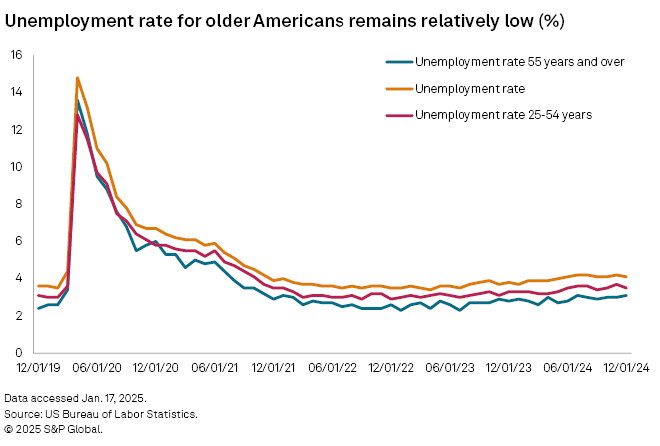
In many cases, stock market gains and soaring home prices are replacing the need for employment income. Tens of thousands of these older workers have also left their jobs to take on childcare responsibilities for grandchildren; others have found alternative sources of income in the wake of the pandemic, and some have simply "aged out" of the jobs market. As the US population continues to skew older, the share of employed, older Americans is expected to continue to shrink, potentially weakening the domestic jobs market, which is already struggling with a mismatch between labor supply and demand.
"As we approach five years from the onset of the COVID-19 pandemic, many of its effects on the labor market have gradually disappeared, but the decline in labor force participation among older Americans has been one of the most persistent post-pandemic developments," said Luke Pardue, policy director at the Aspen Institute's Economic Strategy Group.
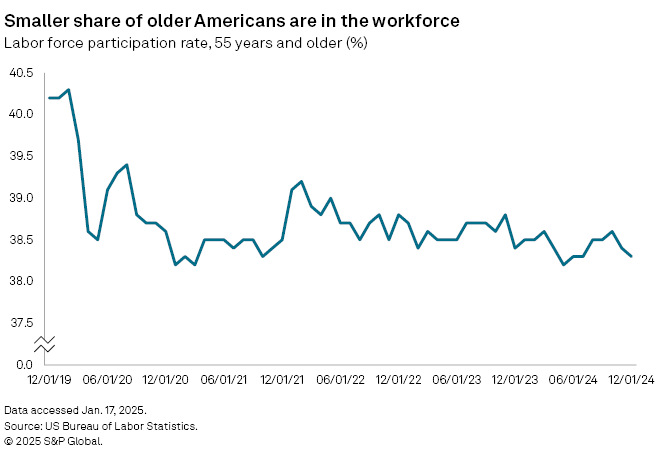
Many older Americans, driven to early retirement due to health risks and pandemic-driven government assistance programs, never rejoined the workforce. The strong stock market, with the S&P 500 up more than 160% from its March 2020 low, has boosted the wealth of many of these early retirees, allowing them to forego work longer than they previously anticipated, Pardue said. In addition, many older Americans decided during the pandemic to retire on a slightly smaller nest egg.
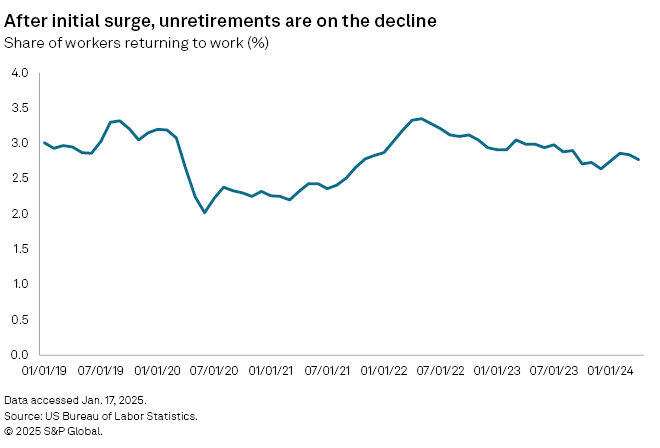
The persistently lower participation rate for older Americans has many potential drivers, but the overall health of the US economy, outsized stock market gains and the rise of home values are the leading contenders, said Cory Stahle, an economist at the Indeed Hiring Lab.
"For Americans who own a home or have access to a pension or other retirement accounts, strong economic performance equates to wealth that can be drawn upon in lieu of returning to the labor market to make ends meet," Stahle said. "Workers with a house and retirement savings are a little more insulated from the ups and downs of the labor market."
Many older Americans also left their jobs early in the pandemic to help care for their grandchildren as daycares and schools closed. As the childcare sector continues to face staffing shortages and parents struggle with higher costs, thousands of grandparents have taken on new roles.
"The lack of access to quality and affordable childcare in this country … means that a lot of grandparents need to alter their work arrangements to fill in gaps," said Matthew Nestler, a senior economist with KPMG Economics.
About 3% of women aged 55 through 64 were affected each month in 2024 by inadequate childcare options, according to an index developed by Nestler using government data to measure parental work disruptions. This equates to about 40,000 women who had to take time off work or leave jobs to care for children. In 2000, just 0.6% of women aged 55 through 64 had their work affected by childcare, or about 6,000 women per month, according to the KPMG index.
Aging boomers
Much of the decline is also due to demographic shifts and how the labor market adapts to them.
"I think the trends in employment for the over-55 population can be explained by the aging baby boomers," said Elise Gould, director of health policy research at the Economic Policy Institute. "Simply put, the 55-plus population is getting older and employment rates decline with age."
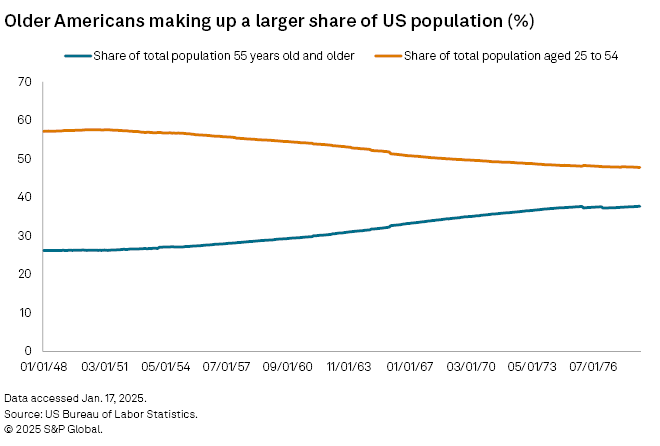
Thirty years ago, Americans aged 25 through 54, a group classified as "prime age" workers in the US, made up 57.1% of the overall US population. Those 55 years old and older comprised 26.2% of the population, government data shows. That gap closed as birth rates fell and life expectancies rose. As of December 2024, Americans aged 25 through 54 made up less than 47.8% of the US population, compared to 37.7% for those 55 and over.
Trend to stay
The trend of older Americans participating less in the labor force is unlikely to reverse anytime soon, partly because shifts in the workforce are rarely sudden.
"If you're older and exit the labor force, it's going to be hard to attract you back; whereas if you are already in the labor force, you're likely to stick with it," said Guy Berger, director of economic research at the Burning Glass Institute. "However, the compositional effects won't necessarily fade — because there are going to be more and more Americans in the oldest age buckets that participate the least."
Still, there are factors that may keep people in the labor force for longer, said Stahle with Indeed. These include further pushback on the full retirement age for Social Security benefits and the shift away from pensions to 401Ks and other defined contribution plans, which could make it more difficult to retire early.
Meanwhile, the ongoing decline in the participation rate for older Americans could prove to be an economic positive, said Aaron Sojourner, a labor economist and senior researcher at the W. E. Upjohn Institute for Employment Research.
"A higher share of Americans over age 65 are retired and a higher share of Americans younger than 65 are employed," Sojourner said. "That seems pretty great as long as it's driven by voluntary, secure retirements with dignity rather than by health failures and inability to find work."