13 Jun, 2023
Feds, states, cities ask 9th Circuit to review Berkeley gas ban opinion

The Biden administration joined a number of states and cities in arguing that a three-judge panel for the US Court of Appeals for the 9th Circuit fundamentally misinterpreted the Energy Policy and Conservation Act (EPCA) in rendering its opinion. In a series of amicus briefs filed June 12, stakeholders said the 9th Circuit should grant Berkeley's petition for rehearing because of the potential for the panel's opinion to cause wide-ranging harm on a matter of exceptional importance.
The opinion has created legal risk for climate-oriented building electrification policies along the West Coast and throughout the US. It also stands to disrupt state and local authority to pass health and safety ordinances, complicate the federal government's ability to establish energy efficiency standards, and hamstring states seeking to limit investment in new gas infrastructure, according to the amicus briefs.
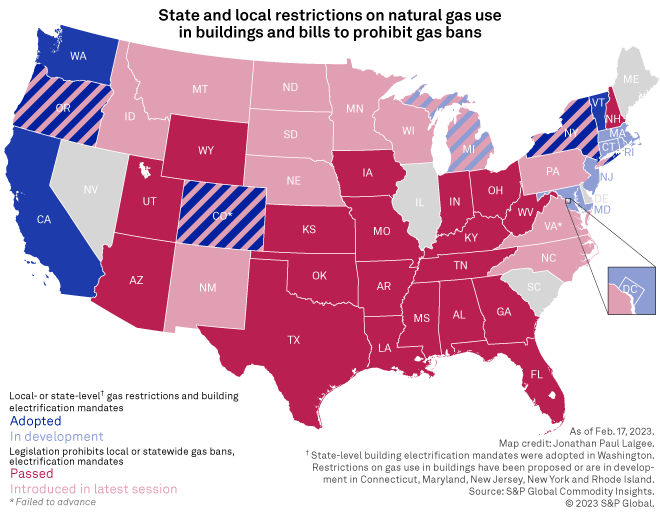
The panel ruled in April that the EPCA, which regulates the energy efficiency and use of consumer products, preempts Berkeley's 2019 gas ban. The ordinance prohibited gas infrastructure in new construction and drew a lawsuit from the California Restaurant Association. A district court judge dismissed the suit in 2021, setting up the 9th Circuit appeal.
Feds see 'cloud of uncertainty'
The 9th Circuit panel's opinion upended a long-settled understanding among the federal government, states and municipalities, lawyers for the US Justice Department and Energy Department said.
That understanding holds that the EPCA prevents cities and states from regulating a product's energy efficiency and use if the DOE has already established an energy conservation standard for that product, but the law leaves intact state and local authority to pass health and safety ordinances, even if an ordinance indirectly restricts the use of a product covered by a federal standard.
The panel made critical errors in its interpretation of the EPCA's preemption provision, including interpreting single words out of context to justify an expansive application of EPCA preemption, the federal lawyers said. That misinterpretation of Congressional intent could have serious and far-reaching consequences, in their view.

Because the panel did not explain why other health and safety ordinances would not warrant preemption, its opinion "cast a cloud of uncertainty over any health or safety law that may indirectly affect someone's ability to use a product for which the federal government has issued an energy conservation standard," the federal lawyers said. That could jeopardize ordinances covering the safe operation of furnaces within certain building types or hazardous emissions from covered products, they said.
The opinion additionally threatens to disrupt the federal government's orderly administration of the EPCA, the lawyers said. By putting an untold number of local health and safety ordinances in conflict with the EPCA, the opinion threatens to overwhelm the DOE with EPCA waiver requests. It would additionally complicate the DOE's ability to establish new energy efficiency standards by forcing the department to consider how those standards could come into conflict with state and local ordinances.
Opinion 'immunized' manufacturers from laws
A group of states, Washington, DC, and New York City put forward similar arguments in a separate amicus brief. They said the opinion's language will invite claims that Congress "immunized manufacturers, consumers, and others from compliance with state and local laws addressing public safety, environmental protection, and any number of other topics besides energy efficiency."
Gas utilities have already leveraged the opinion to challenge electric heat pump requirements in Washington state's building code update, they noted.
Several of the states — California, Maryland, Massachusetts, New Jersey, New Mexico, New York, Oregon and Washington — supported Berkeley earlier in the proceedings. Arizona and Hawaii joined their latest amicus brief.
The New York State Public Service Commission also filed an amicus brief, saying the panel's "misreading of the scope of EPCA's preemption clauses" created "needless uncertainty." Specifically, it raised questions about laws restricting gas use in New York as well as the PSC's ability to mitigate greenhouse gas emissions and regulate gas distribution.
Like other state utility regulators, the PSC has taken steps to limit new gas infrastructure. But the panel's opinion "effectively required the continued expansion of natural gas as a fuel source in new construction ... all while rewriting the relationship between federal and state authority," the PSC said.
Five cities and mayors in Washington and Oregon said conflicting signals in the opinion create confusion about their traditional authority over public rights of way.
"The breadth of the panel's reasoning, despite the oblique assurances otherwise, could leave cities with the impression that the federal government now obliges them to use public rights of way to deliver natural gas for use by covered products in homes, kitchens, and businesses," an attorney for the cities said in a June 12 letter.
S&P Global Commodity Insights produces content for distribution on S&P Capital IQ Pro.