Research — JULY 18, 2025
Rate filings pick up in June, but 2025 requests trail 2024, historical trends
By Heike Doerr
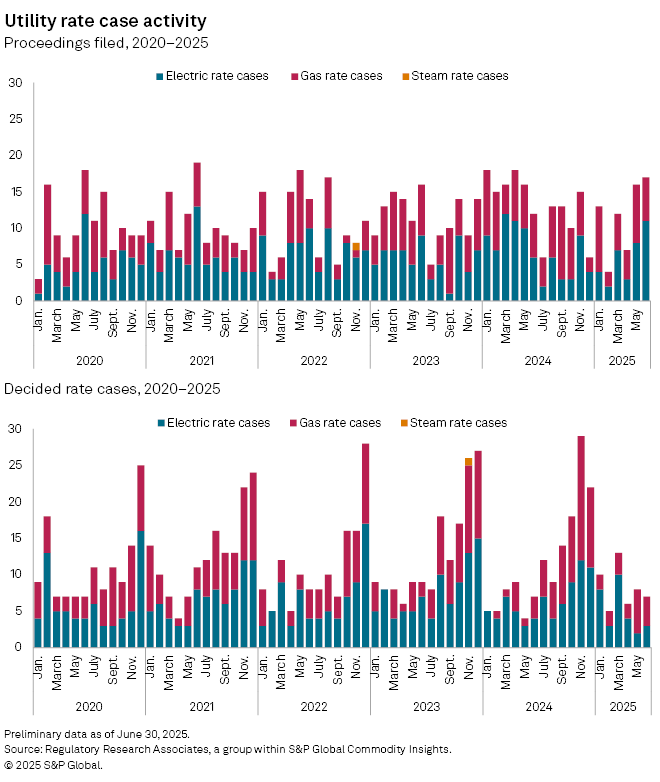
In June, energy utilities filed initial rate increase requests totaling $3.846 billion across 17 cases, largely in line with historical averages. Seven rate case decisions were issued in June with a net aggregate rate increase of $306.5 million.

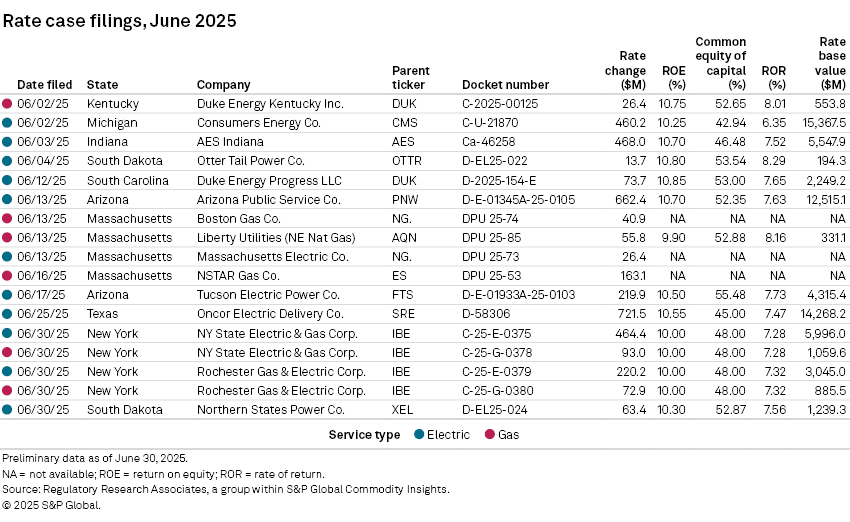
➤ In June, there were 17 rate case filings — 11 electric and six gas — slightly above the average of 16 filings for the month during 2020–2024. Sixty-nine rate proceedings were initiated in the first half of 2025, below the five-year average of 75, and well below the 95 filings observed for the same period in 2024. In the newly filed cases, the companies are seeking returns on equity (ROEs) ranging from 9.90% to 10.85%.
➤ Five electric base rate cases in Arizona, Indiana, Michigan, New York and Texas comprise over 70% of the total revenue requested during the month.
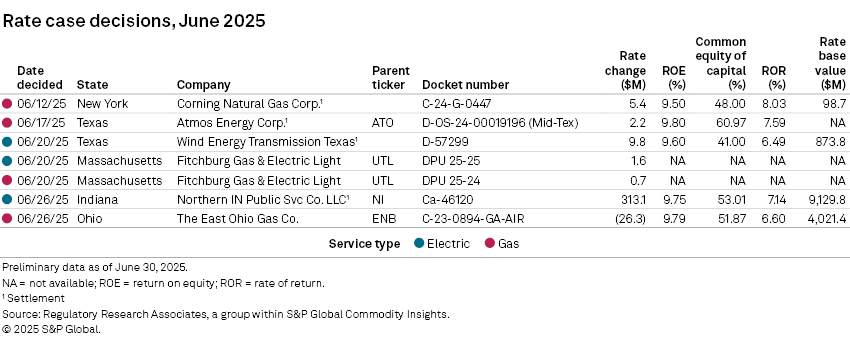
➤ There were seven rate decisions in June, compared to eight in May, and there have been 49 rate decisions issued year to date. During the month, state regulators authorized six new ROEs, ranging from 9.50% to 9.80%.
➤ Additionally, commissioner developments occurred in Alabama, Oregon and Pennsylvania in June. There was also gubernatorial action on key energy policy initiatives in Texas, while Maryland and New Jersey addressed customer affordability.

Following a quiet May, rate requests picked up in June. Historically, the fourth quarter is generally the most active time for utility rate case decisions, while the first quarter is the most active for filings.
Rate case initial filings
The $3.846 billion of rate increases proposed in June includes $3.394 million sought in newly initiated electric proceedings and $452 million of net increases requested in gas rate case filings. The accompanying table details the rate proceedings initiated in June.
Resolved rate cases
Four electric and three gas rate proceedings concluded in June, with authorized rate changes aggregating $306.5 million. The largest completed rate case during the month was Northern Indiana Public Service Co. LLC's base rate case, a settled proceeding that authorized a $313.1 million rate increase.
During the first half of 2025, 49 rate proceedings were completed, which largely mirrors the historical five-year average of cases completed by the end of June each year but represents an increase relative to the 38 completed cases by the end of June 2024.
The accompanying table provides details concerning the rate case decisions issued in June.
Commission and commissioner activity
Alabama — Gov. Kay Ivey (R) appointed Cynthia Lee Almond (R) to the Alabama Public Service Commission to serve the remainder of a term that extends to 2028. Almond assumed the role as commissioner and PSC president effective June 16. Almond fills the vacancy created by Twinkle Cavanaugh's recent departure to take a position in the Trump administration. Cavanaugh was serving a term as commissioner and PSC president that extended to 2028.
Oregon — Gov. Tina Kotek (D) appointed long-serving Oregon Public Utility Commission regulator Letha Tawney (D) as chair of the three-person board. Tawney's appointment was made effective in conjunction with the beginning of Karin Power's (D) four-year term on the commission, which began June 1.
Pennsylvania — Stephen DeFrank, a Democrat, was sworn in to a second term as chairman of the Pennsylvania Public Utility Commission on June 4. DeFrank's new term will extend to April 2030. DeFrank was nominated to the PUC by then-Gov. Tom Wolf (D) and confirmed by the Senate in 2022 to complete an unexpired term.
Legislative, gubernatorial activity
Texas — Gov. Greg Abbott signed several energy-related measures just prior to the state's June 22 deadline for the governor to veto measures passed by both chambers of the legislature before the end of the 2025 session on June 2. Legislation related to datacenter challenges seeks to ensure that costs are properly allocated, reliability is preserved and outage risk is reduced for residential customers. Other key measures addressed utility wildfire risk, the planned transmission build-out in the Permian Basin region of the state, utility use of mobile generation during emergency situations, electric utility recovery of capacity costs, support for new nuclear generation and ways to mitigate regulatory lag for gas utility infrastructure investments.
Customer affordability actions
Maryland – As required by the Next Generation Energy Act signed by Gov. Wes Moore in May, the Maryland Public Service Commission issued an order on June 27, calling for the state's electric distribution utilities to provide refunds to customers in the third quarter of 2025 and then again in the first quarter of 2026. The legislation set aside $200 million to create the Legislative Energy Relief Refund, so that each residential distribution customer will receive bill credits based on the customer's consumption of electricity supply that is subject to the state's renewable energy portfolio standard.
New Jersey – On June 18, the New Jersey Board of Public Utilities approved stipulated rate increase mitigation plans proposed by the state's four major electric utilities. The plans call for the electric utilities to defer collection of $30 from each customer's monthly bill during the months of July and August. The deferrals will be recovered over the four months over September to December, with no carrying charges to accrue on the deferred balances.
Gov. Phil Murphy (D) and certain state legislators announced a proposal under which each residential customer statewide would receive a one-time credit ranging from $100 to $250 on their electric distribution bill. Murphy, along with Senate President Nick Scutari and Assembly Speaker Craig Coughlin, announced a proposal on June 5 to provide "all 3.9 million ratepayers" (presumably residential customers) in New Jersey bill credits of $100, with "eligible low-to-moderate income" ratepayers to receive incremental bill credits of at least $150. Funding for the program (estimated at $430 million) would come from the BPU's allocation of proceeds from the state's participation in the Regional Greenhouse Gas Initiative (RGGI) and the solar alternative compliance payments.
Regulatory Research Associates is a group within S&P Global Commodity Insights.
S&P Global Commodity Insights produces content for distribution on S&P Capital IQ Pro.
For a full listing of past and pending rate cases, rate case statistics and upcoming events, visit the S&P Capital IQ Pro Energy Research Home Page.
For a complete, searchable listing of RRA's in-depth research and analysis, please go to the S&P Capital IQ Pro Energy Research Library.
This article was published by S&P Global Market Intelligence and not by S&P Global Ratings, which is a separately managed division of S&P Global.
Theme
Location
Products & Offerings
Segment