ECONOMICS COMMENTARY — 05 Nov, 2026
Tech spending leads global growth, but only real estate suffers drop in activity

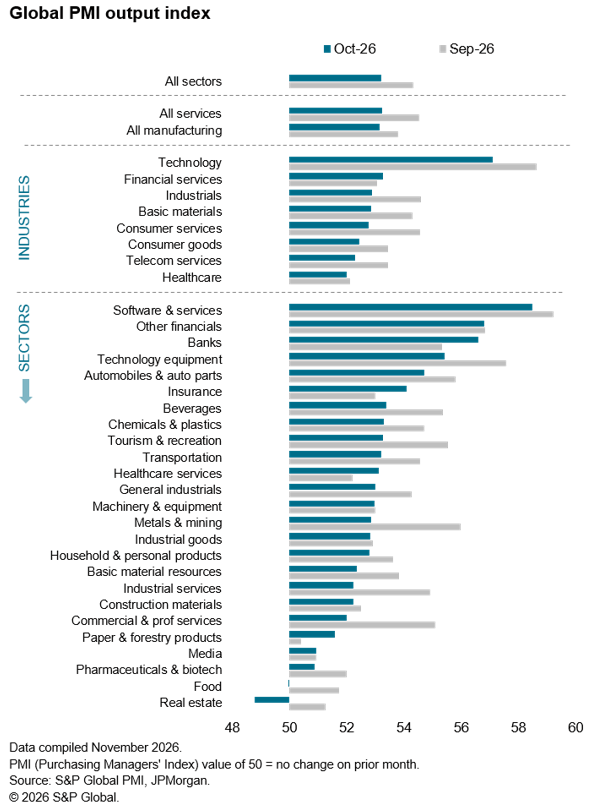
The global economic upturn continued to be led by rising tech spending in October, supported by a broader upturn in economic activity reflecting increased financial services activity, consumer spending and business investment. Only one sector – real estate – reported lower activity, though food production also stalled.
However, rates of growth are showing signs of peaking for tech spending, and the rebound in consumer services activity from the decline following the initial conflict in the Middle East is showing signs of coming under pressure from higher prices and rising interest rates.
Tech sector leads growth rankings
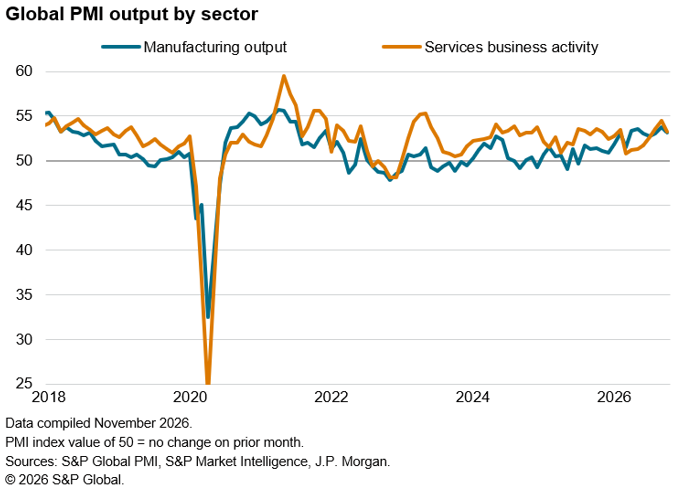
Global growth slowed across manufacturing and services in October, according to S&P Global’s worldwide PMI surveys, but in both cases rates of expansion remained elevated by standards seen over the past five years, buoyed by strong demand for AI-related goods and services.
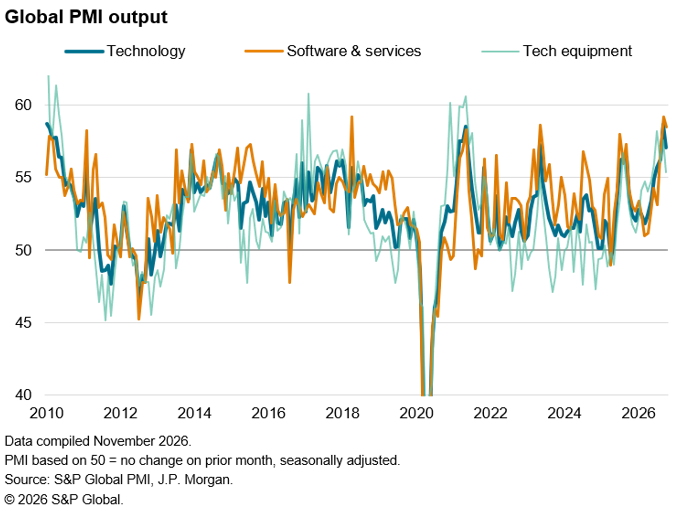
Of the major industries covered by the PMI surveys, technology reported by far the strongest rate of growth globally in October, building on the outperformance seen in the year to date. So far this year, the tech sector has reported its strongest performance since 2018, despite the early months of the year seeing only modest growth.
The tech upturn was led by rising demand for software and related services, which was again the fastest growing sub-sector globally, albeit the rate of growth cooling slightly from September’s all-time high. Tech equipment manufacturing also remained one of the best performing sub-sectors, though with the elevated pace of growth also cooling somewhat in October to hint at a potential peaking of the tech investment boom.
Broader-based upturn sustained
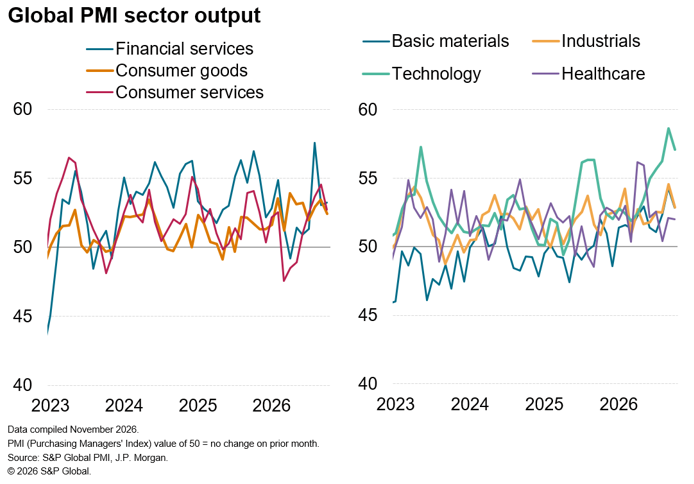
The economic expansion seen in October is by no means limited to tech. Robust expansions were also reported for financial services, industrial services, basic materials and consumer-facing goods and services, pointing to a largely broad-based upturn.
Real estate stands alone in contraction territory
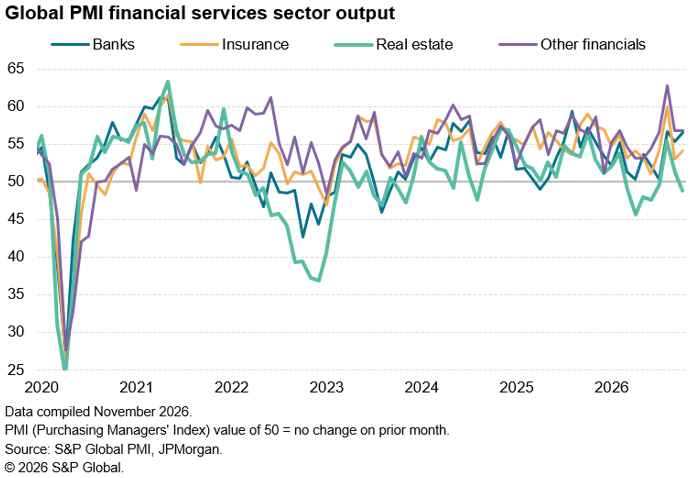
Drilling down into more detail, there was one sector that reported falling activity: real estate, where higher interest rates in many economies continued to dampen demand for both residential and commercial property. The divergence of real estate from other types of financial services activity has been notable throughout the year to date. Real estate has so far endured its worst year since 2023, contracting in six of the past eight months, while insurance, banking and other financial services have all grown strongly.
Food production stalls
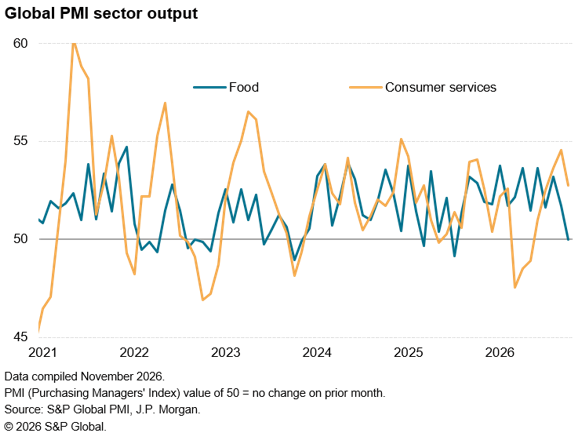
There was one other sector that, although not in decline, failed to grow in October, and that was food manufacturing. Having grown continually over the prior 14 months, output of food manufacturing stagnated in October, linked partly to supply chain delays. Supply disruptions could in turn be linked to transport issues as well as poor harvests.
Consumer rebound loses pace
The biggest change in economic performance in recent months has meanwhile been seen in the consumer services industry. Activities such as travel and tourism were hit hard in the second quarter as the conflict in the Middle East disrupted travel and hiked fuel costs. Consumer services activity in fact fell slightly in the second quarter to be the worst-performing industry, though the third quarter saw a strong rebound in these activities. However, October brought signs that this rebound may now be fading slightly, as renewed upward pressure on fuel costs and higher interest rates squeezed discretionary consumer spending again.
Similarly, production of consumer goods increased at the softest pace for three months in October, likely linked to the rising cost of living as fuel and energy prices spiked again during the month and some central banks took more hawkish stances.
Construction materials, autos and machinery enjoy strong growth spells
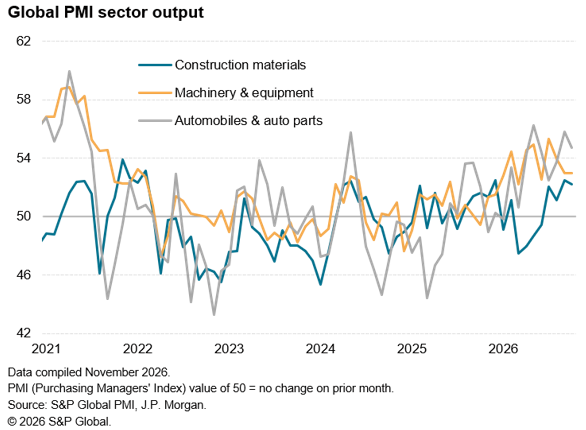
Three other sectors are also of note. Outside of financial and consumer services, the largest improvement in growth since the second quarter has been recorded for construction materials, which is enjoying its best four-month growth spell since early 2022 partly on the back of AI-related construction and inventory building.
Machinery and equipment production also continued to grow strongly in October. Although the pace of increase has likewise cooled from recent highs, the sector is enjoying its best year since 2021 due to rising defense spending and business investment.
Also enjoying its best year for five years is the global autos sector, currently sitting in fifth place in the PMI sector rankings. In contrast, in November of last year the autos sector was reporting the sharpest downturn of all sectors, underscoring a marked turnaround in demand for vehicles over the past year.
© 2026, S&P Global. All rights reserved. Reproduction in whole or in part without permission is prohibited.
Purchasing Managers' Index™ (PMI®) data are compiled by S&P Global for more than 40 economies worldwide. The monthly data are derived from surveys of senior executives at private sector companies, and are available only via subscription. The PMI dataset features a headline number, which indicates the overall health of an economy, and sub-indices, which provide insights into other key economic drivers such as GDP, inflation, exports, capacity utilization, employment and inventories. The PMI data are used by financial and corporate professionals to better understand where economies and markets are headed, and to uncover opportunities.
Read our latest PMI commentary here.
This article was published by S&P Global Market Intelligence and not by S&P Global Ratings, which is a separately managed division of S&P Global.
Theme
Location
Products & Offerings