ECONOMICS COMMENTARY — 12 Nov, 2026
Mozambique growth gathers momentum as demand surge tests capacity

By David Owen
October PMI data saw Mozambique appear as a notable area of demand strength and business optimism in the world’s emerging markets.
The headline S&P Global PMI climbed to a four-and-a-half-year high as new orders rose at their fastest pace since 2021. Businesses responded with record purchasing activity and remained highly optimistic about the year ahead, signalling that the growth spurt may have further to run.
However, falling employment, rising backlogs and intensifying purchase price pressures suggest that the improvement in demand may be exposing greater capacity and cost constraints.
Mozambican private sector sees sharpest improvement since 2022
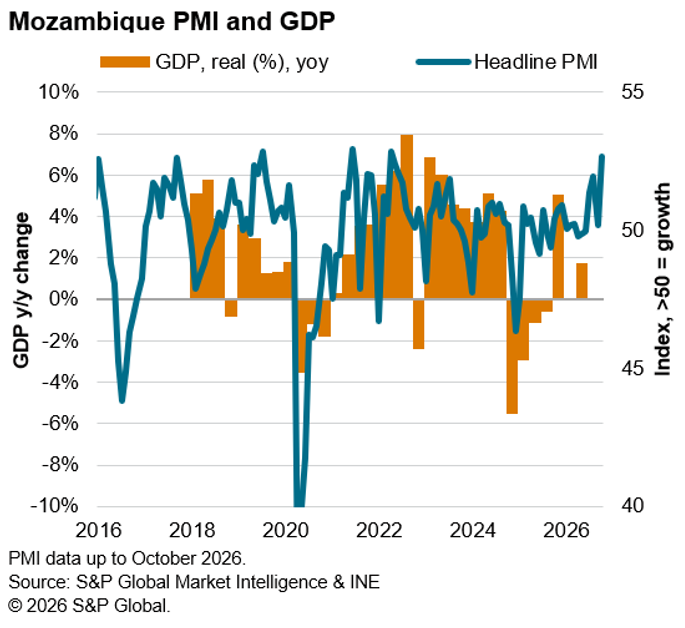
Business conditions in Mozambique improved markedly at the start of the fourth quarter, according to survey data compiled by S&P Global. The headline PMI climbed from 50.2 in September to 52.7 in October, its highest since April 2022 and the fourth consecutive month above the neutral 50.0 threshold.
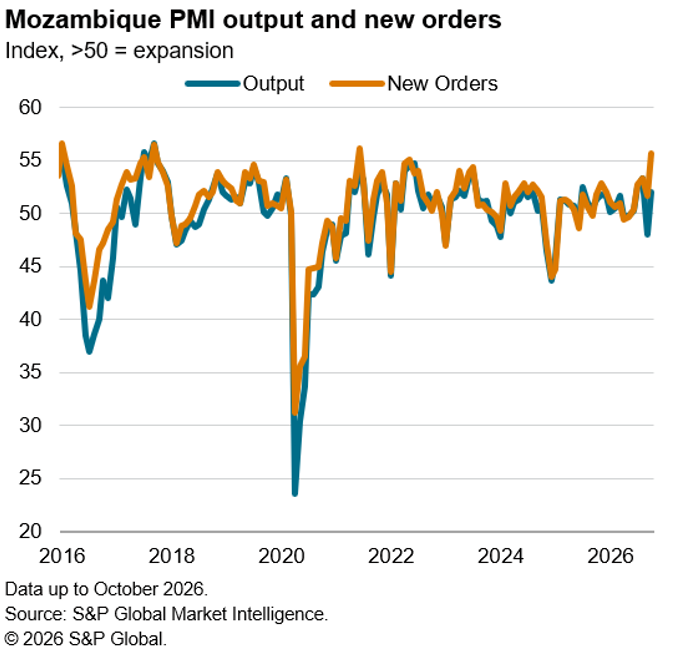
Importantly, the improvement in business conditions was increasingly demand-led. New orders expanded at the fastest rate since June 2021, with 29% of companies reporting an increase in new work compared with just 15% reporting a decline. Firms attributed the improvement to new customer wins, product launches and increased market visibility. Notably, this marked the third time in the past four months where new order growth in Mozambique has beaten the emerging markets average.
Output levels returned to growth in Mozambique following September's decline, although the expansion was comparatively modest. Reports from businesses that working-capital limitations, material shortages and competitive pressures continued to constrain production suggest that the acceleration in demand has not yet fully translated into robust output growth.
Nevertheless, the strength of October's PMI suggests that underlying economic momentum improved at the start of Q4, which will continue to help Mozambique recover from its recession in 2025. Official GDP figures have so far pointed to expansions in economic activity during the first and second quarter.
Businesses respond to demand with record input buying, not hiring
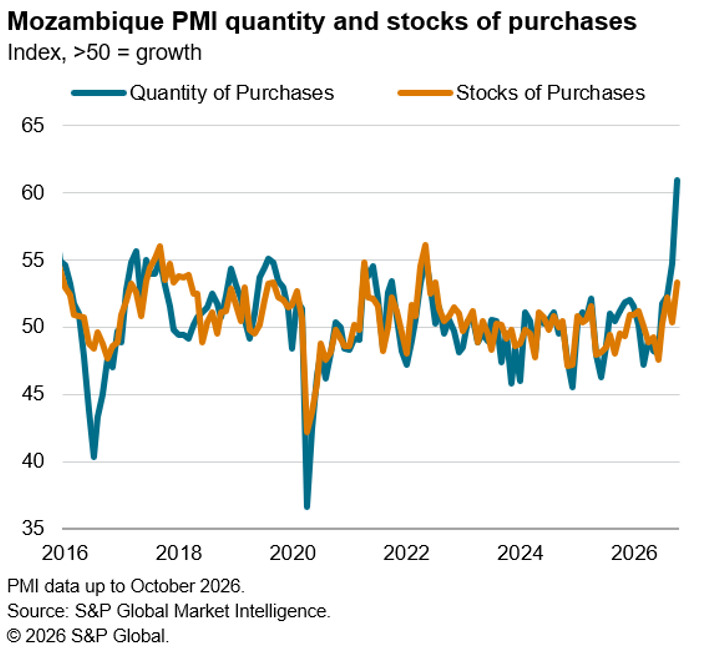
The response to stronger demand has so far been much more visible in inventories than employment. Purchasing activity rose in October at the fastest rate since the survey began in 2015, which firms largely attributed to demand-led restocking. Meanwhile, stocks of purchases increased at their quickest pace since July 2022.
In contrast, employment fell for the third time in four months, with respondents often citing affordability constraints. At the same time, backlogs of orders rose for the first time since June as higher demand placed pressure on existing capacity.
This suggests that Mozambican firms are initially responding to the recovery by building stocks and making greater use of existing capacity, instead of committing to additional labour. That said, should the improvement in orders persist, rising workloads could eventually encourage a firmer employment response.
Business optimism signals a more durable upturn
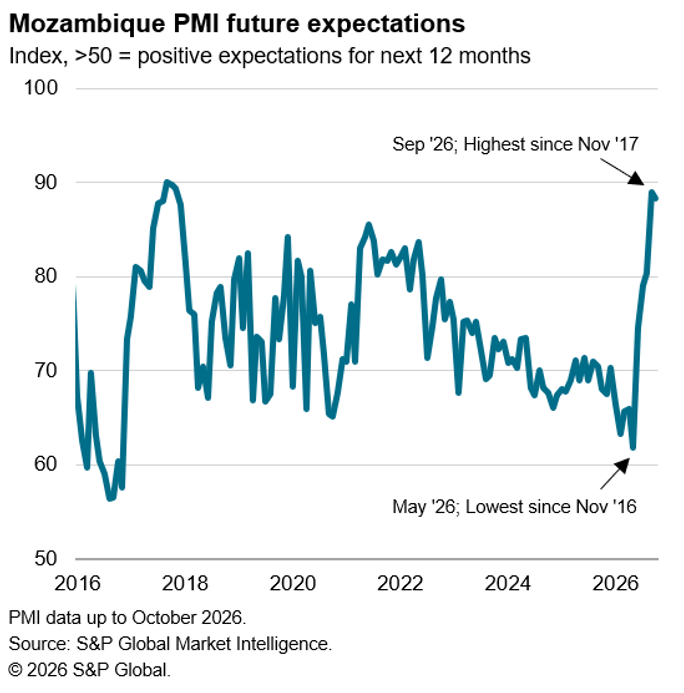
The forward-looking data points to an even more encouraging picture for the Mozambican economy. Although business confidence edged down from September, it remained at its second-highest level in almost nine years. Around 77% of businesses expect output to increase over the next 12 months versus only 1% anticipating a decline. Qualitative reports suggest that companies plan to open new branches, invest in technology and equipment, build stocks and form new business partnerships.
The qualitative evidence also helps explain why output expectations have seen such a pronounced turnaround from May, when the Future Output Index had dropped to nearly a decade low. Weaker purchasing power and challenging market conditions earlier in the year linked to the Middle East conflict meant that firms with a positive outlook often based this on aspirational hopes that sales would revive. By October, a firm rebound in new business volumes meant that firms were much more likely to report concrete expansion plans and efforts to win work through advertising or improving their supply chains.
Price pressures could test the demand recovery
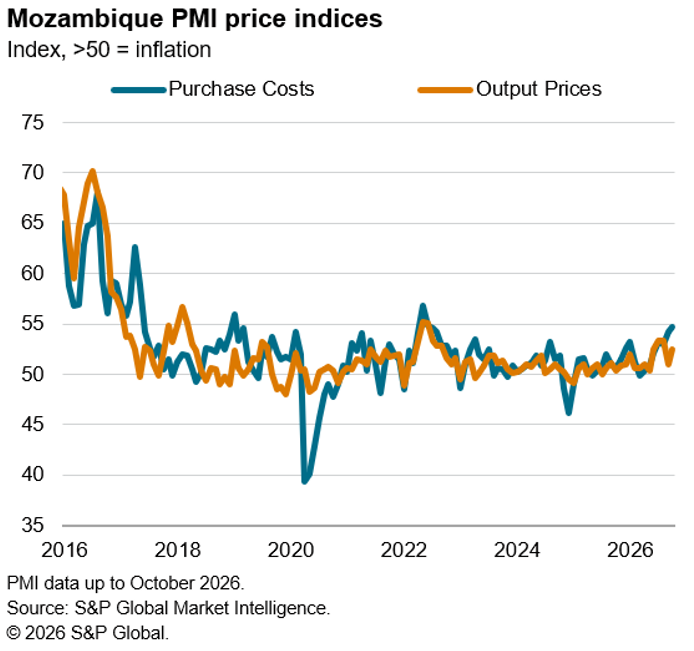
Stronger demand is nevertheless beginning to generate greater inflationary pressure across the Mozambican private sector economy, as firms pass higher costs through the supply chain. Purchase prices rose at the fastest rate since mid-2022 in October, principally reflecting higher fuel, transport and imported-goods costs.
Output prices also rose solidly, with firms citing higher input costs and, in some cases, stronger demand and larger projects. However, competitive pressures remained a constraint on pricing in some markets.
For now, rising prices have coincided with – rather than prevented – strengthening demand. However, this should still be an area of concern, as sustained increases in selling prices could weigh on purchasing power and threaten the recovery in new orders, particularly given continued reports of affordability and financing constraints.
© 2026, S&P Global. All rights reserved. Reproduction in whole or in part without permission is prohibited.
Purchasing Managers' Index™ (PMI®) data are compiled by S&P Global for more than 40 economies worldwide. The monthly data are derived from surveys of senior executives at private sector companies, and are available only via subscription. The PMI dataset features a headline number, which indicates the overall health of an economy, and sub-indices, which provide insights into other key economic drivers such as GDP, inflation, exports, capacity utilization, employment and inventories. The PMI data are used by financial and corporate professionals to better understand where economies and markets are headed, and to uncover opportunities.
Read our latest PMI commentary here.
This article was published by S&P Global Market Intelligence and not by S&P Global Ratings, which is a separately managed division of S&P Global.
Theme
Location
Products & Offerings