ECONOMICS COMMENTARY — 24 Nov, 2026
Japan’s growth becomes increasingly uneven as business confidence weakens and price pressures remain elevated

By Jingyi Pan
Japan’s private sector growth softened midway through the final quarter of the year and became increasingly uneven, according to S&P Global’s Flash PMI® data. Stronger manufacturing sector production growth was contrasted by a slowdown in services activity growth to only a marginal pace in November.
Additionally, business confidence weakened to one of the lowest levels since the initial wave of the Covid-19 pandemic, especially in the service sector, as firms raised concerns over the sales outlook. The business sentiment trends, alongside the changes in new orders, outline the likelihood for greater sector divergence in the near-term.
Meanwhile, price pressures remained elevated by historical standards, even as the rates of inflation eased from October. With inflation yet to be brought under control and goods exports growth strengthening, the latest PMI data provide greater impetus for the Bank of Japan to proceed with tightening in December.
Japan’s business activity expands at slowest pace in six months
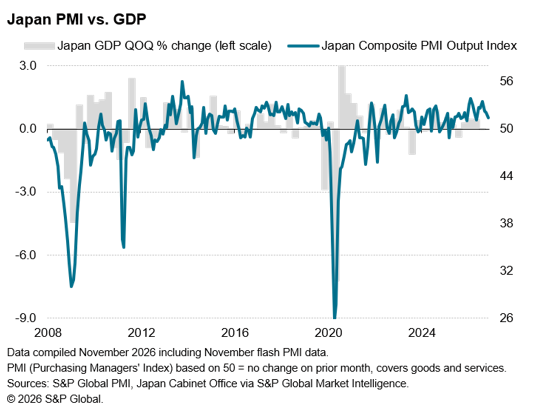
Japan’s business activity growth slowed in the penultimate month of the year, with the rate of growth cooling to the slowest in six months. The S&P Global PMI survey Composite Output Index posted 51.5 in November, down from 52.1 in October.
The fourth-quarter average so far stands at 51.8, below the 52.8 recorded for the July to September period. The official update released earlier this month showed that third-quarter GDP growth had stalled, weighed notably by high import costs, including for energy. Our latest regression analysis suggests that the PMI data are broadly consistent with GDP growth of slightly less than 0.5%, although imported inflation remains a lingering concern, given that price gauges are still elevated.
Services deceleration contrasts with stronger production growth
By sector, growth remained broad-based for the sixth month running. However, the gap between the manufacturing and service sector opened again, with stronger manufacturing output growth helping to offset slower services activity expansion in November.
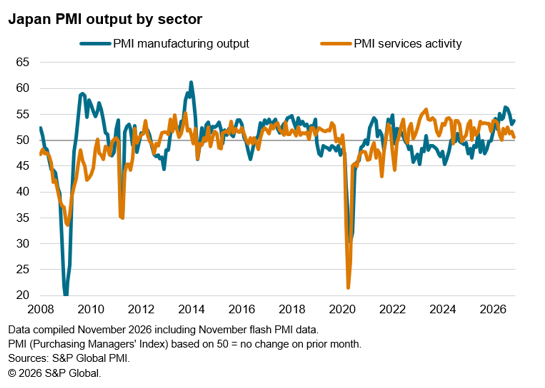
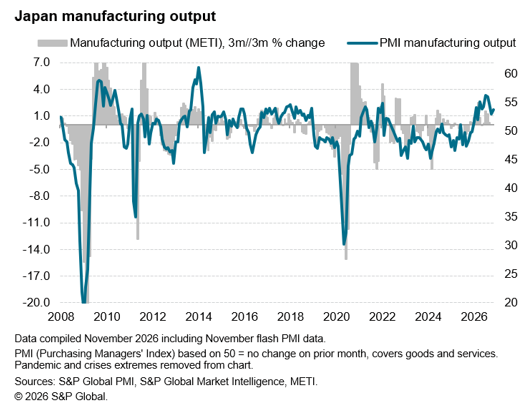
Manufacturing production was boosted once again by AI-related activity, with panellists often mentioning strong demand for semiconductors in particular. The improvement in overall goods new orders was notably overshadowed by the surge in demand from overseas, the latter rising at the second-strongest pace in nearly nine years to outline continued strength in AI spending, and buoyed by the weakness of the yen. As a result of the strong increase in new orders, purchasing activity increased at a sharp pace while strong hiring was also sustained.
The latest development therefore points to resilience in Japan’s ongoing technology cycle, offering an early positive signal for investors ahead of the release of PMI data for the wider region, particularly as the AI-related boom previously drove a record increase in ASEAN new orders in October, though this was before the announcement of additional restrictions on AI chips impacting the region.
On the other hand, services activity growth clearly slowed in November as subdued client interest led services new business to increase at its weakest pace since July. Growth in services new business was also limited to the domestic market for the eighth month in a row, though with the rate of new export business contraction having eased for the third straight month to only a modest pace.
Japan’s two-speed economy
The latest sectoral divergence further reinforced the two-speed economy picture for Japan as services, more closely tied to household demand and domestic consumption, weakened while corporate investment resilience was reflected by the upholding of strong manufacturing sector demand.
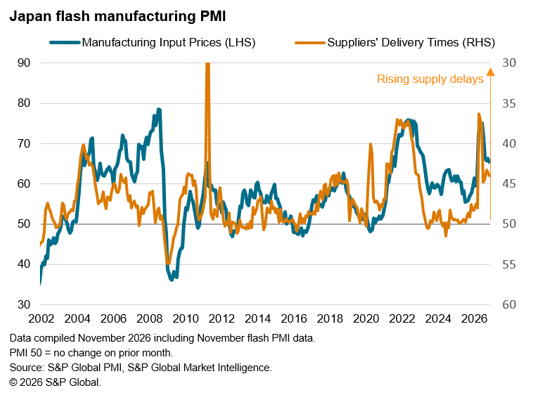
To further assess the strength of Japan’s manufacturing sector, the PMI Suppliers’ Delivery Times Index provides useful insight into whether demand is outstripping supply and creating capacity constraints. Input lead times continued to lengthen in November at one of the fastest rates since the post-pandemic period, although the deterioration was less pronounced than at the mid-year peak. While external factors, including the conflict in the Middle East, continued to play a role in disrupting supply chains, robust demand for inputs also contributed to delivery delays, as an increase in purchasing activity in November strained supplier capacity.
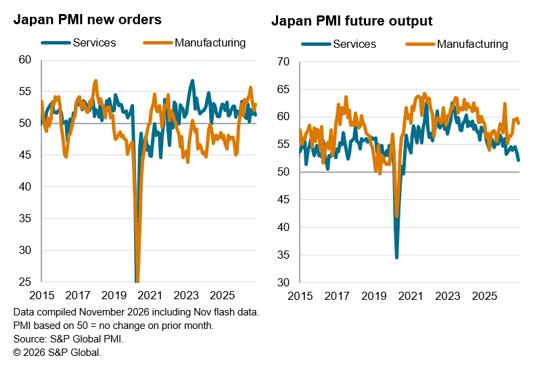
Although performance between the manufacturing and service sectors had at times converged in the past couple of months, the latest widening of the gap is perhaps especially concerning as forward-looking indicators suggest that the divergence may become more entrenched in the coming months.
Over and above the deviation in new order trends, whereby manufacturers saw new order growth accelerates while services new business rose at a slower rate, the gap in the Future Output readings also widened in November. Although firms in both sectors reported lower confidence in November, the difference in readings was the greatest since January 2022, which was the post-pandemic period when goods producers far outperformed their services counterparts.
The latest trends therefore suggest that the divergence could further widen, potentially leaving Japan’s growth to be chiefly dependent on manufacturing and in particular the technology sector.
Inflation remains elevated ahead of December’s BOJ meeting
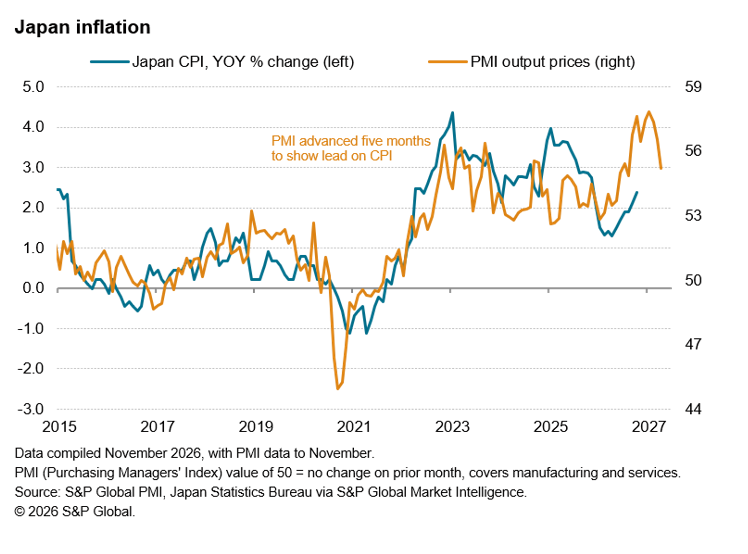
Turning to prices, rates of inflation were again elevated in the penultimate month of the year, supporting a widely anticipated December tightening of policy by the Bank of Japan.
Higher raw material, energy, logistics and wage costs remained behind the hike in average input costs in November, further aggravated by a weak domestic currency. This was widely reported in both the manufacturing and services sectors, even though the rates of input price inflation eased in both cases.
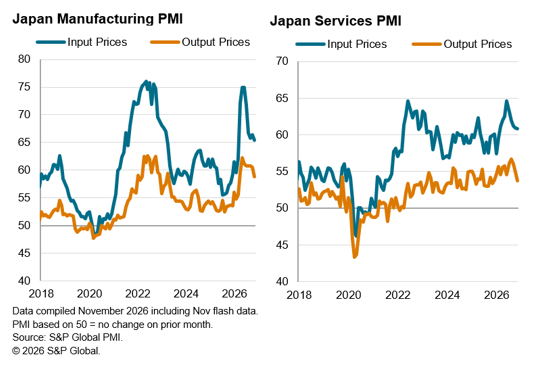
The softer increase in input costs in November enabled firms to lift their selling prices at a slower pace in November. That said, a comparison of the PMI Output Prices Index and Japan’s CPI indicates that inflation is likely to remain elevated above the central bank’s target in the coming months, thereby supporting the BOJ’s December move.
Besides the PMI price sub-indices, comments from panellists highlighting the yen weakness having been a key contributor to the surge in cost inflation and the solid improvement in manufacturing exports growth, reinforcing more inelastic goods demand, which also backs the Japanese central bank’s decision if they should proceed with tightening at their year-end meeting.
S&P Global Market Intelligence forecasters see the BOJ hiking rates by 25 basis points in December to about 1.50% before moving again around the middle of 2027.
Access the press release here.
© 2026, S&P Global. All rights reserved. Reproduction in whole or in part without permission is prohibited.
Purchasing Managers' Index™ (PMI®) data are compiled by S&P Global for more than 40 economies worldwide. The monthly data are derived from surveys of senior executives at private sector companies, and are available only via subscription. The PMI dataset features a headline number, which indicates the overall health of an economy, and sub-indices, which provide insights into other key economic drivers such as GDP, inflation, exports, capacity utilization, employment and inventories. The PMI data are used by financial and corporate professionals to better understand where economies and markets are headed, and to uncover opportunities.
Read our latest PMI commentary here.
This article was published by S&P Global Market Intelligence and not by S&P Global Ratings, which is a separately managed division of S&P Global.
Theme
Location
Products & Offerings