Research — Nov 13, 2026
Iron ore cost curve under pressure as prices test marginal producers

By Jason Holden
The Platts IODEX benchmark fell to $90.05 per dry metric ton CFR China on Oct. 9, 2026, a two-year low, and has since hovered around $90/dmt, dipping to $89.50/dmt on Oct. 15, as low Chinese steel demand coincides with rising seaborne supply. At this price, we estimate an average all-in sustaining cost (AISC) of $62.50/dmt and an average cash margin of $42.55/dmt. Industry economics, therefore, remain robust in aggregate, but these averages mask a sharp divide between low-cost producers and the marginal, high-cost tail.
Cash margin is the difference between a mine's realized price — adjusted for product grade and type — and its cash operating costs, while AISC adds sustaining capital, royalties and corporate overheads to show the full cost of maintaining current production.
Approximately 72 million dmt, or 3.6% of the production covered by the S&P Global Mine Economics curve, is already operating at a negative cash margin. Losses are concentrated among a relatively small group of higher-cost operations, including in Russia, Mexico, the US, and China's domestic sector, while the major producers in Australia and Brazil remain comfortably profitable.

➤ At $90/dry metric ton, the IODEX benchmark is testing the high-cost tail rather than the industry as a whole. Most covered production remains comfortably cash-positive.
➤ A total of 72.2 million dmt, or 3.6% of covered production, is already cash-negative, while a further 2.1 million dmt generates cash margins of $0-10/dmt.
➤ Brazil remains a major source of resilience. Its 410.5 million dmt of covered production generates a weighted average cash margin of $53.99/dmt, compared with $42.55/dmt across the curve.

Higher costs do not necessarily signal distress. The Lebedinsky mine carries an estimated AISC of $84.22/dmt, close to the IODEX benchmark, reflecting the cost of upgrading ore into high-grade concentrate, pellets and hot briquetted iron (HBI). Those products sell at a significant premium to the benchmark, however, and JSC Holding Co. Metalloinvest's overall production remains cash-positive on an equity-weighted basis.
ArcelorMittal SA illustrates the divergence within a producer's portfolio. We estimate a cash margin of negative $64.76/dmt at Las Truchas in Mexico and negative $12.64/dmt at Kryvyi Rih in Ukraine, based on modelled costs, as neither operation reports stand-alone mine-level financials. Both are part of integrated operations that supply company-owned steel mills, so their economics are better judged at the steelmaking level than against the seaborne price. ArcelorMittal's iron ore portfolio as a whole remains cash-positive, at $33.15/dmt — the lowest among the diversified majors.
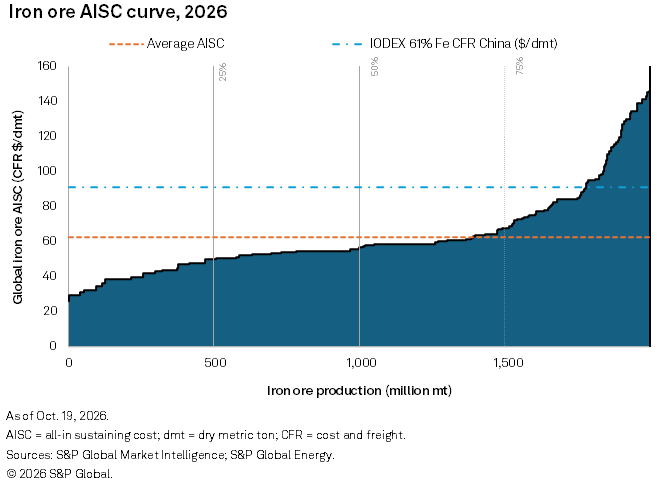
Cleveland-Cliffs Inc. sits substantially closer to the high-cost end of the curve, with an equity-weighted cash margin of $16.30/dmt and an AISC of $105.07/dmt — above the $90.05/dmt IODEX benchmark. Its position is partly protected by the quality and higher value of its pellet products. Multiple state-owned captive producers in China also carry negative cash margins, but may be supported by government policy.
India sits at the opposite end of the cost spectrum, with a country-level weighted AISC of just $31.17/dmt — the lowest among the countries represented. This reflects short haulage distances and low costs at NMDC Ltd. and Tata Steel Ltd. Bosnia and Herzegovina is the only country with a negative total cash margin, at negative $47.04/dmt. Russia, the US and Sweden remain cash-positive at the country level, but sustaining economics become more challenging higher up the cost curve. Production weighted AISC reaches $100.82/dmt in the US and $108.62/dmt in Sweden, both above the current $90.05/dmt benchmark.
The loss-making tail is geographically diverse rather than confined to a single producing region. Operations in Russia, the US, Australia, Brazil, Ukraine, Kazakhstan and Mexico and smaller operations in China appear below zero on the mine-level cash-margin curve. China's domestic sector accounts for a disproportionate share of this tail. Run-of-mine grades of only 20%-30% Fe, compared with 60%-65% for seaborne supply, mean high beneficiation costs that leave these mines uncompetitive.
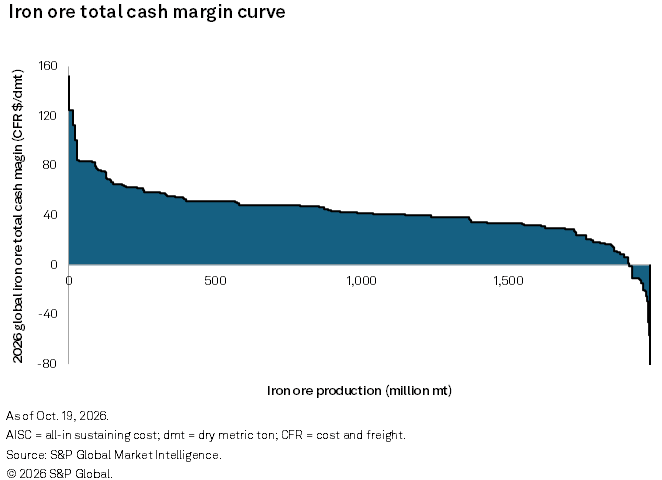
The 18 loss-making operations account for 72.2 million dmt, equivalent to 3.6% of the 1,986 million dmt represented by the Mine Economics curve. A further 2.1 million dmt has a cash margin of $0-10/dmt, bringing the total covered production earning $10/dmt or less to 74.3 million dmt.
The narrowness of this near-breakeven band is significant. Rather than showing a large volume of supply clustered just above breakeven, the curve moves relatively quickly from profitable production into a deeper loss-making tail. The industry's weighted-average cash margin remains at $42.55/dmt, reinforcing that iron ore at $90/dmt represents concentrated stress at the margin rather than broad financial distress.
The key question is, therefore, not whether the iron ore industry can operate at $90/dmt, but how long the high-cost tail can absorb sustained pressure at that price. If supply continues to outpace demand, adjustment is likely to be concentrated among marginal metric tons rather than across the industry's large low-cost production base.
This article was published by S&P Global Market Intelligence and not by S&P Global Ratings, which is a separately managed division of S&P Global.