Research — Nov 26, 2026
India Podcasts: YouTube leads reach, regional platforms lead engagement
Podcast listening in India is a common habit that primarily occurs at home and is centered on a young audience. S&P Global Market Intelligence Kagan's latest Asia-Pacific Consumer Insights survey captures how podcast audiences in India compare across platforms.

➤ Podcast listeners make up 64% of total survey respondents in India.
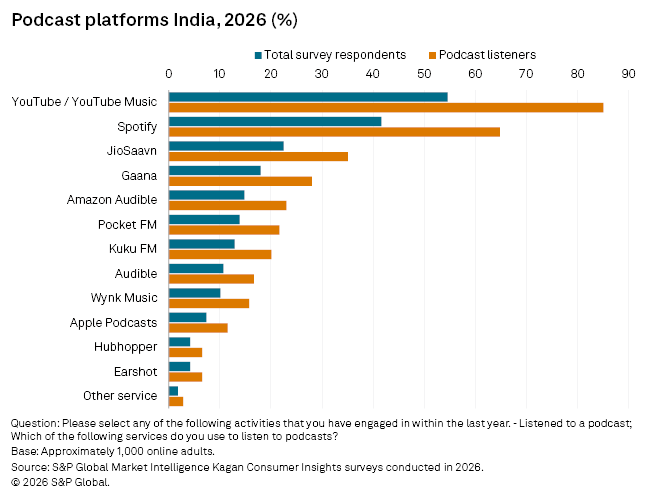
➤ YouTube/YouTube Music is the most popular platform used to listen to podcasts, reaching 55% of survey respondents.
➤ Eighty-five percent of podcast users tune in at least weekly, with most falling into the daily to several times per week brackets.
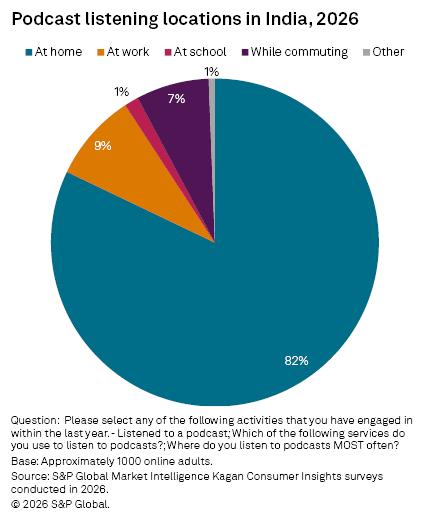
➤ Home is the dominant listening location with 82% of podcast service users across all platforms. Workplace listening accounted for 9% and commuting for 7%.

S&P Global Market Intelligence Kagan's 2026 Asia-Pacific Consumer Insights survey, conducted in the second quarter of 2026, provided insight into the most popular services used to listen to podcasts in India. The data shows which platforms attract the largest audience, which genres drive engagement, and when and where surveyed adults tune in. Demographic breakdowns across age, gender, household composition, income, and education provide additional context for understanding who the Indian podcast audience is and how engagement patterns differ by platform.
Across the dataset, usage patterns in India indicate a strong preference for globally available platforms. Among total survey respondents, YouTube LLC's YouTube reached 55% of respondents, making it the most-used platform. Spotify Technology SA's Spotify followed at 42%, JioSaavn ranked third at 23% and Gaana fourth at 18%. All remaining platforms (including Pocket FM, Kuku FM, and Amazon.com Inc.'s Amazon Audible) each reached fewer than 15% of respondents. Among the podcast service users specifically, YouTube reached 85%, Spotify 65%, JioSaavn 35% and Gaana 28%.
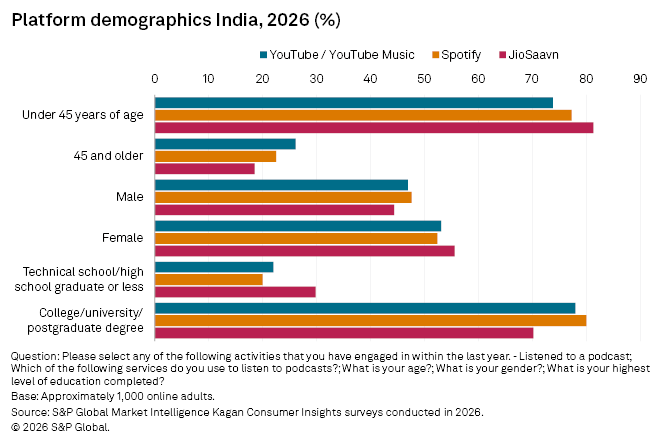
Podcast service users in India skewed toward a younger demographic, with 70% of the users under the age of 45 and the highest concentration of those in the 25-34 age range. Regional platforms showed high usage rates among younger audiences: 81% of JioSaavn's audience was under the age of 45, while 75% of Gaana users indicated the same. Among the two most popular platforms, YouTube and Spotify, there was also high use from respondents under 45 at 74% and 77%, respectively.
The gender split was nearly even overall, with women holding a slight majority across most platforms. The podcast audience was highly educated, with 74% of podcast service users holding a college, university, or postgraduate degree, compared with 26% who were technical school or high school graduate level or below.
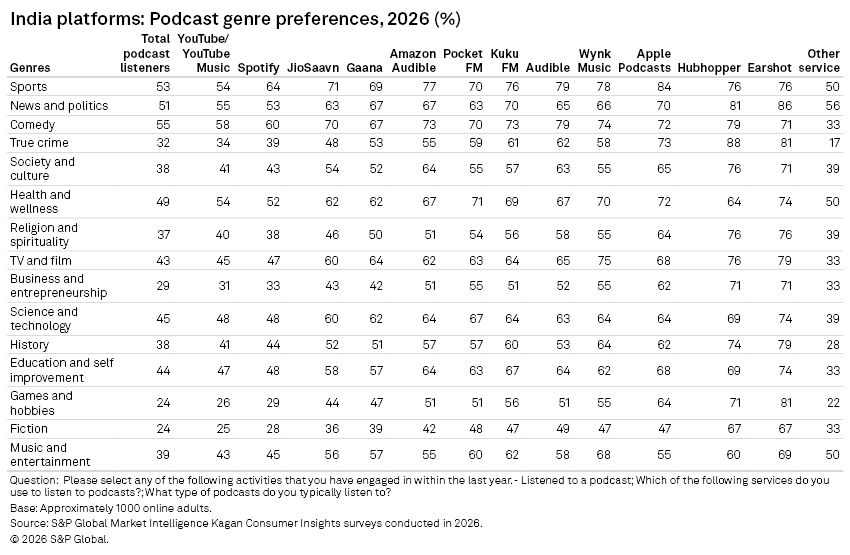
Survey data indicated that podcast service users in India prefer a consistent set of top genres across platforms. Comedy was popular with 55% of respondents, followed by sports at 53%, and news & politics at 51%. Across YouTube, Spotify, JioSaavn, and Gaana, sports, news & politics, and comedy emerged as the top three genres, though their ranking varied by platform.
Among JioSaavn users, the sports genre was the most popular at 71%, followed by comedy at 70%, news & politics at 63%, and health & wellness at 62%. Gaana users showed similar preferences: sports at 69%, comedy at 67%, news & politics at 67%, and health & wellness at 62%. These figures were above YouTube’s baseline, where sports, comedy, news & politics, and health & wellness reached 54%, 58%, 55%, and 54% of users, respectively. Spotify users reported engagement rates of 64% for sports, 60% for comedy, and 53% for news & politics. True crime and games & hobbies genres displayed the greatest variation between platforms, with a 55-percentage-point difference between end points. YouTube had 34% of users interested in true crime and 26% in games & hobbies. In contrast, Hubhopper had 88% of users engaged in true crime, and Earshot saw 81% of its audience interested in games & hobbies.
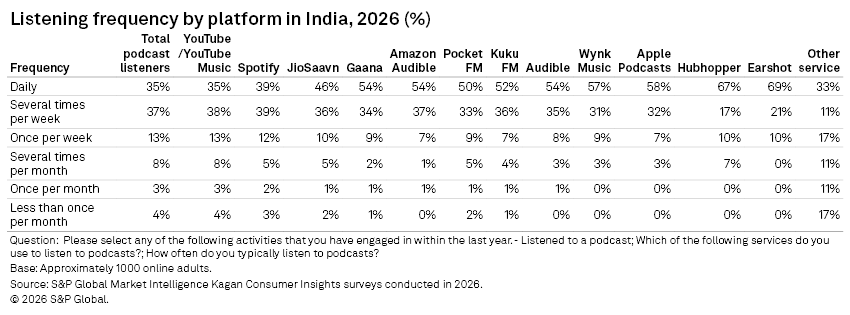
Frequency of engagement among podcast platform users was high, with 72% reporting that they listen daily or several times per week. Specifically, 35% reported daily listening and 37% reported listening several times per week. Listening frequency was generally highest on local platforms, with 54% of Gaana users and 46% of JioSaavn users reporting daily listening, compared with 39% of Spotify users and 35% of YouTube users.
Survey results show that JioSaavn and Gaana users not only reported higher daily listening frequencies but were also more engaged within the genres measured. This suggests that users who engage more frequently with a platform are also more likely to consume a wider range of content. This data points to a relationship between platform engagement and broader genre exploration. Regional platforms (despite smaller respondent bases) are reaching audiences with distinctly more active and varied listening habits than the general YouTube podcast audience.
When asked about their listening location, 82% of podcast service users in India reported listening at home. Workplace listening accounted for 9% and commuting for 7%. Home listening held consistently across platforms, ranging from 77% among Gaana respondents to 86% among YouTube and Wynk Music listeners.
Overall, the survey portrays India's podcast landscape as a frequent, home-based activity among a young and demographically balanced audience. YouTube and Spotify have the widest reach, while regional platforms attract smaller but more frequently engaged audiences. Across all platforms, genre preferences focus on comedy, sports, and news & politics, with steady interest in other genres such as music & entertainment and health & wellness.
The Kagan 2026 Asia-Pacific Consumer Insights survey was conducted in June of this year, consisting of 1,000 internet adults in China, South Korea and India. The margin of error is +/-3.0 ppts at the 95% confidence level. Survey data should only be used to identify general market characteristics and directional trends.
Consumer Insights is a regular feature from S&P Global Market Intelligence Kagan.
This article was published by S&P Global Market Intelligence and not by S&P Global Ratings, which is a separately managed division of S&P Global.
Content Type
Theme
Segment
Language