ECONOMICS COMMENTARY — 05 Nov, 2026
Global PMI remains elevated in October, but dips on heightened economic uncertainty

Global economic growth slowed but remained elevated in October, the headline PMI consistent with annualised global GDP growth of 2.9%, building on a strong third quarter. Growth trends varied among the major economies, however. While the US continued to lead the developed markets and India again outperforming among the largest emerging economies, Australia, Canada and Brazil – economies typically reliant on commodity-focused industries – all contracted.
One common theme among all economies was an unusual lack of business confidence despite the robust global expansion, linked to heightened uncertainty over geopolitics.
Global PMI cools from 40-month high but growth rate remains elevated
Global business activity rose sharply again in October, according to the PMI surveys, albeit losing a little momentum from September’s recent high.
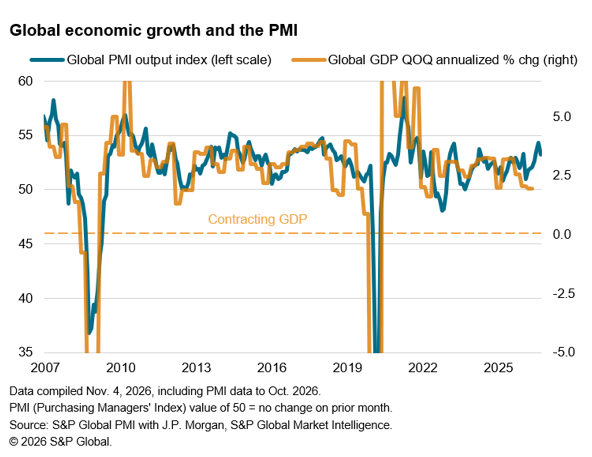
The J.P. Morgan Global Composite PMI Output Index, compiled by S&P Global, fell from 54.3 in September to 53.2 in October, falling for the first time in seven months. Although down to a three-month low in October, September’s PMI had been the highest for nearly three and a half years, and the October reading was still among the highest recorded over the past five years.
Historical comparisons indicate that the October PMI is broadly consistent with global GDP growth running at an annualised 2.9% rate, with growth in the third quarter signalled to have been running at a 3.0% pace.
The survey data therefore hint at a much stronger economic performance in the second half of 2026 so far compared to the first half of the year.
Robust growth is by no means universal, however, with notable variances across both developed and emerging markets.
US outperformance sustained, but gap narrows with Europe and Japan
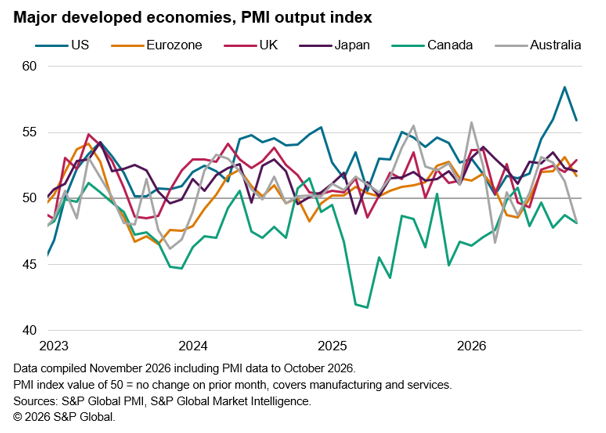
Strong growth in the US was accompanied by more modest, though still encouragingly robust, upturns in Europe and Japan, while both Australia and Canada saw output fall in October.
The US reported the fastest pace of output growth across the major developed economies for a fourth successive month in October. Although the rate of expansion in the US slowed from September’s 62-month high, it was still the third strongest since April 2022 and indicative of GDP growing at a quarterly pace in excess of 1.0%.
The second strongest performer was the UK, where the pace of expansion moved up a gear to its fastest since the outbreak of the Middle East war back in February, consistent with GDP rising at a 0.7% quarterly rate.
Growth meanwhile slowed in the eurozone and Japan, though remained indicative of GDP rising at 0.3% and 0.5% quarterly rates respectively. However, growth varied markedly within the eurozone: France notably lagged with a marked contraction of output, coinciding with political and social unrest, but Spain outperforming alongside solid growth in Germany and a sustained, though weakened, upturn in Italy.
Output falls in Australia and Canada
In contrast to the robust gains seen in the US, Europe and Japan, output fell into decline for the first time in five months in Australia, registering its steepest decline since March. Output also fell in Canada for the eleventh time in the past 12 months, the rate of contraction deepening slightly.
India leads emerging markets as Brazil’s downturn deepens
India remained the best performer among the largest emerging economies in October, its growth rate at a four-month high though markedly below that seen this time last year, and with business growth expectations remaining among the weakest seen over the past four years.
Growth rates meanwhile deteriorated in the other ‘BRIC’ economies. The pace of expansion in mainland China edged down to its second lowest in the past seven months, running especially weak in the service sector.
Output stagnated in Russia after two months of modest expansions, but the worst performance was again seen in Brazil, where output fell sharply in part-response to heightened political uncertainty during an election month. The drop in output in Brazil was the sharpest recorded since June 2020, during the height of the COVID-19 pandemic.
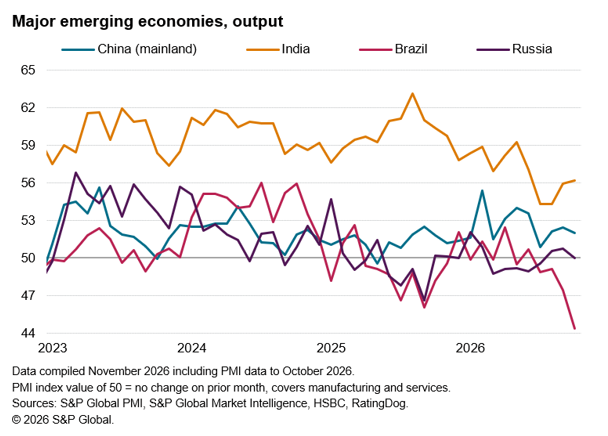
While Brazil’s downturn can be partly explained by especially elevated levels of political uncertainty, a common theme among the three contracting economies – Australia, Canada and Brazil – is their economic orientation toward commodities, demand for which has been squeezed during the post-pandemic global manufacturing weakness up to 2025 and, more recently, the spending and investment focus on higher value tech manufacturing amid the AI boom.
Business lacks confidence
A further notable divergence persisted, however, in terms of current and anticipated output growth among businesses worldwide.
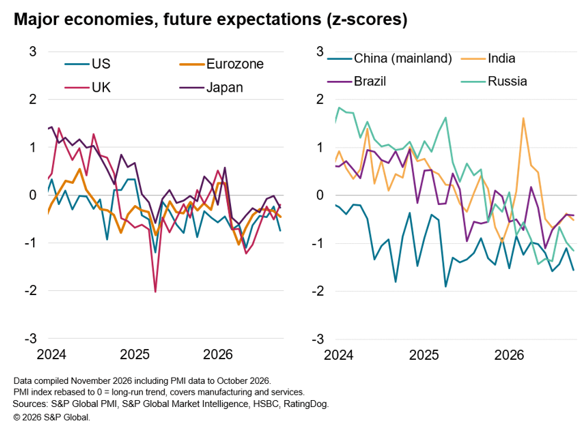
Continuing the trend seen since the announcement of US tariffs in April 2025, business growth expectations remained very weak by historical standards in October, deteriorating globally to fall further below the long run average (1.1 standard deviations) and one of the lowest levels seen since the pandemic.
The sustained robust global expansion in the face of low business confidence is unusual according to historical comparisons of current and expected output growth from the PMI. That said, the only time prior of such divergence was after the prior announcement of US tariffs and escalation of global protectionism in 2018 and 2019, indicating that uncertainty over geopolitics, and US policy in particular, is a key dampener of business confidence.
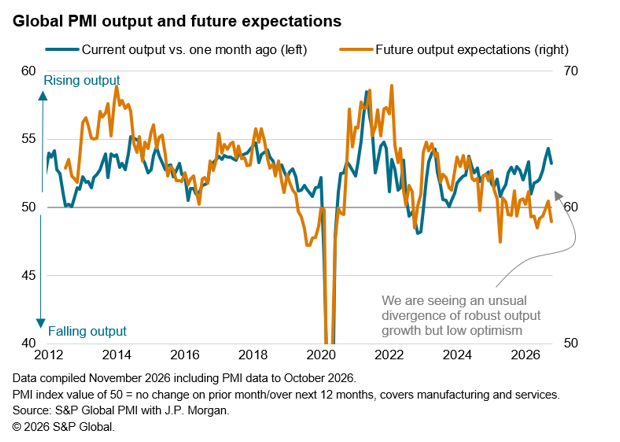
The weakness of business growth expectations relative to long run averages is evident in all major developed and emerging markets, including the US. The US in fact saw the lowest confidence relative to its average of all the major advanced economies in October, in part reflecting heightened uncertainty amid the approaching mid-term elections.
In the emerging markets, confidence is lowest relative to its long-run average in mainland China.
© 2026, S&P Global. All rights reserved. Reproduction in whole or in part without permission is prohibited.
Purchasing Managers' Index™ (PMI®) data are compiled by S&P Global for more than 40 economies worldwide. The monthly data are derived from surveys of senior executives at private sector companies, and are available only via subscription. The PMI dataset features a headline number, which indicates the overall health of an economy, and sub-indices, which provide insights into other key economic drivers such as GDP, inflation, exports, capacity utilization, employment and inventories. The PMI data are used by financial and corporate professionals to better understand where economies and markets are headed, and to uncover opportunities.
Read our latest PMI commentary here.
This article was published by S&P Global Market Intelligence and not by S&P Global Ratings, which is a separately managed division of S&P Global.
Theme
Location
Products & Offerings