ECONOMICS COMMENTARY — 12 Nov, 2026
Global payroll growth slows as firms juggle fuller order books against outlook uncertainty

Worldwide PMI survey data showed global employment rising for a fourth straight month in October. Although the rate of job creation slowed, it was still the third strongest in over two years.
The US led the major developed economies, while technology firms topped the job gains globally by industry. However, while all eight major industries added staff for a second successive month, employment trends were more varied among the major economies, ranging from strong growth in the US and Spain to steep job losses in France and Canada.
Although growing order backlogs supported hiring, low confidence in the future outlook held back faster job creation, underscoring how greater business optimism is needed to drive a sustained job market improvement.
Global employment continued to rise in October
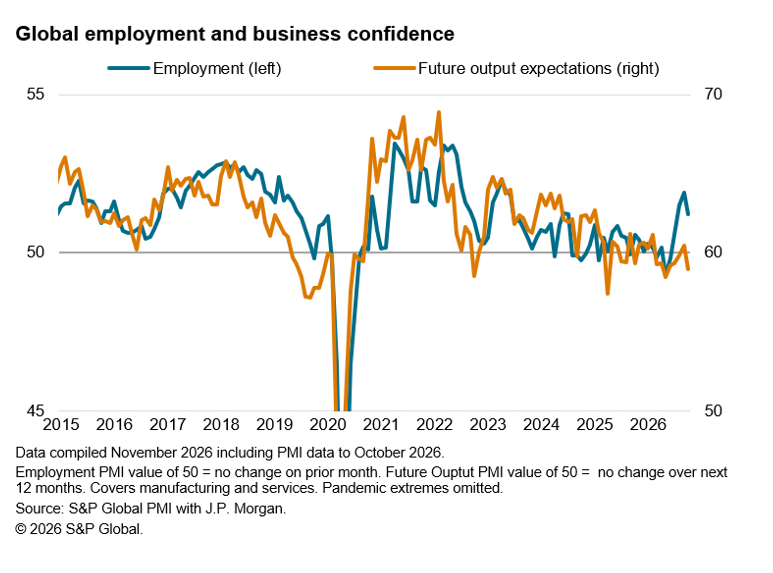
Global employment rose for a fourth consecutive month in October, according to S&P Global’s PMI survey data, compiled at the worldwide level on behalf of J.P. Morgan. Although the rate of job creation slowed, it remained the third strongest seen for over two years, the pace having shown a marked improvement in momentum over the past three months.
Tech sector leads broad-based jobs growth
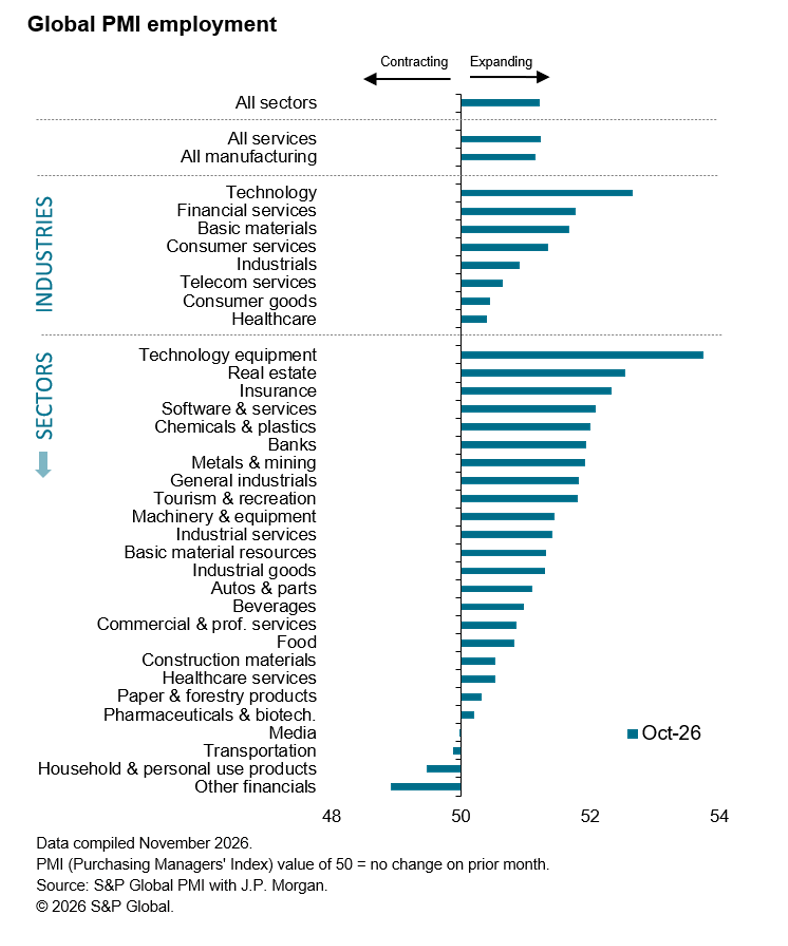
The worldwide labour market improvement was again led by technology firms, which have taken on extra workers at a rate not seen for over two years in recent months. Tech equipment manufacturing jobs were created at a rate surpassing all other sub-sectors, though software and related tech services jobs were also added in especially strong numbers.
Jobs growth was not all about the tech sector, however, as October saw all eight major industries report higher employment for a second successive month, indicating the most broad-based spell of job gains for over three years. That said, drilling down into more detail, jobs were cut for other financial services, household products and transportation.
Mixed labour market trends geographically
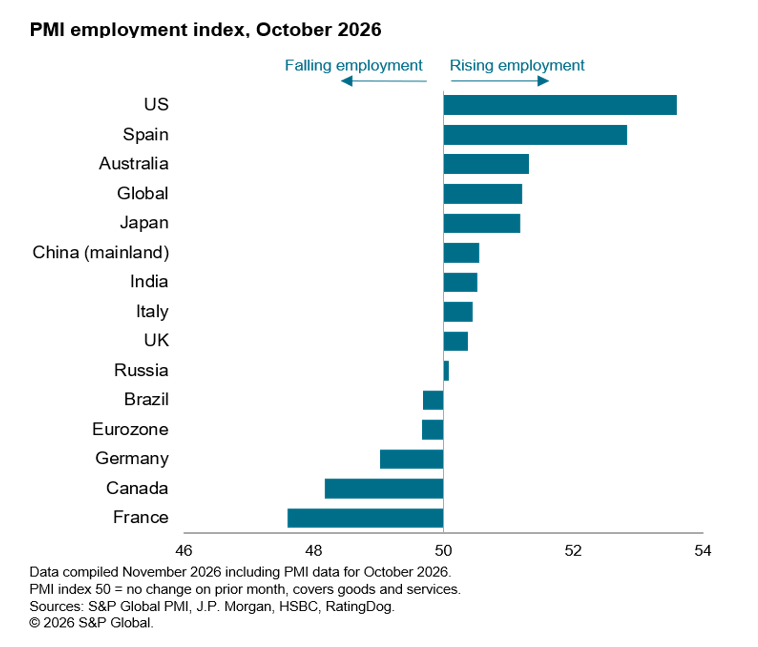
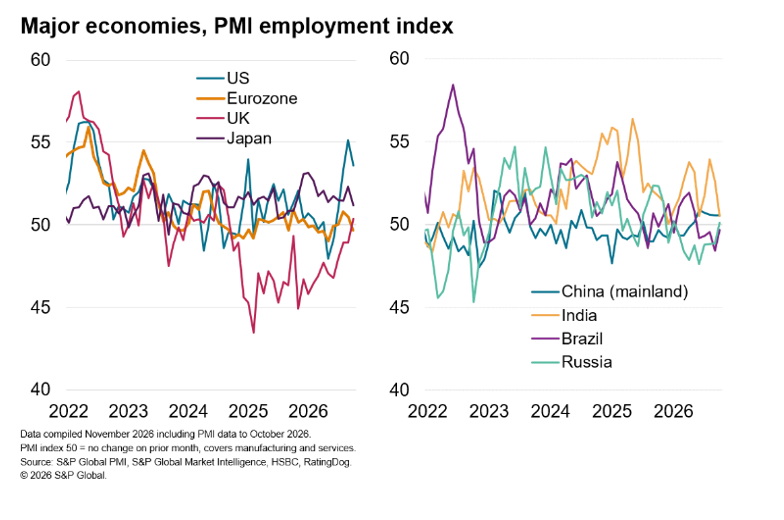
Among the major developed economies, labour market trends were mixed. The strongest job gain continued to be reported in the US, where the October improvement was the second-largest since July 2022, down from September’s recent peak. Slower – but still solid – jobs growth was also reported in Japan.
Better news came out of the UK, where a rise in payrolls was reported for the first time since the late-2024 tax rises on labour announced in the Autumn Budget. Australia also reported a gain in payrolls after a dip in September.
In contrast, the eurozone saw a renewed net loss of jobs after two months of tentative growth. The decline was led by a marked drop in employment in France, which reported the steepest job losses of the economies tracked by the PMI surveys covering both manufacturing and services, alongside a renewed drop in employment in Germany for the first time in three months. Spain, however, reported further strong jobs growth alongside a small rise in Italy.
Canada, meanwhile, reported the steepest decline in headcounts for ten months.
In the major emerging markets, employment rose at a markedly reduced rate in India, with the pace of job creation now matching that of mainland China, where employment has now risen for six months after a protracted period of decline.
While the Russian labour market stabilised after eight months of decline, jobs were cut in Brazil for a fifth successive month.
Fuller order books, but for how long?
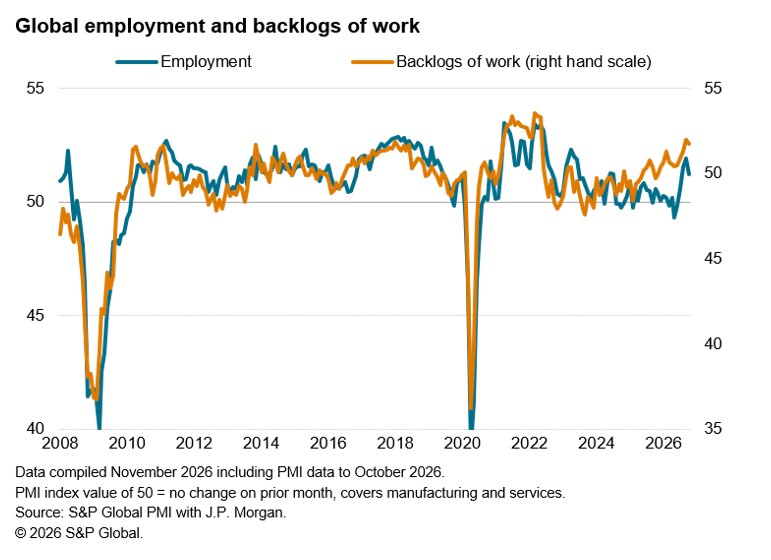
The rise in employment in recent months has reflected the need for firms to address a steady build-up of backlogs of uncompleted orders, which have risen globally in recent months at a pace not seen since 2022. However, at the same time, hiring was restrained by a lack of optimism in relation to future output requirements, as business growth expectations globally have been running at some of the lowest levels seen since the pandemic.
Juggling this need to boost capacity to meet the immediate order book requirements against worries that greater employee numbers may not be needed in the future continued to dominate the hiring picture in October, with a renewed dip in confidence contributing to a pull-back in employment growth.
The data therefore underscore how companies need greater confidence in the business outlook in order to propel accelerating jobs growth.
© 2026, S&P Global. All rights reserved. Reproduction in whole or in part without permission is prohibited.
Purchasing Managers' Index™ (PMI®) data are compiled by S&P Global for more than 40 economies worldwide. The monthly data are derived from surveys of senior executives at private sector companies, and are available only via subscription. The PMI dataset features a headline number, which indicates the overall health of an economy, and sub-indices, which provide insights into other key economic drivers such as GDP, inflation, exports, capacity utilization, employment and inventories. The PMI data are used by financial and corporate professionals to better understand where economies and markets are headed, and to uncover opportunities.
Read our latest PMI commentary here.
This article was published by S&P Global Market Intelligence and not by S&P Global Ratings, which is a separately managed division of S&P Global.
Theme
Location
Products & Offerings