ECONOMICS COMMENTARY — 23 Oct, 2026
UK flash PMI signals strong start to fourth quarter amid elevated price pressures

The UK economy has picked up momentum in October, with early PMI data indicating the strongest rate of growth since February. This encouraging sign of economic resilience is underscored by firms taking on additional workers for the first time since hiring was hit by the 2024 Autumn Budget.
There are reports of paused spending due to a lack of clarity on domestic economic policy in the run-up to the Budget, meaning the promising economic picture from the latest PMI should provide an encouraging base for further robust economic growth through the winter months, barring any adverse surprises to businesses in the tax and spending review.
Geopolitics, and notably the potential for conflicts in the Middle East and Ukraine add to energy market volatility, however, are clearly still unsettling many businesses, and the cost-of-living concerns and broader fiscal worries are being compounded by the prospect of higher borrowing costs.
Price pressures remain worryingly elevated, not only making a rate hike from the Bank of England at its upcoming policy meeting a near certainty but also likely shortening the odds of further rate hikes into 2027.
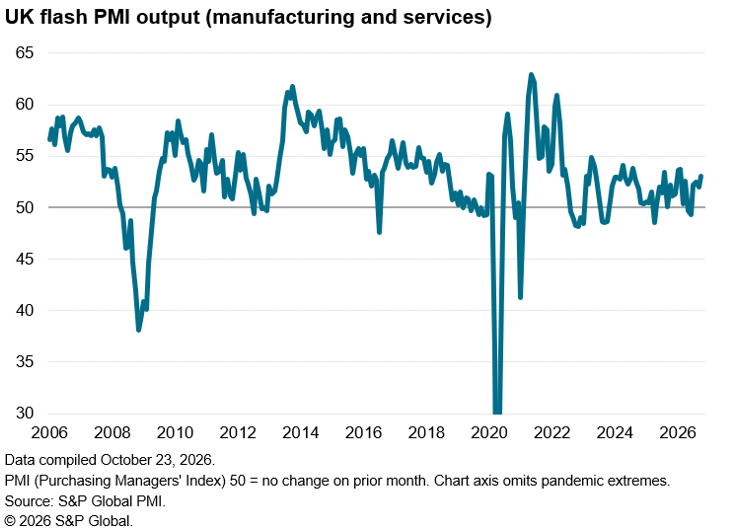
Economy picks up speed
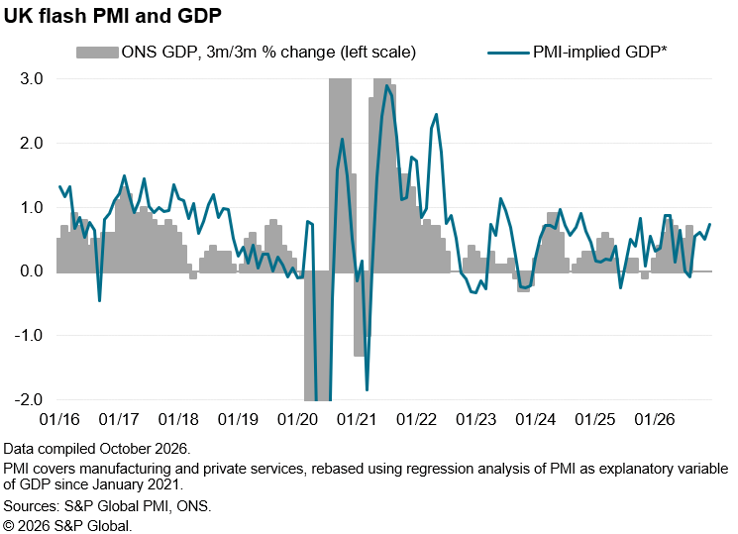
UK business activity rose in October at its fastest rate since February, expanding for a fourth successive month. The headline Output Index from the flash PMI surveys climbed from 52.0 in September to 53.1 in October.
A simple statistical comparison of the PMI with official GDP over the past five years indicates that the October PMI reading is consistent with 0.7% quarterly GDP growth.
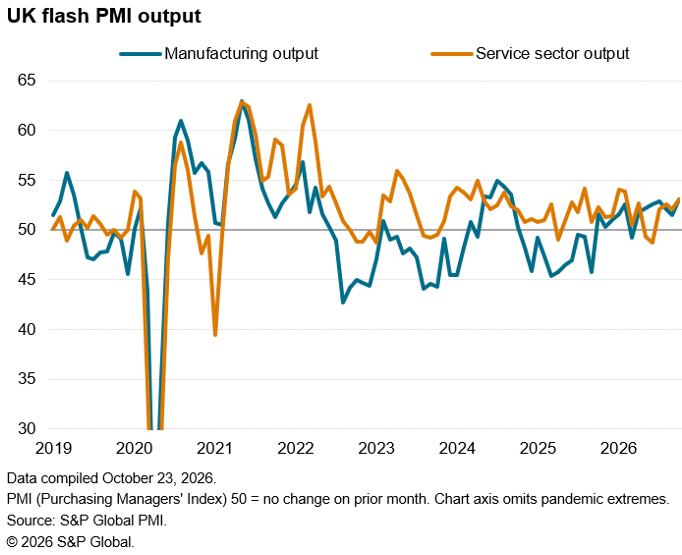
Manufacturing output growth hits two year-high alongside improved service sector expansion
The PMI sector data showed both manufacturing and services activity expanding at identical rates. While services growth was merely the fastest since February, the rise in factory output was the strongest since September 2024.
New orders placed at service providers, meanwhile, jumped markedly, posting the largest monthly rise since August of last year, thanks in part to the first rise in export sales since February, and was accompanied by an upturn in manufacturing new orders. The latter was buoyed by one of the largest improvements in export order inflows for goods seen over the past five years.
Hiring takes off
The improving demand environment encouraged companies to take on additional workers for the first time since September 2024. This halted a continuous spell of falling employment recorded by the PMI surveys since the Autumn Budget of 2024, which saw staffing costs rise on the back of new legislation. The rise was driven by the service sector, as manufacturing headcounts were pared back slightly during October amid cost-cutting.
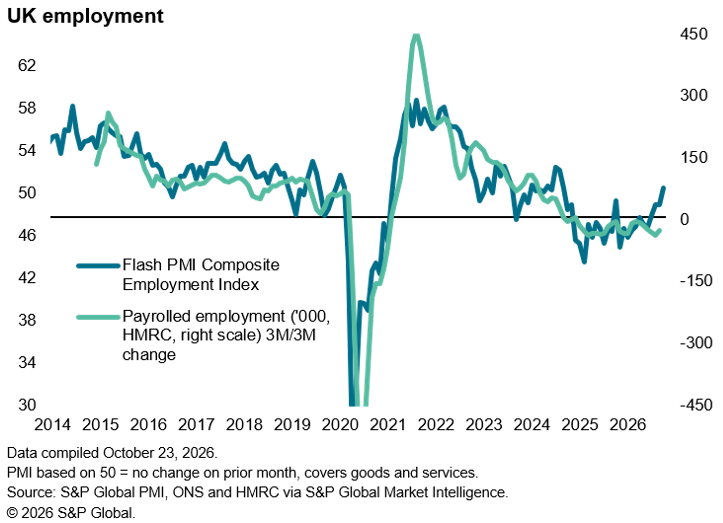
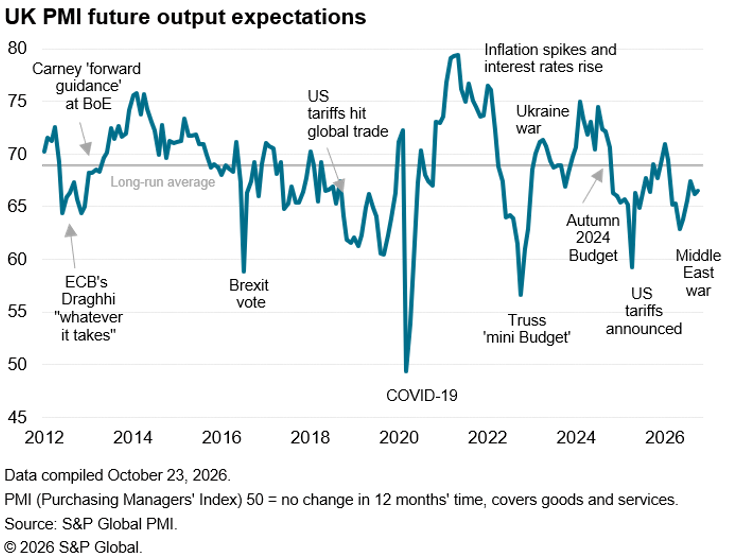
The overall pace of job creation remained only modest, however, largely in reflection of relatively subdued business confidence about the outlook. While business growth expectations are up from the lows seen earlier in the year, having been hit hard by the start of the war in the Middle East, optimism remains below the survey’s long-run average.
Amid ongoing geopolitical worries and high energy costs, companies also cited concerns over potential tax or policy changes in the upcoming Budget as well as the impact of interest rate hikes and higher borrowing costs.
Rising costs add to inflation worries
As growth and hiring picked up in October, cost pressures also moved higher. Input cost inflation accelerated across both manufacturing and services. While energy and fuel prices were especially widely reported as having pushed costs higher alongside freight surcharges amid Middle East-related supply disruptions, October saw widespread reporting of higher prices for a variety of inputs including steel, copper, aluminium, plastics, semiconductors, corrugated board, chemicals, food, software licences and servers or other electronic components.
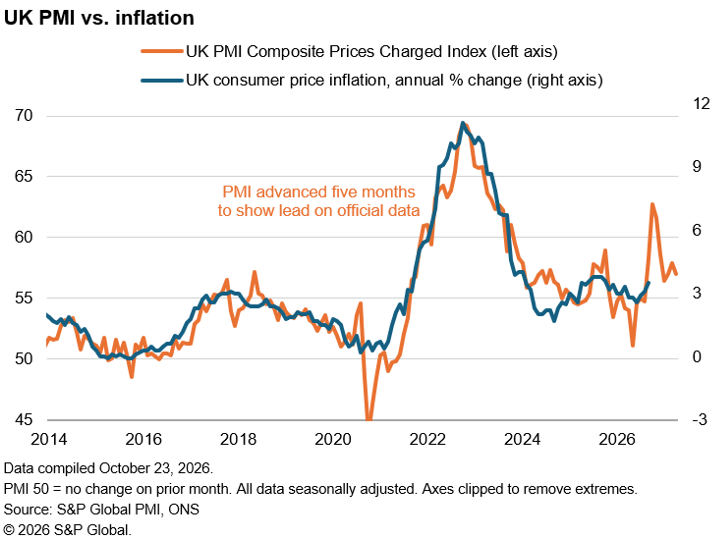
Average prices charged for goods and services rose sharply again as firms came under pressure to protect margins from the cost increase. Although less than the rise seen in September, October’s increase was among the largest seen over the past year and a half. With the PMI prices index acting as a leading indicator of the annual rate of consumer price inflation, the survey data signal a further acceleration of the headline inflation rate from the 3.5% pace registered by the latest official data. Inflation is therefore likely to remain well above of the Bank of England’s 2% target in the coming months.
Bank of England to start tightening policy
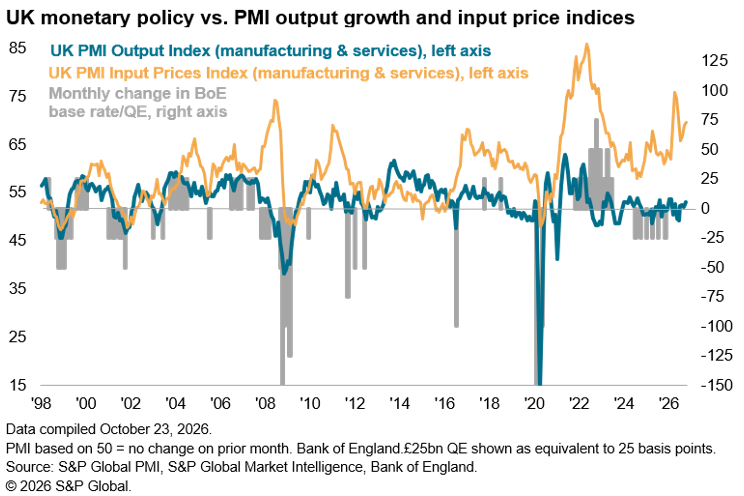
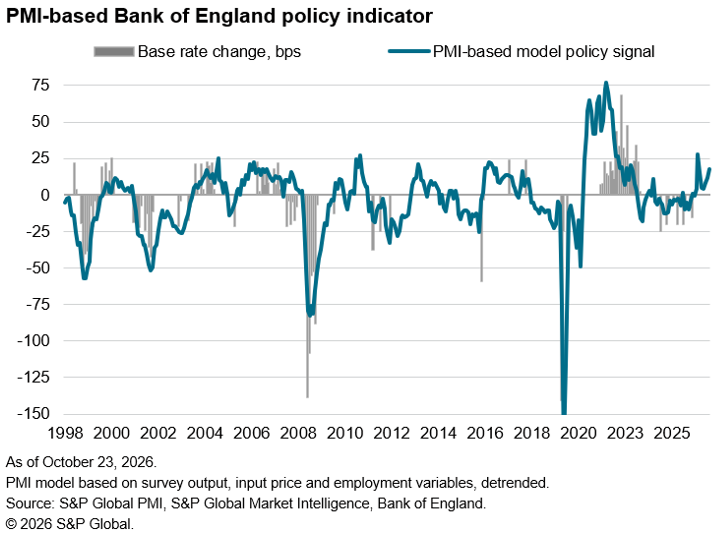
The flash PMI data for October will add to speculation of an imminent rate hike from the Bank of England. Markets had already fully priced in a 25-basis-point rise of the policy rate to 4% at the November MPC meeting, but the signs of stubbornly elevated inflation and resilient growth from the latest surveys will likely add to the odds of further rate hikes into 2027.
Outlook
A range of factors, both domestic and international, cloud the near-term horizon for businesses, however. At home, businesses and households will be eager to assess next week’s Budget. From a business perspective, confidence will be steered by the main policy direction of the Budget, which will in turn help determine appetite to invest and hire.
The Budget will also have to be viewed alongside any forward guidance from Bank of England policymakers on the extent to which they believe interest rates may have to rise in order to dampen demand and anchor inflation expectations.
Meanwhile, conflicts in the Middle East and Ukraine remain sources of geopolitical stress and uncertainty, affecting energy market pricing in particular. Upcoming mid-term elections in the US also have the potential to trigger changes in decision-making by the US administration. The political environment in the eurozone, the UK’s largest trading partner, has also entered a more uncertain phase, which could add to external headwinds for UK businesses.
Read the press release here.
© 2026, S&P Global. All rights reserved. Reproduction in whole or in part without permission is prohibited.
Purchasing Managers' Index™ (PMI®) data are compiled by S&P Global for more than 40 economies worldwide. The monthly data are derived from surveys of senior executives at private sector companies, and are available only via subscription. The PMI dataset features a headline number, which indicates the overall health of an economy, and sub-indices, which provide insights into other key economic drivers such as GDP, inflation, exports, capacity utilization, employment and inventories. The PMI data are used by financial and corporate professionals to better understand where economies and markets are headed, and to uncover opportunities.
Read our latest PMI commentary here.
This article was published by S&P Global Market Intelligence and not by S&P Global Ratings, which is a separately managed division of S&P Global.
Theme
Location
Products & Offerings