ECONOMICS COMMENTARY — 23 Oct, 2026
Japan’s October flash PMI points to sustained solid growth and rising cost pressures

By Jingyi Pan
October’s S&P Global Flash PMI® for Japan revealed that the economy continued to expand at a strong pace, with services activity showing signs of catching up to meet manufacturing output growth, the latter remaining solid despite easing to a seven-month low.
That said, employment growth softened while business confidence fell in October, altogether reflecting a slightly more cautious stance among businesses. Meanwhile, margin pressure mounted, with output price inflation easing despite a faster increase in costs.
The latest PMI data therefore pointed to still-steady growth but with further signs that rising prices, attributed to higher energy costs and a weak yen, have negatively affected demand conditions and business confidence, thereby keeping the Bank of Japan on a cautious tightening bias in the near term.
Growth remains steady in October
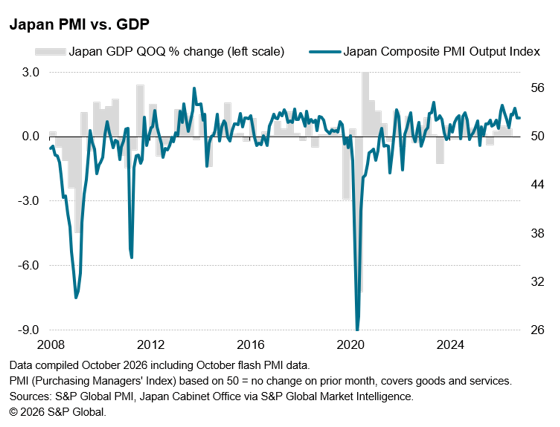
Japan’s business activity continued to expand at a strong pace at the start of the fourth quarter, with the rate of growth unchanged from September. The survey’s Composite Output Index posted 52.3 for a second consecutive month, which is again indicative of GDP rising at a quarterly rate of approximately 0.5%.
After rounding off a solid third quarter with an average of 52.9, the latest data showed the fourth quarter commencing with a reading closer to the Q2 average of 52.0, which nevertheless corresponds to a positive GDP reading of 0.4% reported for the second quarter.
Services activity plays catch-up to manufacturing
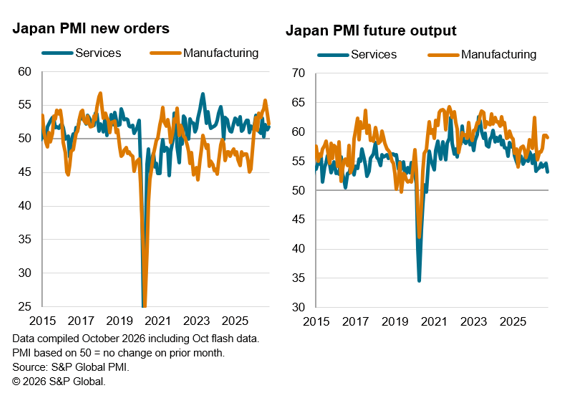
By sector, growth was broad-based with both manufacturing output and services activity rising collectively for the fifth month in a row. While the overall rate of expansion remained unchanged from September, what was notable was a convergence of growth rates between the two broad sectors.
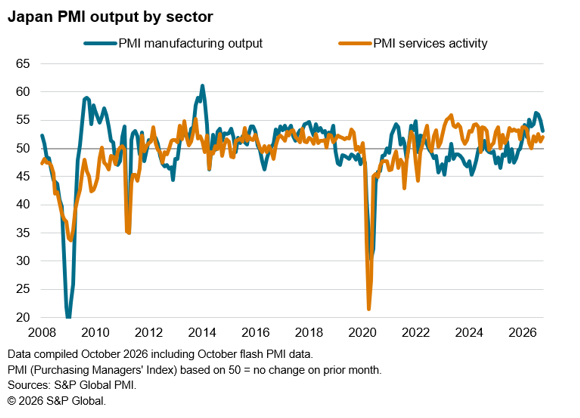
Services activity growth accelerated in October to a pace almost matching its year-to-date average as demand improved. Anecdotal evidence suggested that service providers were able to make good progress in their business development efforts to expand both their client bases and volume of new work. The improvement was concentrated among domestic clients, however, as overseas new business remained in contraction, albeit at a softer pace than in September.
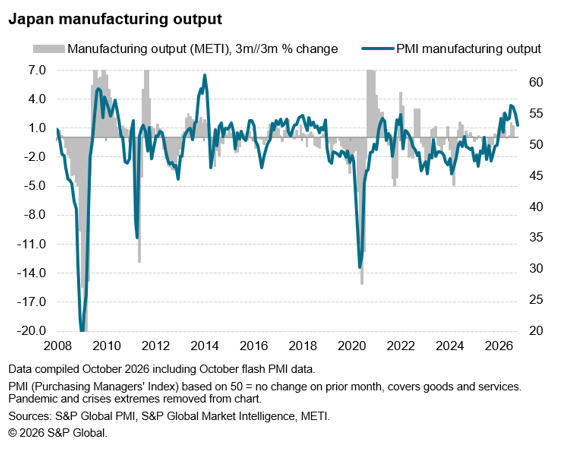
On the other hand, manufacturing output growth softened to the slowest since March. The rate of growth was nevertheless solid and extended the current spell of expansion to 10 months, the longest recorded since 2018.
As with the prior months, the expansion of the manufacturing sector was powered by AI-related demand and a weak domestic currency, with qualitative responses from the survey also pointing to safety stock building among clients as having buoyed demand for Japanese manufactured goods. Demand from overseas clients remained solid as well, despite easing from the sharp rates of increases in August and September. Many exporters reported greater inflows of work from North America, mainland China and other Asian economies.
Safety stock building continues in Japan
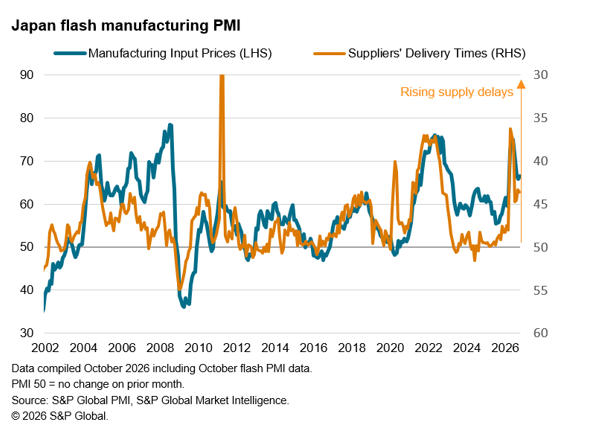
Once again, the motivation for building buffer stocks can be seen from the still-aggravated supply chain conditions as observed via the PMI Suppliers’ Delivery Times Index. While off the peak seen in the second quarter this year, the degree to which vendor performance has deteriorated remained marked at the start of the final quarter of the year, linked again principally to the war in the Middle East. As such, both clients of manufacturers and goods producers themselves have indicated safety-stock building as a driver for their acquisition of both semi-finished and finished products.
The substantial delays also contributed to higher cost pressures in October for manufacturers, with the rate of input price inflation for manufacturers picking up again after falling over the past three months.
Margin pressures increase in October
Overall, average input prices increased at a quicker pace in October, driven by higher manufacturing cost inflation while the rate of cost increases remained elevated and largely unchanged from September for service providers. To some extent, this highlighted the relatively more severe increases in raw material and fuel costs, which manufacturers are the heavy users of. Comments from panellists nevertheless also mentioned increased wage costs and imported cost inflation, the latter stemming from a weak yen.
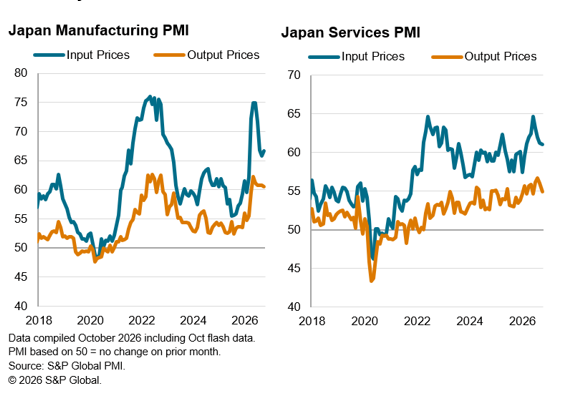
In contrast to the trend for input costs, overall output price inflation declined in October, falling to the joint-lowest in nine months. This was underpinned by lower selling price inflation among both manufacturers and service providers. Heightened competition, especially in the goods producing sector, was observed to have restricted the pass-through of increased cost burdens to clients among firms in October. The strong increase in costs has clearly affected demand going into the fourth quarter of the year, and this was also reflected via lower confidence, as measured by the Future Output Index, among Japanese private sector companies, often citing concerns over weaker spending among clients as prices rose.
Flash PMI hints at more rate hikes
The biggest takeaway from the October flash PMI for central bank watchers may perhaps be the fact that growth remains robust despite inflation becoming a growing threat for the economy, thereby keeping the Bank of Japan (BoJ) on a hawkish bias.
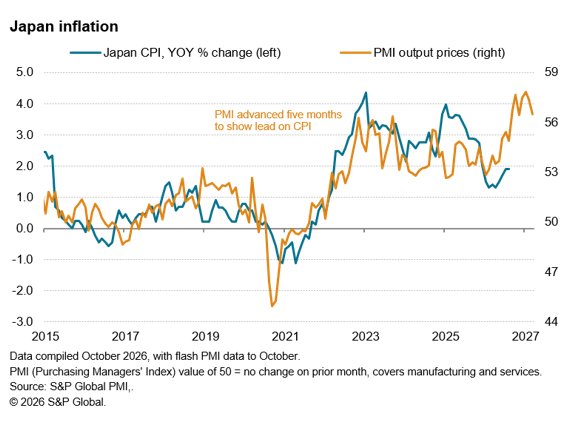
A comparison of the PMI Output Prices Index and Japan’s CPI showed inflation is expected to remain elevated above the central bank’s target in the coming months even with the former falling over the latest survey period. This does not yet take into account that the latest surge in input costs may result in a delayed pass-through to selling prices, should demand improve. The pressure on margins here, owing partly to a weak domestic currency, also provides impetus for the BoJ to join other major central banks in furthering the ongoing tightening cycle.
S&P Global Market Intelligence forecasters see the BoJ mulling another hike at their October meeting before taking action again in December with a 25 basis point hike.
Access the press release here.
© 2026, S&P Global. All rights reserved. Reproduction in whole or in part without permission is prohibited.
Purchasing Managers' Index™ (PMI®) data are compiled by S&P Global for more than 40 economies worldwide. The monthly data are derived from surveys of senior executives at private sector companies, and are available only via subscription. The PMI dataset features a headline number, which indicates the overall health of an economy, and sub-indices, which provide insights into other key economic drivers such as GDP, inflation, exports, capacity utilization, employment and inventories. The PMI data are used by financial and corporate professionals to better understand where economies and markets are headed, and to uncover opportunities.
Read our latest PMI commentary here.
This article was published by S&P Global Market Intelligence and not by S&P Global Ratings, which is a separately managed division of S&P Global.
Theme
Location
Products & Offerings