ECONOMICS COMMENTARY — 23 Oct, 2026
Eurozone flash PMI: growth spurt wanes amid renewed French downturn and elevated inflation

Flash PMI data showed the eurozone continuing to grow at one of the fastest rates seen over the past three years in October, though the rate of expansion slowed thanks in part to a renewed downturn in France. Inflationary pressures meanwhile remained elevated, attributable to the pass-through of a further uplift in oil prices seen during the month. Policymakers will be concerned that the PMI’s price gauges remained well above levels consistent with their inflation target, but the faltering of growth will be a concern, and could temper appetite for more demand-sapping rate hikes, especially given the fragility of the French economy, where bond market stress has intensified.
Slower eurozone growth
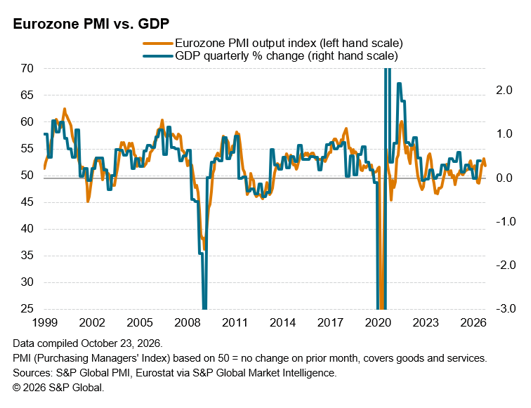
The eurozone economy has started the fourth quarter with businesses reporting further robust growth, according to the preliminary PMI reading for October. The S&P Global Flash Eurozone PMI Output Index, based on approximately 85% of usual survey responses, posted 51.9 in October against 53.1 in September.
By staying above 50, the index signalled a fourth consecutive monthly increase in business activity in the euro area, though the rate of growth has weakened. Nevertheless, despite the fall, the flash PMI is consistent with GDP growing at a 0.3% quarterly cadence. While that is below the 0.4% pace enjoyed in September, importantly it is still among some of the best performances seen over the past three years.
French drag
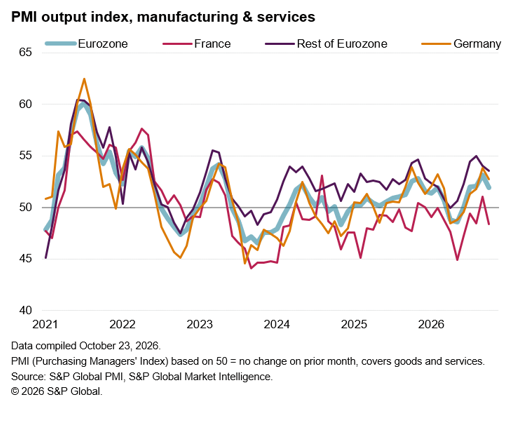
A drag on growth was a renewed drop in business activity in France, which saw widespread strikes and protests, including substantial civil unrest during the month alongside uncertainty caused by broader political instability. However, while some of the weakness in France may be linked to strikes and unrest having disrupted certain local economies, growth has also edged lower in the rest of the eurozone, both in terms of manufacturing and services activity.
Lack of hiring appetite
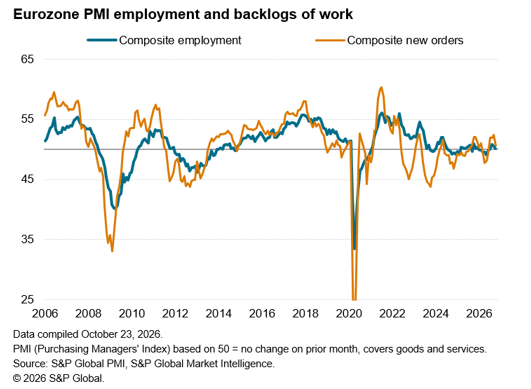
Hiring has meanwhile come close to stalling as new order inflows cooled to show only meagre demand growth.
Above target inflation
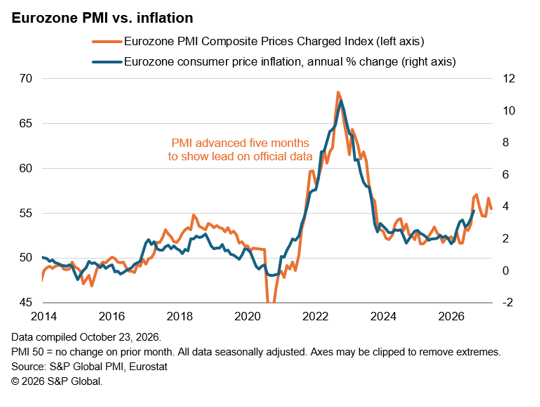
Central to the broader slowdown was the further escalation of inflationary pressures during the month, driving up the cost of living and deterring spending. Input costs rose sharply again, the rate of increase surging in manufacturing on the back of higher energy prices, causing firms to push selling prices higher in order to protect margins.
Although selling price inflation moderated slightly during the month, October’s rise in prices was among the largest since early 2023, and leaves the PMI index at a level which is indicative of consumer price inflation remaining elevated – and well above the ECB’s 2% target – in the coming months.
Higher interest rates
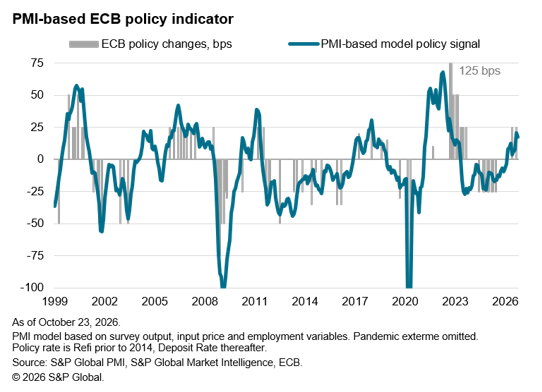
Higher interest rates are also starting to take a toll, dampening demand, and the picture of sustained growth and stubbornly elevated inflation from the October flash PMI will likely add to further speculation of more aggressive policy tightening from the ECB. A composite policy indicator, based on PMI output, input cost and employment indices, has remained firmly in rate hike territory in October, and in recent months has been sending the most hawkish signal for rates for almost four years. The ECB has already raised rates twice accordingly, taking its Deposit Rate up to 2.50% in September.
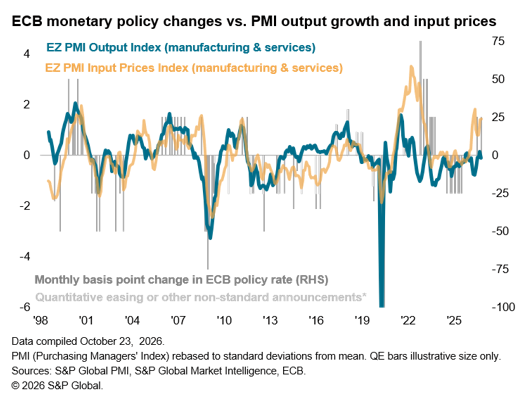
However, the policy picture is blurred by the fact that, although price data are convincingly in rate hike territory, output growth is merely hinting at a neutral stance, and the relatively modest output growth seen in recent months will reduce the chances of ‘second-round’ inflationary pressures, notably as the limited appetite among companies to hire will likely contain wage pressures.
Bond market stress
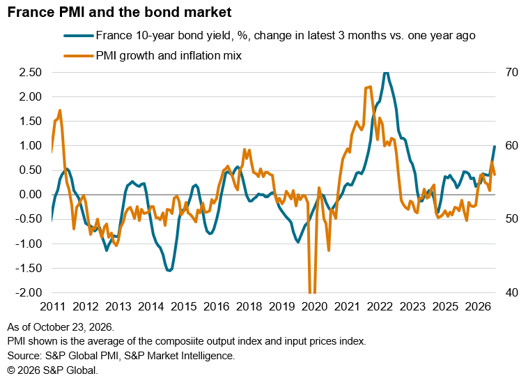
A further complicating factor is the bond market. While markets are keen to see inflationary pressures contained, a lack of growth is also a worry in terms of government borrowing requirements, and the spotlight has turned sharply toward France in this respect.
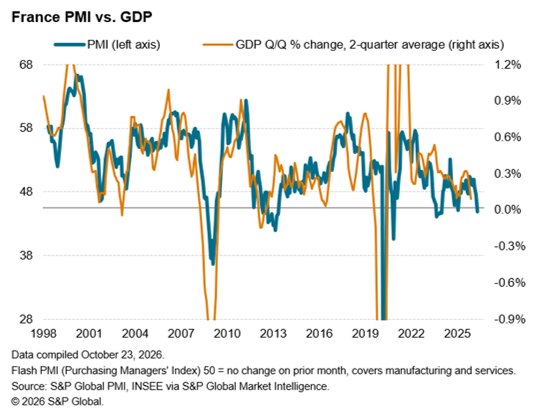
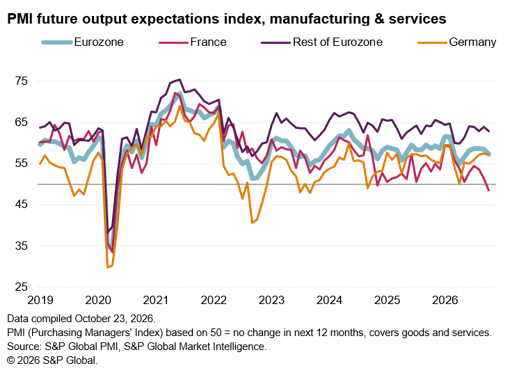
The flash data underscore the difficult situation France faces, with the PMI indicating that the economy is slipping into contraction as business confidence hits the lowest since 2012 if the pandemic is excluded, a time when the promise of “whatever it takes” from the ECB was needed to lift the eurozone out of its debt crisis.
Access the press release here.
© 2026, S&P Global. All rights reserved. Reproduction in whole or in part without permission is prohibited.
Purchasing Managers' Index™ (PMI®) data are compiled by S&P Global for more than 40 economies worldwide. The monthly data are derived from surveys of senior executives at private sector companies, and are available only via subscription. The PMI dataset features a headline number, which indicates the overall health of an economy, and sub-indices, which provide insights into other key economic drivers such as GDP, inflation, exports, capacity utilization, employment and inventories. The PMI data are used by financial and corporate professionals to better understand where economies and markets are headed, and to uncover opportunities.
Read our latest PMI commentary here.
This article was published by S&P Global Market Intelligence and not by S&P Global Ratings, which is a separately managed division of S&P Global.
Theme
Location
Products & Offerings