Research — Oct 22, 2026
Energy affordability a defining issue in the 2026 state legislative cycle

By Heike Doerr
Rising electricity rates, surging data center demand and volatile global energy markets pushed state legislatures to make energy affordability a top priority in 2026.
These pressures fueled one of the most active affordability-focused legislative cycles in years. Lawmakers in 20 states enacted at least 55 bills addressing customer energy costs, spanning income-based payment programs, data center cost-allocation rules, performance-based ratemaking reforms and omnibus packages.

➤ Policymakers passed a broad array of bills targeting energy affordability, with the geographic and political diversity of these measures reflecting the pressure lawmakers face as residential electricity and natural gas rates rise, driven in large part by data center growth. The 2026 legislative cycle has established frameworks, including large-load tariffs, affordability metrics, changes to integrated resource planning (IRP) and performance-based regulation (PBR). These frameworks will be examined further in 2027 and beyond, as structural reforms begin with studies and reporting, leaving subsequent determinations to future commission proceedings.
➤ A growing number of data center cost-allocation laws are reshaping the cost-recovery framework for large-load interconnections. Under these new rules, utilities are prohibited from incorporating data center interconnection costs into the general rate base and recovering them from all customers. Additionally, in response to uncertainty surrounding data center load growth and AI-driven demand, several states revised their IRP frameworks so that long-term resource portfolios optimize for both cost and reliability.
➤ Policymakers passed laws that target affordability by altering the foundation of the investor-owned utility model, directing commissions to study and implement PBR. A parallel structural change requires utilities to measure and report affordability directly. Hawaii, Maine, Maryland and New York now mandate that affordability metrics be taken into consideration.
➤ States also expanded programs that directly assist customers, particularly lower-income households, and protect against service disconnections. Income-based payment programs are transitioning from voluntary utility offerings to statutory mandates with specific numeric targets.

This article does not include every energy affordability bill passed in 2026. Rather, it highlights those with the broadest impact on rates, the strongest potential to set a precedent or the clearest illustration of the year's defining legislative trends.
Reshaping how regulators set rates
Large-load tariffs
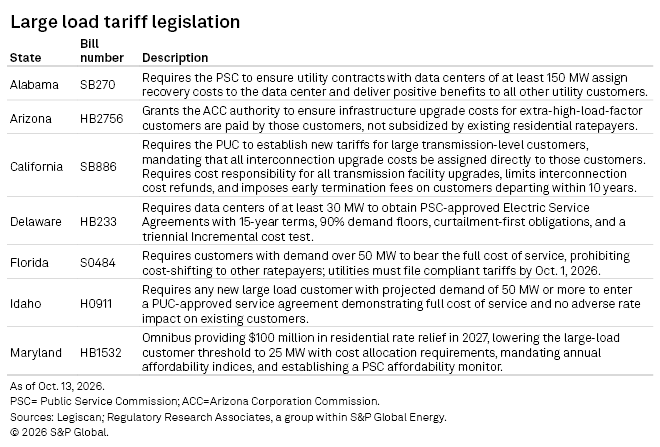
The question of who should pay for the grid infrastructure needed to serve new data centers, and how those payments should be structured, ranks among 2026's most important energy policy questions. Legislation is not the only tool public officials are using to answer it. Still, across the political spectrum, states have moved to ensure that existing residential and commercial ratepayers do not subsidize load growth driven primarily by AI and data centers.
The resulting laws are too new to reveal their long-term effects, but they point to a legislative focus on minimum load thresholds, long-term service contracts, minimum billing provisions and cost allocation. Many of the details, however, are left to utility commissions, which will review them with utilities and other stakeholders.
The breadth of this push, spanning both Republican- and Democratic-controlled legislatures, signals that cost-shifting from large loads has become a mainstream ratepayer protection concern, one unlikely to ease heading into 2027.
Affordability in the regulatory mandate
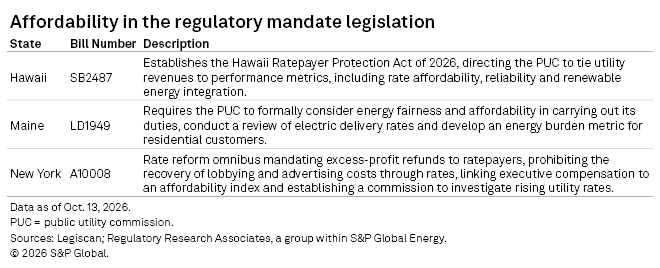
Several bills in 2026 require commissions to formally measure affordability in rate cases, a notable shift from how these proceedings have traditionally unfolded. In most jurisdictions, the rates a commission approves account for utility costs, infrastructure and an authorized return, among other factors. These new laws largely direct commissions to design affordability metrics, deferring the more difficult implementation questions to future proceedings.
Once active, these metrics will alter how rate cases proceed. Consumer advocates may find statutory grounds to contest rate increases on affordability terms in every case, while commissioners who approve a rate increase that worsens affordability metrics may have to justify their decisions.
Affordability metrics give commissions a new standard to incorporate into the rate-case process, while IRP reforms reshape the planning that precedes it.
Integrated resource planning
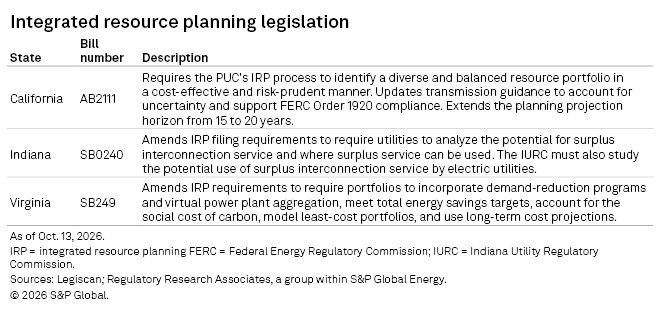
In 2026, lawmakers also modified their IRP frameworks to ensure that long-term resource portfolios optimize for both cost and reliability. AI-driven demand heightened the urgency, creating pressure to add generation and transmission infrastructure that ratepayers would fund for decades. Compounded by uncertainty over how much of that load will actually materialize, IRPs have become less predictable, but more important for designing a functional grid.
Requiring commissions to evaluate least-cost portfolios — weighing demand reduction and virtual power plant aggregation alongside supply-side options and local grid planning — changes the baseline against which regulators judge new capital investment. These planning changes could narrow the scope for capital growth.
Performance-based regulation
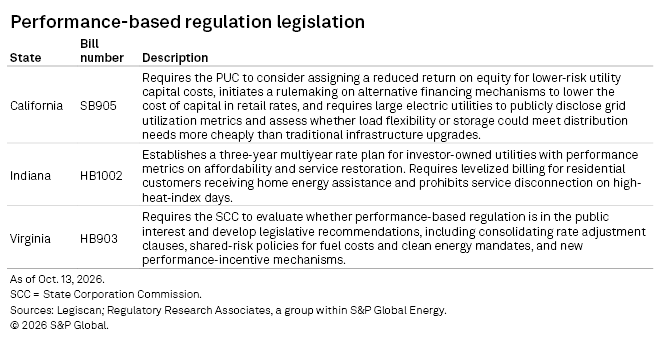
Policymakers passed laws that address affordability by altering the foundation of the investor-owned utility model, directing commissions to study and implement PBR. In doing so, these laws challenge the utility cost-of-service model by tying revenue to customer outcomes rather than capital deployment. As they take effect, the cost-of-capital advantages historically embedded in utility business models could narrow.
Three approaches dominate: compressing returns on traditional capital-heavy spending, smoothing costs through structured mechanisms, and using bonds and extended recovery timelines to ease customer bill shock without undermining utility credit stability.
The most significant of these is California's Senate bill 905. The bill requires the California Public Utilities Commission to consider assigning a lower return on equity (ROE) for certain electric utility capital costs. It also mandates that the commission develop performance-based metrics for large electric utilities and help develop the Policy-Oriented and Wildfire Electric Reimbursement program, which will reimburse electric utilities for certain costs driven primarily by state policies.
Similarly, although still pending, legislation in Pennsylvania targets utilities' cost of equity and would tie the authorized ROE to the 10-year US Treasury yield plus 2 percentage points. House bill 2224 passed the Pennsylvania House on June 22 by a unanimous 202-0 vote and was referred to the Senate Consumer Protection and Professional Licensure Committee. The Pennsylvania legislative session ends Nov. 30.
Reaching customers directly
Energy finance and incentives
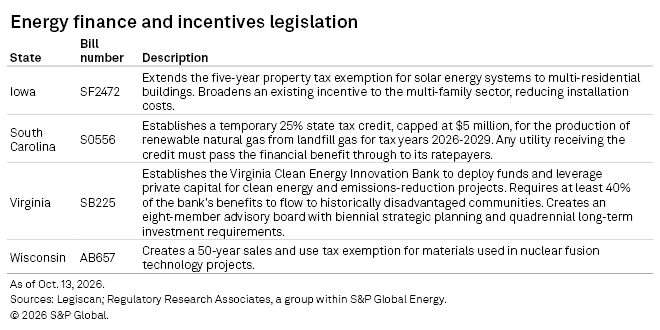
Alongside affordability mandates and ratemaking reforms, a parallel set of legislation measures deploys public funds and tax incentives to expand investment in new and emerging energy technologies. These measures aim to reduce the cost of financing the infrastructure that ratepayers ultimately fund, potentially lowering rates over the asset's life.
Consumer protection
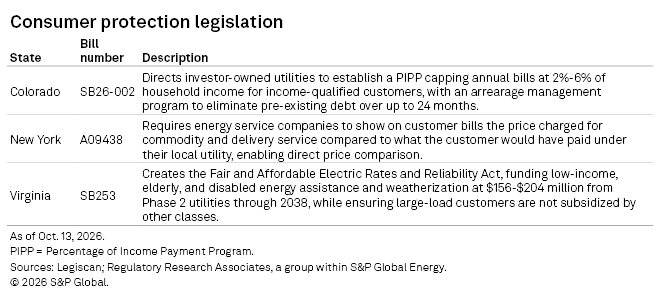
Rising utility rates affect lower-income households most, prompting a notable legislative response in 2026. States moved to incorporate structural mechanisms into the regulatory framework to support low-income customers. The concurrent focus on billing protections points to a recognition among policymakers that an affordability agenda limited to the rate-case level may take longer to reach the customers who need relief. The most notable feature of 2026's legislation in this category is the shift toward mandatory programs.
Regulatory Research Associates is a group within S&P Global Energy.
S&P Global Energy produces content for distribution on S&P Capital IQ Pro.
For a complete, searchable listing of RRA's in-depth research and analysis, please go to the S&P Capital IQ Pro Energy Research Library
For a full listing of past and pending rate cases, rate case statistics and upcoming events, visit the S&P Capital IQ Pro Energy Research Home Page
This article was published by S&P Global Market Intelligence and not by S&P Global Ratings, which is a separately managed division of S&P Global.