Research — Oct 22, 2026
CES 2026: Price rally boosts copper exploration to its highest since 2012

By Paul Manalo
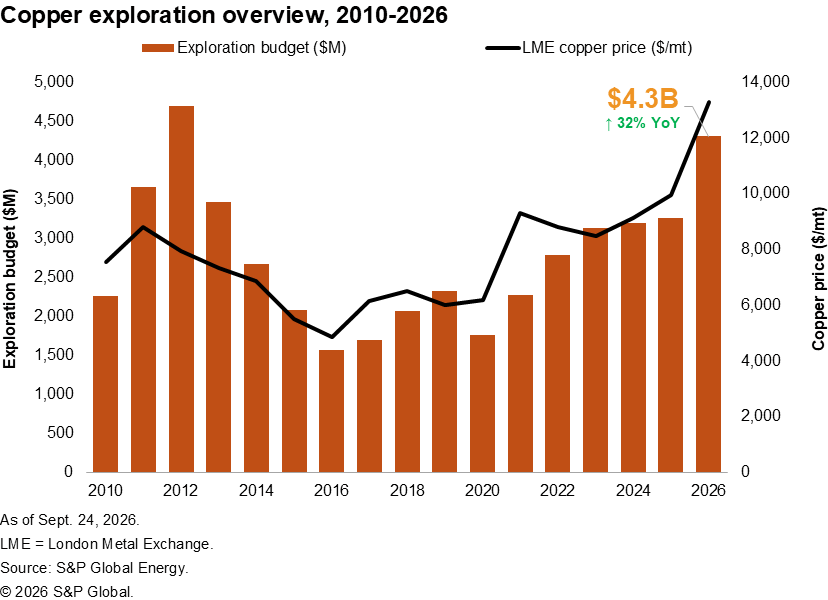
Copper exploration has reached its highest level since 2012, as both junior and major companies increased their efforts to explore the red metal. Exploration budgets rose 32% to $4.3 billion in 2026, marking the second-highest level on record, only surpassed by the $4.7 billion allocated in 2012 during the peak of the commodity-cycle boom. Except for 2020, copper exploration budgets have grown steadily since 2017. Copper now accounts for 26% of global nonferrous exploration budgets, up from 21% in 2017.

➤ Majors remain the dominant explorers, but juniors narrow the lead.
➤ New frontiers for exploration are gaining ground from various regions such as Saudi Arabia, Canada and the Democratic Republic of Congo.
➤ Early-stage exploration is still not a priority among explorers, as many of them prefer to explore known deposits and existing mines.
➤ Strong growth in copper exploration is expected, as prices are anticipated to be supported by a refined balance deficit in the medium and long term.

Copper prices: Too irresistible to ignore
Copper prices reached a low of $4,600 per metric ton in March 2020 but have trended higher since. In September 2026, the average monthly price for copper was $14,400/mt — more than three times the pandemic lows. Prices have even surpassed levels seen during the last commodity boom in 2011 and 2012. This sustained price increase is driven by supply constraints, rising demand from AI data centers and the electrification of transport, as well as ongoing global trade and tariff uncertainties.
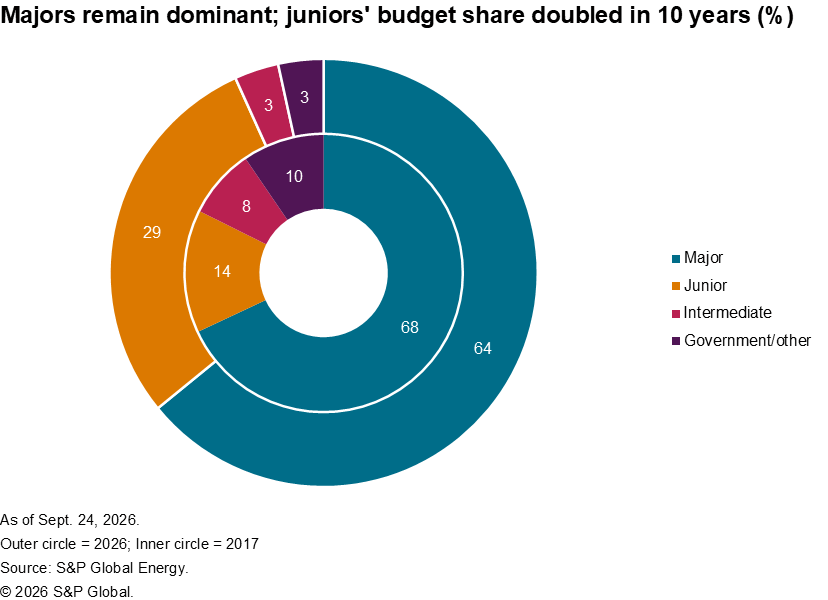
Copper exploration continues to be dominated by major mining companies, which accounted for 64% of total exploration budgets in 2026. But while majors maintain a strong presence, junior companies have gradually increased their share over the past decade. Juniors remain gold-focused, but we are seeing signs that they are increasingly interested in copper.
In 2026, junior companies accounted for 29% of copper exploration budgets, more than double their share in 2017. The number of juniors exploring copper increased to 643 — the highest since 2012. This growth has come primarily at the expense of intermediate companies and the government/others group, whose combined share dropped to 7% from 18% over the same period. In contrast, the majors' share declined only slightly, down to 64% from 68% in 2017.
New frontiers
Growth in copper exploration is not limited to any specific region or mining jurisdiction. All regions in the CES reported growth in 2026. While Latin America, led by Chile, remains the top destination for copper exploration due to its large mines and excellent geology, other countries are also attracting significant interest, including Canada, DRC and Saudi Arabia.
In Saudi Arabia, exploration growth is driven almost exclusively by Saudi Arabian Mining Co. (Maaden)'s increased allocation and focus on copper. The company announced plans to allocate more than half of its exploration budget to copper, primarily targeting greenfield assets in the Shayban Belt and Shahad region. This substantial investment is part of Saudi Vision 2030, which aims to diversify the kingdom's economy away from oil.
Unlike Saudi Arabia, where increased copper exploration is driven by a major company, growth in Canada is mainly led by junior explorers, though majors remain significant contributors. Junior explorers in Canada have shown growing interest in copper, with their budgets in 2026 increasing 42% to $270 million — the highest in our record. Among the juniors, FireFly Metals Ltd. and Osisko Metals Inc. are allocating the largest budgets for copper exploration for their reserve development work in Newfoundland and Quebec.
DRC has been one of the fastest-growing copper producers over the past decade, thanks to the Central African Copper Belt, home to the Kamoa-Kakula mine, one of the world's highest-grade large copper mines. Exploration budgets for the DRC grew by more than 50% in 2026, driven by Ivanhoe Mines Ltd. substantial exploration program in the Western Forelands project.
Still no appetite for new discoveries
Grassroots copper exploration spending jumped 38% to $1.11 billion in 2026, representing the largest year-over-year increase in the past 15 years. Despite this rise, the share of grassroots in total copper exploration budgets remains only slightly above the record-low 25% observed in 2024 and 2025 due to a low spending base.
The growth in early-stage exploration also lacks breadth. Key regions — namely Africa, Australia and the US — recorded declines in early-stage exploration allocations, highlighting uneven recovery across jurisdictions. Nearly one-third of the overall increase in early-stage spending can be attributed to Maaden's accelerated investment in new exploration zones. Beyond Saudi Arabia, Canada, Chile, Colombia and Kazakhstan also posted notable increases in grassroots exploration budgets.
While minesite exploration continues to dominate development stages, late-stage and feasibility exploration saw the largest boost, rising by $401 million, or 38%. Leading companies such as Maaden, Vale SA, Koryx Copper SA and Freeport-McMoRan Inc. significantly increased their allocations for copper exploration to accelerate reserves development and feasibility studies to cash in on the price rally. Increased minesite allocations are buoyed by expansions in Australia, Canada, Chile and Peru.
Our latest report on copper discoveries highlights the thinning supply pipeline of new major copper deposits, even as copper demand accelerates.
Outlook
Along with gold, copper is expected to drive growth in the exploration sector in the next few years as prices remain elevated. Our near-term forecast suggests a market surplus for refined copper. However, anticipated medium- and long-term increases in demand from electrification and data center build-out — complicated by declining ore grades, mine disruption and thinning supply pipeline — will push the refined balance to negative territory beginning in 2031.
As highlighted in our recent copper discoveries report, current exploration efforts are yielding fewer, smaller discoveries. This is brought by explorers' focus on known deposits and established mines, which offer lower risk but also limited rewards compared to unexploited areas that present greater potential but higher uncertainty. The thinning copper supply pipeline was exacerbated by the long lead time between discovery and production, due to permitting delays and opposition from local communities.
Decades of underinvestment in early-stage exploration have helped to create a perfect storm that pushed copper prices to record highs. While elevated prices historically encourage increased exploration activity, the industry has yet to witness a meaningful shift in copper exploration strategies. Unless there is a drastic change in these exploration trends, relief for the copper market is unlikely in the near term.
This article was published by S&P Global Market Intelligence and not by S&P Global Ratings, which is a separately managed division of S&P Global.