ECONOMICS COMMENTARY — 08 Sep, 2026
Global PMI signals fastest economic growth for over two years

Global economic growth accelerated to the fastest for over two years in August, according to PMI survey data, signaling above-trend GDP growth of around 3.0%. Manufacturing continued to expand, aided by ongoing AI investment and equipment spending, but the big improvement came from the services sector, notably financial services.
Global PMI at 27-month high
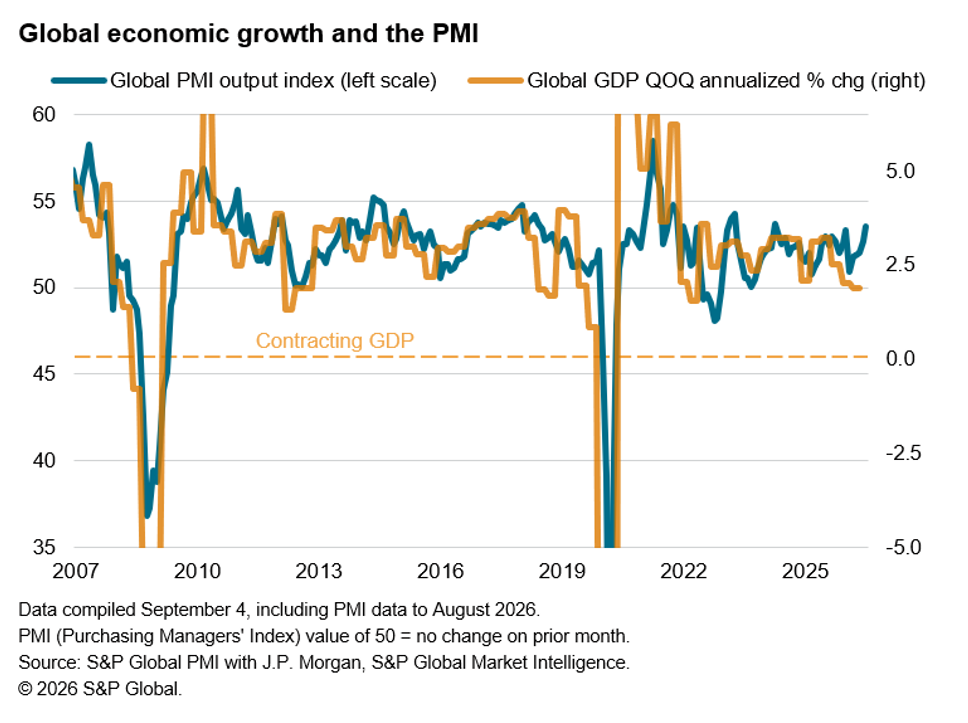
Global business activity growth gained momentum for a fourth consecutive month in August, signalling the fastest economic growth since May 2024. The J.P. Morgan Global Composite PMI Output Index, compiled by S&P Global, rose from 52.7 in July to 53.5, a 27-month high and a reading exceeded only once since May 2023.
Historical comparisons indicate that the August PMI reading is broadly indicative of global GDP growth running at an annualized 3.0% rate, with growth in the third quarter so far at 2.9%. This points to a marked acceleration of growth since the second quarter, for which official estimates currently point to a modest 1.9% annualized increase in global GDP.
Service sector boost
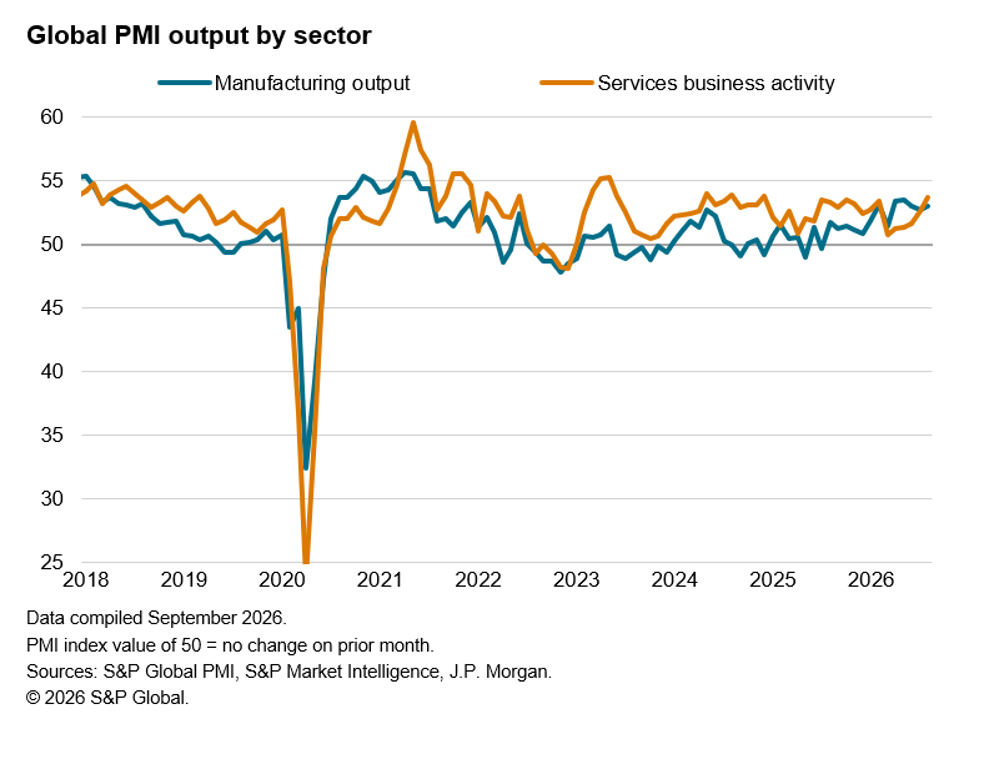
Manufacturing output continued to expand at a solid pace, buoyed by tech equipment spending and rising machinery demand, as well as ongoing stock building. However, although the rate of manufacturing expansion ticked higher in August, the average for the third quarter (52.9) so far runs slightly behind that recorded over the second quarter (53.3).
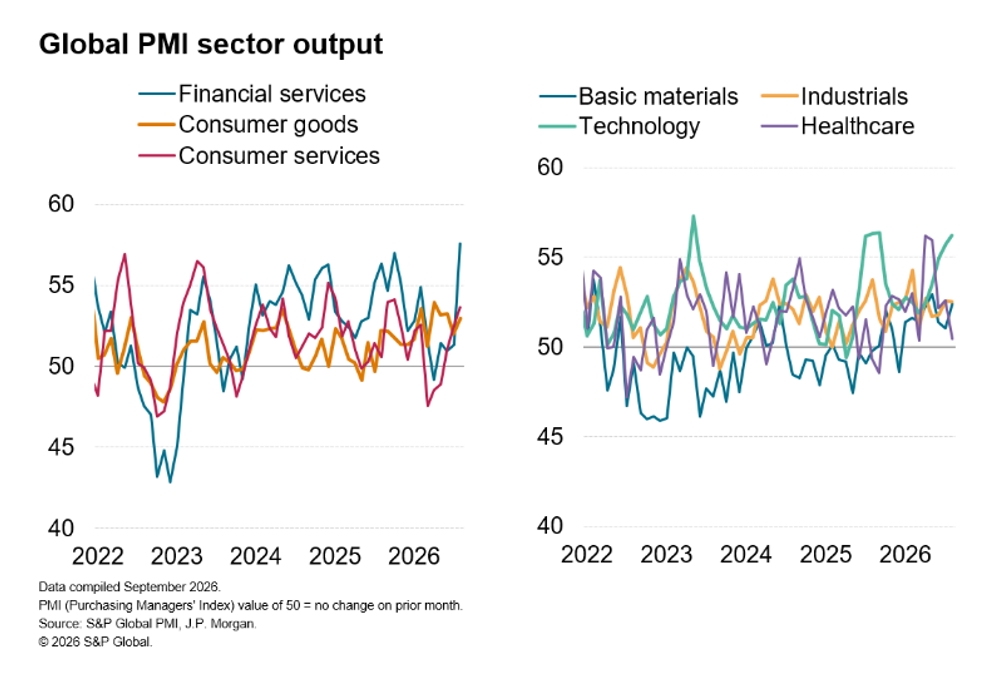
The big improvement has therefore come from the service sector, where growth in August accelerated for a fifth successive month to the fastest since December 2024. The rise lifts the third quarter average so far (53.2) almost two index points higher than that seen over the second quarter (51.4) and marks a major improvement from the near stalled picture seen in the service sector back in March. Service sector growth was led by the financial sector, where the expansion was the strongest since May 2021, supported by IT services and reviving spend by consumers after the war-related slowdown seen in the second quarter.
Small improvement in business confidence
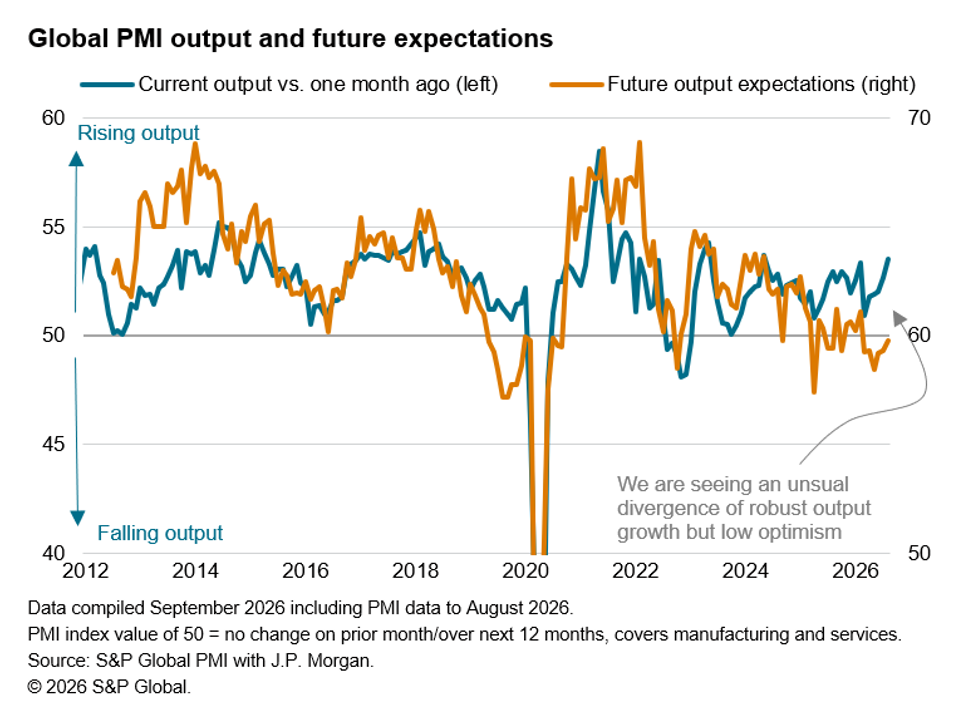
August also saw business optimism improve slightly, with year-ahead growth expectations edging up for a third month to reach their highest since the outbreak of the Middle East war back in February. However, the upturn in confidence appears limited, and global output growth continues to run much higher than confidence by historical standards, representing a sustained but unusual divergence between actual output and business confidence that has opened up since the second quarter of 2025, largely coinciding initially with the announcement of so-called ‘Liberation Day’ US tariffs.
Uncertainty eases
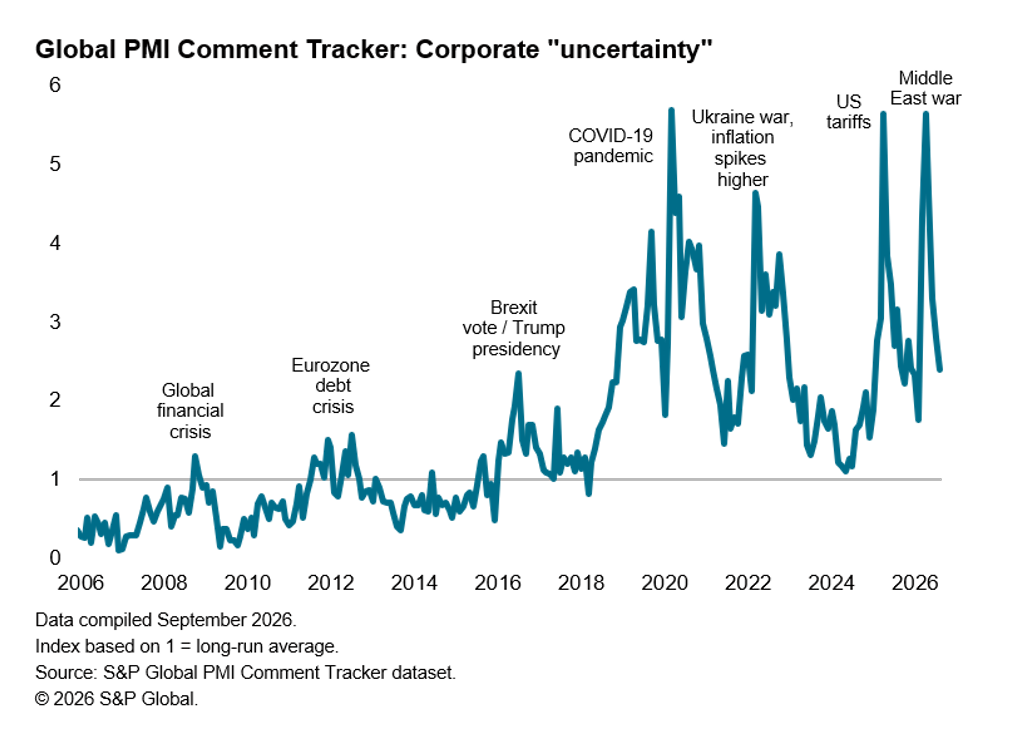
Perhaps more important than the level of business confidence in terms of output is the degree of business ‘uncertainty’. As measured by the PMI survey Comment Trackers, which capture trends in key aspects of what’s driving changes in business metrics from survey participants, corporate uncertainty came close to an all-time survey high in April but has since fallen sharply to its lowest since February – albeit still somewhat elevated by historical standards (the gauge in in fact still at 2.4 times it’s long run average, down from 5.6 times in April).
AI investment
The August PMI data take the global economic picture in terms of growth drivers back to that seen throughout much of 2025 and early 2026, whereby the two key pillars of growth are the tech sector and financial services, with AI investment playing a key – and increasing - role in both in recent months. US policy developments meanwhile continue to dampen business confidence globally, though the spike in uncertainty caused by the war in the Middle East has shown further signs of easing, helping lift sentiment and support sustained growth in sectors such as consumer services.
© 2026, S&P Global. All rights reserved. Reproduction in whole or in part without permission is prohibited.
Purchasing Managers' Index™ (PMI®) data are compiled by S&P Global for more than 40 economies worldwide. The monthly data are derived from surveys of senior executives at private sector companies, and are available only via subscription. The PMI dataset features a headline number, which indicates the overall health of an economy, and sub-indices, which provide insights into other key economic drivers such as GDP, inflation, exports, capacity utilization, employment and inventories. The PMI data are used by financial and corporate professionals to better understand where economies and markets are headed, and to uncover opportunities.
Read our latest PMI commentary here.
This article was published by S&P Global Market Intelligence and not by S&P Global Ratings, which is a separately managed division of S&P Global.
Theme
Location
Products & Offerings